
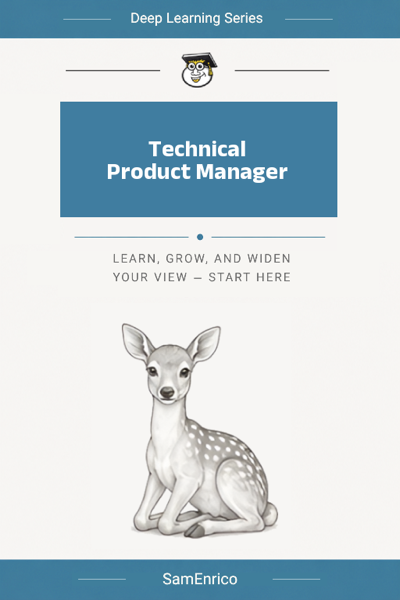
Non-FictionInformativeEducational
Technical Product Manager eBook
A Coursebook on Technical Product Manager
A Coursebook on Technical Product Manager
Formats
Free sample
Chapter 1: The Architect’s Mirror--–- You have been managing requirements for eighteen months. Your Jira board is immaculate. Your user stories have acceptance criteria so precise that a robot could execute them. Your burndown charts trend predictably downward. Your stakeholders call you “reliable,” which is corporate praise for “does not cause problems.”And yet, something is wrong.You sit in the weekly engineering sync, and the lead architect says something about “idempotency keys” and “eventual consistency.” You nod.
You have learned to nod at the right moments. But inside, you feel the quiet terror of the impostor who has built a career on nodding. Later, in the product review, the vice president asks, “How confident are we that this architecture will scale to Black Friday traffic?” You open your mouth to answer, and what comes out is a string of words that sound like confidence but feel like guesswork.You are not alone.Thousands of product managers wake up to this exact anxiety every day. They have mastered the business side—the market sizing, the customer interviews, the ROI spreadsheets—but when the conversation turns to technical trade-offs, they become translators without a dictionary. They rely on their engineering leads to make technical decisions, then struggle to understand why those decisions take three weeks instead of three days.
They prioritize features based on “business value” alone, only to discover that the architecture has been quietly accumulating debt like a credit card with no payment due.This book is for you.But before we fix the problem, we must name it. The problem is not that you lack technical skills. The problem is that the traditional product management playbook was written for a world where “technical” meant “someone else’s problem.” That world is dead.The Rise of the Technical Product Manager Five years ago, the typical product manager could succeed without ever looking at a line of code. They wrote requirements, handed them over a wall to engineering, and measured success by whether features shipped on time. The technical details—database schemas, API contracts, caching strategies—belonged to the engineers.
The PM owned the “what”; engineering owned the “how.”That separation was always a fiction, but it was a comfortable fiction. Today, it is impossible.Consider what has changed. Software has eaten the world, and now software is eating itself. Every company is a technology company, which means every product decision is a technical decision. Your pricing model depends on your infrastructure costs.
Your user onboarding flow depends on your API latency. Your competitive advantage depends on whether your team chose a monolithic architecture or microservices three years ago. The “what” and the “how” are no longer separate conversations; they are the same conversation, happening simultaneously, and if you can only participate in half of it, you are not a product manager. You are a spectator.This is why the Technical Product Manager—the TPM—has emerged as the most valuable role in modern technology organizations. Not the “product manager who used to code.” Not the “engineer who learned to talk to customers.” The TPM is something else entirely: a professional who can hold business strategy and architectural reality in the same mental space, who can translate user needs into technical requirements without losing nuance, and who can lead engineering teams without pretending to be one of them.But here is the critical insight that most people get wrong: the TPM is not a hybrid.The Hybrid Trap The most common mistake aspiring TPMs make is believing they need to be 50% business person and 50% engineer.
They take coding bootcamps. They study system design interview questions. They learn just enough Python to be dangerous and just enough SQL to run a query, and they call themselves “technical.”This is the hybrid trap, and it fails for two reasons.First, no one can be genuinely excellent at both. The cognitive modes required for product strategy—abductive reasoning, pattern recognition across markets, emotional empathy for users—are different from the cognitive modes required for engineering—deductive logic, systematic decomposition, tolerance for ambiguity in implementation details. Attempting to be equally skilled at both produces mediocrity in each.
You become the PM who engineers don’t trust and the engineer who PMs don’t understand.Second, and more importantly, the hybrid model misunderstands what organizations need. They do not need a generalist who can write a little code and write a little copy. They need a specialist who can bridge. A bridge is not half-land and half-water. A bridge is its own structure, designed specifically for connection.
The TPM’s unique value is not in doing both jobs but in enabling both jobs to work together.This chapter introduces a new framework for understanding the TPM role. We will call it the Technical Trinity.The Technical Trinity: User Value, Engineering Integrity, Architectural Feasibility Every product decision lives at the intersection of three forces. Most PMs are trained to see only one or two of them. The TPM learns to see all three simultaneously.User Value. This is the traditional PM’s home territory.
What problem does the user have? How much are they willing to pay to solve it? What is the smallest thing we can build that will create measurable value? User value lives in the world of jobs-to-be-done, outcome-based roadmaps, and continuous discovery. It answers the question: Should we build this at all?Engineering Integrity.
This is the domain of the engineer’s craft. Does the solution maintain data consistency? Is it testable? Is it observable? Will it degrade gracefully when something fails?
Engineering integrity lives in the world of idempotency, idempotency, idempotency—and idempotency is just the beginning. It answers the question: Can we build this correctly?Architectural Feasibility. This is the long-term lens. Does this solution fit within our existing system boundaries? Will it scale to ten times the current load?
How much technical debt will it incur, and who will pay that down? Architectural feasibility lives in the world of non-functional requirements, coupling and cohesion, and the cruel arithmetic of trade-offs. It answers the question: Should we build this here, now, given the system we have and the system we need?Here is the secret that separates TPMs from traditional PMs: you do not need to be an expert in all three. You need to be fluent enough to hold the conversation when experts from each domain speak. You need to know what questions to ask, when to push, and when to trust.Let us examine each dimension in detail.User Value: The Traditional PM’s Gift You already know much of this.
You know how to conduct customer interviews without biasing the responses. You know how to distinguish between a “want” and a “need.” You know how to build an opportunity solution tree and how to run a design sprint.But the TPM adds a specific technical lens to user value. You must learn to ask: How does the technical implementation affect the user’s experience of value?Consider a simple example. You are building a search feature for an e-commerce site. The traditional PM asks: “What should users be able to search for?
How should results be sorted? What happens when there are no results?”The TPM asks additional questions: “What is the acceptable…
This is the end of the free sample. Get the eBook to keep going. Buy now
About this book
Details
- Author
- Erickson Archie
- Publisher
- SamEnrico
- Language
- English
- Genre
- Non-Fiction, Informative, Educational
- Released
- 2026-06-03
- Pages (approx.)
- 138
- Available as
- eBook, Audiobook

Read better in the ZLOADR app
Your eBooks on your phone or tablet. Sign in with your SamEnrico account and start reading.
More by Erickson Archie
 Travel Burnout ResetErickson Archie$11.99
 Leveraged ESOP GuideErickson Archie$11.99
 Alcoholism and Perfectionism Recovery PlanErickson Archie$11.99
 Compulsive Spending Self AssessmentErickson Archie$11.99
 The Medici Mirage: Florence's Golden Veil of Art and PowerErickson Archie$11.99
 Multi Supplier Order Routing GuideErickson Archie$12.99
 How to Produce an Anderton Shearer LoaderErickson Archie$11.99
 Ultimate Handbook Guide to El-jadida : (Morocco) Travel GuideErickson Archie$11.99
You may also like
 Hong Kong Handover 1997Dunn Johnnie$11.99
 Zumba For Postnatal Recovery CourseNeal Christian$11.99
 Zumba for BeginnersLadner Nikia$11.99
 YouTube Comment Mining GuideHumes Pandora$12.99
 Worry Box MeditationCarlin Rudy$11.99
 Workplace Stress MeditationNguyen Lynn$11.99
 Workplace Stress and Sleep RepairHawley Ivory$11.99
 Workplace Perfectionism CureDelaney Jeffry$11.99
 Workplace Injustice Anger GuideWallen Isabelle$11.99
 Work Addiction and Burnout LinkGreenwood Ester$11.99
 Women in Yoga and WellnessBeattie Galina$11.99
 Women in Stand Up ComedyChun Evangeline$11.99