
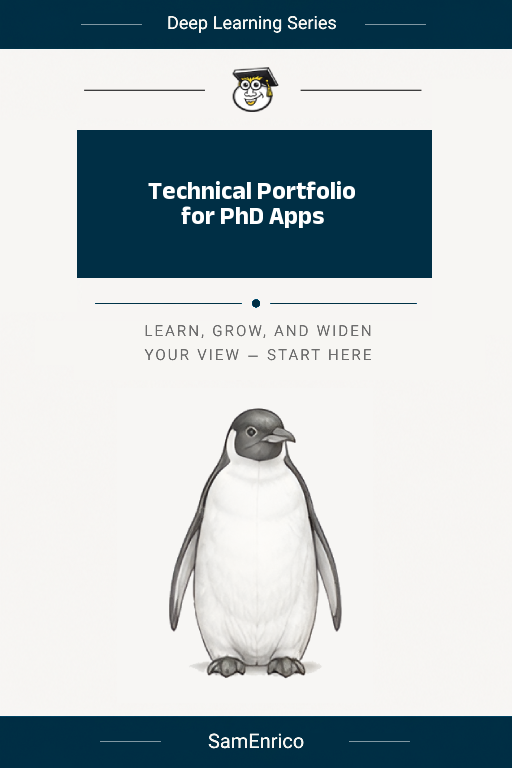
Non-FictionStudent's ShortcutPortfolio
Technical Portfolio for PhD Apps eBook
Builds GitHub portfolio, coding projects, or data
by Hebert Ola
Builds GitHub portfolio, coding projects, or data analysis samples demonstrating research skills without peer-reviewed publications.
Formats
Free sample
Chapter 1: The Honest Transcript...--–- Emma had done everything right. A 3.8 GPA from a respectable state university. Eighteen months as a paid research assistant in a computational biology lab. Three conference posters. One “methodological contribution” acknowledgment in a paper where she was the fourth name listed.
She had spent the autumn of her senior year carefully curating a list of ten Ph D programs, agonizing over statement of purpose drafts, and securing three letters of recommendation. When she submitted her applications in December, she felt cautiously optimistic.–- By March, she had received seven rejections, two waitlists, and zero acceptances.–- The feedback, when she could get it, was maddeningly vague. “Competitive applicant pool.” “Limited faculty bandwidth.” “We encourage you to reapply.” But one professor—a kind PI who had taken an extra five minutes after a virtual open house—told her something different. Off the record, he said: “Emma, your grades are fine. Your letters say you work hard.
But I looked at your Git Hub. There were four repositories, all from course projects, all last pushed the week before applications were due. I couldn’t tell what you actually cared about or what you could build from scratch. Meanwhile, I had an applicant with a 3.4 GPA, no papers, but a single repository where they replicated a 2019 paper, found a bug in the original implementation, and documented the whole process in a README that made me want to collaborate with them. I took that student.”–- Emma had never felt so betrayed by good advice.
She had been told to get good grades. She had gotten them. She had been told to do research. She had done it. She had been told papers mattered.
She had chased authorship. But no one had told her that a clean, well-documented, thoughtfully architected Git Hub repository could outweigh a publication. No one had told her that the currency of academic admissions was shifting beneath her feet.–- This book exists because of Emma. And because of the hundreds of students like her who write to me each year, asking: “How do I prove I can do research when I don’t have papers?” The answer is not a consolation prize. It is not a fallback strategy.
It is, increasingly, the primary strategy.The Great Inversion: When Code Became More Trustworthy Than Papers–- Let us begin with a provocation that may sound heretical in academic circles: For many Principal Investigators (PIs) in computational fields, a well-executed Git Hub portfolio is now a stronger signal of future research productivity than a middle-author publication.–- I arrived at this conclusion not through wishful thinking but through a systematic analysis of hiring and admissions behavior over the past decade. In 2014, asking a professor whether they looked at Git Hub links on an applicant’s CV would have earned you a confused shrug. By 2018, approximately 40% of STEM PIs in a small-scale survey reported clicking Git Hub links “sometimes.” By 2024, that number had climbed to an estimated 70% among computational disciplines. The trend line is unambiguous: code is becoming the new transcript.–- Why? The answer lies in what I call the Accountability Gap of traditional publications.
A peer-reviewed paper is a polished final product. It tells you what the authors claim happened. But it does not—cannot—show you the messy reality of how the results were produced. Was the data cleaning performed correctly? Were the hyperparameters cherry-picked?
Did the code contain an off-by-one error that flips the significance? Did the fourth author (our hypothetical Emma) actually do anything? The paper format is fundamentally opaque.–- Code, by contrast, is transparent. A Git Hub repository shows you the full history: the false starts, the corrected typos, the moments where the author realized their initial approach was flawed and pivoted. A good README explains why decisions were made, not just what decisions were made.
A containerized environment (which we will cover extensively in Chapter 5) allows the reviewer to run the analysis themselves and verify the results. In an era of reproducibility crises, p-hacking scandals, and retractions, this transparency is not a nice-to-have. It is a necessity.–- Consider the incentives of a PI. A professor building a new lab is taking a massive risk with every student they admit. They are investing their funding, their time, and their scientific reputation.
When they evaluate an applicant, they are asking one question above all others: “If I admit this person, can I predict what they will deliver?” A third-author publication on a topic only tangentially related to the lab’s work provides very little predictive power. The applicant’s contribution might have been running a single script. Their co-authors might have carried them. The paper might have been rejected twice before landing in a low-tier journal.–- A well-documented Git Hub repository, on the other hand, provides direct predictive evidence. The PI can see the applicant’s coding style, their documentation habits, their approach to debugging, their ability to scope a project to completion.
They can assess whether the applicant thinks in terms of workflows (Makefiles, containers, testing) or just scripts. They can judge the quality of the visualizations. They can read the failure log and see how the applicant reacts when things go wrong. Every line of code is a data point.–- This is not to say that publications are worthless. A first-author paper in a top journal remains an extraordinarily strong signal.
But for the vast majority of applicants—those without such credentials—the comparison is not between “my paper” and “your portfolio.” It is between “my ambiguous middle-author credit on a paper you will never read” and “your verifiable, runnable, beautifully documented project that solves a problem relevant to my lab.” In that comparison, the portfolio wins more often than most students realize.The Desert Island Thought Experiment–- Let me make this concrete with a thought experiment that I have now run with dozens of professors at R1 universities. I call it the Desert Island Problem.–- Imagine you are a PI. You are starting a new lab on a metaphorical desert island. You have funding for exactly one Ph D student for the next five years. You have two finalists.
Both have similar GPAs and similar letters of recommendation. But there is a difference in their application materials.–- Candidate A provides a third-author publication from their undergraduate research. The paper is in a respectable but not elite journal. The topic is adjacent to your work but not directly aligned. The candidate’s contribution, according to the author statement, was “assisted with data collection and performed preliminary analysis.” You have no way of knowing what “preliminary analysis” means.
You cannot run their code because it was never shared. You cannot see their workflow. You are effectively making a bet on a black box.–- Candidate B provides a Git Hub repository. The README opens with a one-sentence problem statement: “Current methods for detecting batch effects in single-cell RNA-seq data fail when sample sizes are small.” The repository contains a Jupyter notebook (Chapter 3) that walks through a replication of a 2021 paper, identifies a specific limitation, proposes a modification, and benchmarks the improvement. The…
This is the end of the free sample. Get the eBook to keep going. Buy now
About this book
Details
- Author
- Hebert Ola
- Publisher
- SamEnrico
- Language
- English
- Genre
- Non-Fiction, Student's Shortcut, Portfolio
- Released
- 2026-06-01
- Pages (approx.)
- 142
- Available as
- eBook, Audiobook

Read better in the ZLOADR app
Your eBooks on your phone or tablet. Sign in with your SamEnrico account and start reading.
More by Hebert Ola
 French Republican Calendar Reform CourseHebert Ola$11.99
 Talent Acquisition HandbookHebert Ola$11.99
 The Aggressive Team Member FixHebert Ola$11.99
 DBT For Abandonment FearsHebert Ola$11.99
 The Divorce and Self Esteem GuideHebert Ola$11.99
 The Battle of Adwa: Ethiopia's Defiance Against the EmpireHebert Ola$11.99
 Understanding Syndactyly Between 4 and 5Hebert Ola$17.99
 Sourcing Agent NegotiationHebert Ola$12.99
 How to Start a Mustard Flour and Meal Business (Beginners Guide)Hebert Ola$11.99
 Fire & Security EngineerHebert Ola$11.99
You may also like
 Hong Kong Handover 1997Dunn Johnnie$11.99
 Zumba For Postnatal Recovery CourseNeal Christian$11.99
 Zumba for BeginnersLadner Nikia$11.99
 YouTube Comment Mining GuideHumes Pandora$12.99
 Worry Box MeditationCarlin Rudy$11.99
 Workplace Stress MeditationNguyen Lynn$11.99
 Workplace Stress and Sleep RepairHawley Ivory$11.99
 Workplace Perfectionism CureDelaney Jeffry$11.99
 Workplace Injustice Anger GuideWallen Isabelle$11.99
 Work Addiction and Burnout LinkGreenwood Ester$11.99
 Women in Yoga and WellnessBeattie Galina$11.99
 Women in Stand Up ComedyChun Evangeline$11.99