
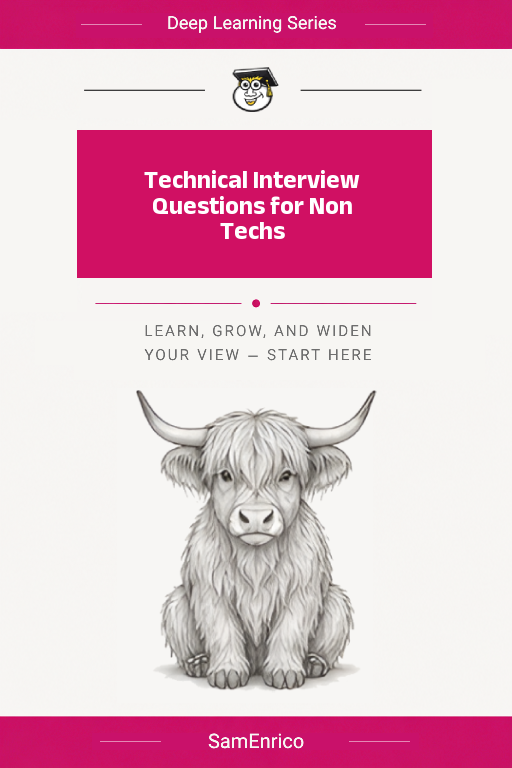
Non-FictionStartup GuideInterviewing
Technical Interview Questions for Non Techs eBook
Ask behavioral and scenario-based questions that r
Ask behavioral and scenario-based questions that reveal technical competence without coding tests.
Formats
Free sample
Chapter 1: The Syntax Trap--–- In 2019, a hiring manager at a well-funded Series B startup did everything right. She followed the engineering team’s rubric. She administered the prescribed coding test. She watched the candidate write flawless Python on a shared screen—elegant, efficient, and thoroughly commented. She checked every box.
Six weeks later, that same candidate had alienated the entire backend team, refused to document anything, and introduced a production bug that cost the company $40,000 in lost revenue. The code was perfect. The hire was a disaster.This story is not unusual. It is not a cautionary tale about a single bad hire. It is the predictable outcome of a broken system that has infected technology hiring for the last fifteen years.
The traditional technical interview—whiteboarding, algorithm puzzles, syntax recall, and live coding tests—is not merely imperfect. It is actively harmful. It selects for the wrong traits, filters out the right candidates, and leaves non-technical hiring managers feeling powerless to push back against engineering orthodoxy.Here is the liberating truth that this book will prove across twelve chapters: you do not need to read code to read people. In fact, your lack of syntax expertise is not a weakness. It is a superpower.The Syntax Trap: What You See That Engineers Miss When a non-technical interviewer sits in on a technical interview, they notice things that the engineering team often overlooks.
The engineers are busy evaluating whether the candidate remembered that Python lists are mutable or whether they correctly implemented a depth-first search. They are scanning for syntax errors, algorithmic efficiency, and language-specific idioms. They are, in short, acting as human compilers.But while they are distracted by semicolons and indentation, you are watching something far more important. You are watching the candidate’s face when they are asked to explain their approach to a non-technical stakeholder. You are noticing whether they interrupt the recruiter to correct a minor misstatement about a framework.
You are observing whether they ask clarifying questions about the business problem or dive straight into technical jargon. You are seeing the human being behind the code.This is the Syntax Trap. It is the mistaken belief that the ability to write correct syntax in an artificial, high-pressure environment predicts the ability to deliver value in a messy, collaborative, real-world workplace. It does not. The research is clear: coding tests correlate weakly with on-the-job performance, and they correlate negatively with traits like collaboration, empathy, and business judgment.What the Research Actually Says In 2015, a team of researchers at North Carolina State University analyzed fifteen years of data on technical interviewing.
Their findings, published in the IEEE Transactions on Software Engineering, were devastating to conventional wisdom. Technical interview performance—whiteboarding, algorithm questions, and coding challenges—predicted less than fifteen percent of the variance in on-the-job performance for software engineers. Put simply: acing the coding test told you almost nothing about whether someone would be a good hire.More striking was what the researchers found when they looked at false negatives—candidates who were rejected despite having strong on-the-job potential. These candidates tended to share certain characteristics. They were often older, with more experience.
They were more likely to be neurodivergent. They were more likely to have learned to code through non-traditional paths. And they were overwhelmingly more likely to be women and underrepresented minorities. The coding test was not just inaccurate. It was systematically biased.In the years since that study, the problem has only gotten worse.
The rise of competitive programming platforms like Leet Code and Hacker Rank has created an entire industry of test prep for technical interviews. Candidates can now spend hundreds of hours memorizing solutions to hundreds of algorithm problems. They are not learning to be better engineers. They are learning to be better test-takers. And the system rewards them for it.A candidate who has memorized the solution to “reverse a binary tree” but cannot explain why their team would choose one database over another will pass your coding test.
A candidate who has never seen that specific problem but can articulate a thoughtful trade-off between consistency and availability will fail. Which one would you rather hire?The Hidden Advantage of the Non-Technical Interviewer Here is where your position becomes uniquely valuable. Because you are not distracted by syntax, you can focus entirely on the signals that actually matter. You are not impressed by a candidate who can recite the time complexity of a sorting algorithm. You are not intimidated by someone who uses jargon to obscure rather than clarify.
You are free to listen for what the engineers are missing.Consider a typical technical interview from the perspective of an engineering manager. They ask the candidate to write a function that finds the most frequent element in an array. The candidate writes a solution. It works. The engineering manager notes: “Good problem-solving, reasonable syntax, passes tests.” They move on.Now consider the same interview from your perspective.
You notice that the candidate never asked what the array contained. They never asked about edge cases—empty array, very large array, array with all identical elements. They never asked about performance requirements. They simply wrote code. When you ask a follow-up: “How would you explain this function to a product manager who doesn’t code?” the candidate stumbles.
They use words like “hash map” and “iteration” without defining them. They seem annoyed by the question.You have just seen something the engineering manager missed. The candidate can write code, but they cannot communicate. They can solve a well-defined problem, but they cannot navigate ambiguity. They have technical skill but zero business acumen.
In a real workplace, this candidate will generate bug fixes that no one understands, alienate non-technical stakeholders, and require constant translation from other engineers. They are not a hire.This is your advantage. The engineering team sees the code. You see the person.The Four Signals That Actually Predict Success After analyzing hundreds of technical interviews across dozens of companies, researchers and experienced hiring leaders have converged on a small set of signals that reliably predict on-the-job performance for technical roles. None of them involve writing syntax.Signal One: Accountability The best engineers own their mistakes.
When something breaks, they do not blame the requirements, the timeline, the legacy code, or another team. They say: “I broke it. Here is how I fixed it. Here is how I will prevent it from happening again.” This signal is so powerful that one question—”Tell me about a time you broke something important”—predicts more about future performance than an entire hour of coding tests.Signal Two: Learning Agility Technology changes constantly. The programming language that was dominant five years ago is now niche.
The framework that everyone used three years ago is now legacy. An engineer who cannot learn quickly will become obsolete. Learning agility is not about how many languages they already know. It is about how they approach something they have never seen before. Do they panic?
Do they freeze? Do they pretend to know? Or do they say: “I don’t know that yet, but here is how I would learn it.”Signal Three: Communication Software engineering is a…
This is the end of the free sample. Get the eBook to keep going. Buy now
About this book
Details
- Author
- Triplett Hermelinda
- Publisher
- SamEnrico
- Language
- English
- Genre
- Non-Fiction, Startup Guide, Interviewing
- Released
- 2026-06-01
- Pages (approx.)
- 143
- Available as
- eBook, Audiobook

Read better in the ZLOADR app
Your eBooks on your phone or tablet. Sign in with your SamEnrico account and start reading.
More by Triplett Hermelinda
 Tool Stack for MeasurementTriplett Hermelinda$11.99
 The Elevator Rising PracticeTriplett Hermelinda$11.99
 Conversation Starters for Doctors VisitsTriplett Hermelinda$11.99
 Napping for Creativity BoostTriplett Hermelinda$11.99
 Loving Kindness PainTriplett Hermelinda$11.99
 Bipolar Sleep Hygiene PlanTriplett Hermelinda$11.99
 Crisis Legacy BuildingTriplett Hermelinda$11.99
 Amazon Subscription Box ModelTriplett Hermelinda$11.99
 Financial Boundary GuideTriplett Hermelinda$11.99
 The Great Pacific Garbage Patch: A Plastic OdysseyTriplett Hermelinda$11.99
 Masters of the Marble: Florence's Renaissance RevivalTriplett Hermelinda$11.99
 Harald Hardrada's Last Stand: The Blood Eagle of Stamford BridgeTriplett Hermelinda$11.99
You may also like
 Hong Kong Handover 1997Dunn Johnnie$11.99
 Zumba For Postnatal Recovery CourseNeal Christian$11.99
 Zumba for BeginnersLadner Nikia$11.99
 YouTube Comment Mining GuideHumes Pandora$12.99
 Worry Box MeditationCarlin Rudy$11.99
 Workplace Stress MeditationNguyen Lynn$11.99
 Workplace Stress and Sleep RepairHawley Ivory$11.99
 Workplace Perfectionism CureDelaney Jeffry$11.99
 Workplace Injustice Anger GuideWallen Isabelle$11.99
 Work Addiction and Burnout LinkGreenwood Ester$11.99
 Women in Yoga and WellnessBeattie Galina$11.99
 Women in Stand Up ComedyChun Evangeline$11.99