
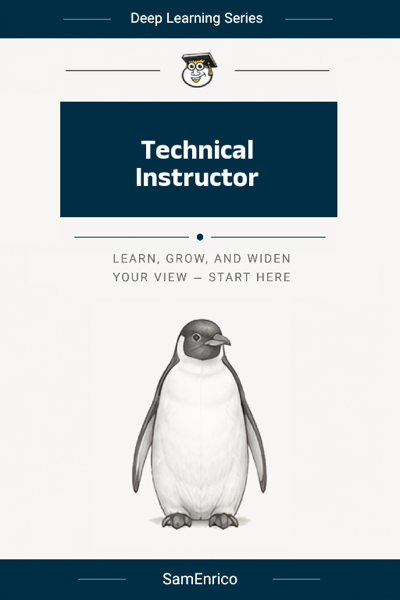
Non-FictionInformativeEducational
Technical Instructor eBook
A Coursebook on Technical Instructor
by Osborn Deena
A Coursebook on Technical Instructor
Formats
Free sample
Chapter 1: The Expert’s Trap...--–- The first time Raj tried to teach someone to solder, he destroyed $4,000 worth of circuit boards in eighteen minutes.He wasn’t a bad person. He wasn’t even a bad technician. In fact, Raj was the best diagnostic engineer at a midsize medical device manufacturer. He could read a schematic like most people read a menu. He could hear a failing capacitor from three feet away.
When the production line stalled, Raj was the person everyone called. And when the company decided to build an internal training program, Raj was the obvious choice to lead it.The company flew him to a three-day “Train the Trainer” seminar. He returned with a binder full of Power Point templates, a certificate suitable for framing, and complete confidence that he understood what teaching required. His supervisor gave him eight newly hired technicians for a week-long soldering and rework course. Raj had soldered thousands of joints.
He could do it in his sleep. Teaching it would be easy.On the morning of day three, Raj demonstrated a surface-mount component replacement. He did it in forty-five seconds. His hands moved like those of a concert pianist. The component lifted cleanly.
The new one settled into place. The solder flowed like liquid mercury. He looked up at the eight students and said, “Any questions?”No one asked anything. They were too busy trying to remember what they had just failed to see.What followed was eighteen minutes of quiet catastrophe. One student held the iron on a pad for so long that the copper trace lifted off the board entirely.
Another reversed the polarity of a diode despite the clear white stripe on the component body. A third, attempting to wick away excess solder, accidentally bridged three adjacent pins into a solid silver line. By the time Raj circulated to check their work, four boards were beyond repair. The remaining four were salvageable but ugly.Raj did what most experts do in that situation. He assumed the students weren’t paying attention.
He repeated the demo, this time a little slower, and added a few more words of explanation. The second round was only marginally better. By lunch, the company’s training budget had taken a $4,000 hit. Raj’s supervisor called him into an office and asked, gently but directly, “Are you sure you’re cut out for this?”Raj’s story is not unusual. It is not even remarkable.
It happens every day in factories, repair shops, IT departments, and vocational schools around the world. The best technician gets promoted to trainer. The best coder gets asked to teach the junior developers. The best welder gets assigned to mentor apprentices. And almost without exception, the first few months are a disaster.This book is for Raj.
It is for the engineer who can rebuild a transmission but cannot figure out why his students keep stripping bolts. It is for the network administrator who can configure a router in her sleep but watches helplessly as her class misconfigures the same router for the seventh time. It is for the chef, the electrician, the machinist, the programmer, and the lab technician who have been told, “You know this stuff. Now go teach it.”The problem is not that you don’t know your subject. The problem is that you know it too well.
And that knowing is a trap.The Hashima Effect: Why Experts Make the Worst Beginners In 2016, a cognitive psychologist named Ayumi Hashima published a small study that should be required reading for every technical instructor. Hashima asked expert origami artists to teach novices how to fold a traditional paper crane. She filmed the experts as they taught. Then she asked a separate group of novices to learn the same crane from written instructions alone.The results were striking. The novices who learned from written instructions made significantly fewer errors than those who learned from the live experts.
The experts, it turned out, were skipping steps. Not deliberately. They simply no longer perceived the intermediate folds as distinct steps. Their hands had automated the process so completely that their brains no longer registered the individual movements. When they said “now fold the paper in half,” they actually meant “now fold the paper in half, crease it firmly with your thumbnail, verify that the edges align within one millimeter, then unfold it and fold it the other way just to be sure, then refold it along the original crease because that creates a cleaner line.” But they didn’t say any of that.
They said “fold the paper in half.” And the novices folded it poorly.Hashima called this the Expert’s Automation Gap—though in the training world, it has come to be known as the Hashima Effect. The core insight is simple and brutal: as you become more skilled at a task, your brain compresses the procedural steps into unconscious chunks. This is what makes you fast. This is what makes you efficient. But it also makes you a terrible teacher unless you learn to decompress those chunks.The Hashima Effect explains almost every failure of technical instruction.
The electrical engineer who says “current just flows” has forgotten that novices need to understand electron drift theory. The machinist who says “set the feed rate appropriately” has forgotten that novices don’t know what “appropriately” means. The programmer who says “just debug it” has forgotten that debugging is a suite of fifteen distinct skills, not a single action.Here is the most important sentence in this book: Your expertise is not the solution. Your expertise is the problem you must solve before you can teach anyone anything.Every technical instructor must learn to see their own mind as a foreign country. The shortcuts, the intuitions, the “obvious” next steps—none of these are obvious to a beginner.
You must learn to slow down, to unpack, to narrate the silent decisions that your brain now makes automatically. This is harder than learning any technical skill. It requires a kind of metacognitive violence: forcing yourself to remember what you have deliberately forgotten.The Four Principles of Technical Learning (Bruner, Applied)Before we go further, we need a shared vocabulary for how technical skills are actually acquired. The educational psychologist Jerome Bruner spent decades studying how people learn complex procedures, and his four principles remain the best map we have for the territory of technical instruction.Principle 1: Predisposition People learn technical skills best when they are curious about how something works. Curiosity is not a nice-to-have.
It is a biological prerequisite. The brain literally releases dopamine when a curiosity gap is closed, and that dopamine consolidates memory. Without curiosity, instruction is just noise.For the technical instructor, this means you must never start with a definition or a diagram. You must start with a mystery. Show them a broken motor and ask what happened.
Give them a malfunctioning circuit and ask where the fault might hide. Present a piece of code that compiles but crashes and ask why. The curiosity gap is your most powerful teaching tool. Use it before you use anything else.Principle 2: Structure The human brain craves…
This is the end of the free sample. Get the eBook to keep going. Buy now
About this book
Details
- Author
- Osborn Deena
- Publisher
- SamEnrico
- Language
- English
- Genre
- Non-Fiction, Informative, Educational
- Released
- 2026-05-09
- Pages (approx.)
- 158
- Available as
- eBook, Audiobook

Read better in the ZLOADR app
Your eBooks on your phone or tablet. Sign in with your SamEnrico account and start reading.
More by Osborn Deena
 Cellulite Acceptance Summer PlanOsborn Deena$11.99
 Burnout In Sales Roles CourseOsborn Deena$11.99
 Navigating Mental Health DisclosuresOsborn Deena$11.99
 Academic Self Esteem TeensOsborn Deena$11.99
 Pitta Cooling Ayurvedic PlanOsborn Deena$11.99
 The Ghost of Shanghai: The Fingerprint That Solved a Political MurderOsborn Deena$11.99
 Understanding Mesomelic Dysplasia Skin DimplesOsborn Deena$17.99
 Implementation Plan GenerationOsborn Deena$12.99
 EU AI Liability DirectiveOsborn Deena$12.99
 How to Start a Sports Team and Club BusinessOsborn Deena$11.99
You may also like
 Hong Kong Handover 1997Dunn Johnnie$11.99
 Zumba For Postnatal Recovery CourseNeal Christian$11.99
 Zumba for BeginnersLadner Nikia$11.99
 YouTube Comment Mining GuideHumes Pandora$12.99
 Worry Box MeditationCarlin Rudy$11.99
 Workplace Stress MeditationNguyen Lynn$11.99
 Workplace Stress and Sleep RepairHawley Ivory$11.99
 Workplace Perfectionism CureDelaney Jeffry$11.99
 Workplace Injustice Anger GuideWallen Isabelle$11.99
 Work Addiction and Burnout LinkGreenwood Ester$11.99
 Women in Yoga and WellnessBeattie Galina$11.99
 Women in Stand Up ComedyChun Evangeline$11.99