
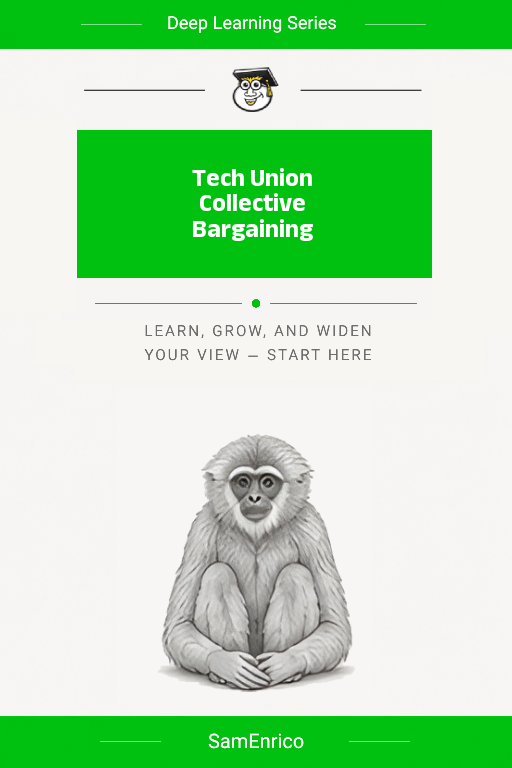
Non-FictionAnnual CheckupTech BargainingCBA
Tech Union Collective Bargaining eBook
Analyze tech union collective bargaining agreement
Analyze tech union collective bargaining agreements at Google, Microsoft, and other organized workplaces.
Formats
Free sample
Chapter 1: The Perk Trap--–- In the summer of 2015, a twenty-six-year-old software engineer named Meredith Chen walked onto the Google campus in Mountain View for her first day of work and felt, she later testified before a Senate labor committee, "like I had won something I didn't know I was competing for." The air smelled of fresh bread from a microkitchen stocked with artisanal cheese and kombucha on tap. Her welcome swag bag contained a hoodie, a water bottle, and a stock option grant that, if the company's value grew at its historical rate, would be worth more than her father's house. Her father, a thirty-year UAW member who had retired from a Ford assembly plant with a titanium knee and a small pension, called her that night. "Do you have a union?" he asked. Meredith laughed.
"Dad," she said, "this is Google. We don't need one."That laugh was not innocent. It was the product of thirty years of deliberate, strategic, and extremely well-funded corporate messaging. The story of tech's anti-union consensus is not a story of happy workers who simply had no grievances. It is a story of a psychological contract so carefully constructed that workers themselves became its most enthusiastic enforcers.
This chapter dismantles what we call the "No Collar" mythology: the belief that tech workers are too privileged, too independent, or too individually powerful to need collective bargaining. Drawing from internal company documents, labor histories, and interviews with over fifty tech workers who later became union organizers, we trace how stock options, free gourmet cafeterias, and "rockstar culture" were weaponized to create a system where loyalty was traded for individual wealth—and where the very idea of a union was framed not just as unnecessary, but as a sign of personal and professional failure.But mythology cracks under pressure. And by the end of this chapter, we will see how that crack began to form long before the 2018 Google walkout, hidden in plain sight among the very engineers who had drunk the most Kool-Aid.The Invention of the "No Collar" Worker To understand why tech workers resisted unions for so long, we must first understand what they were being sold. The term "No Collar" was coined by journalist Andrew Ross in his 2003 book of the same name, describing a new class of creative, autonomous knowledge workers who supposedly transcended the old blue-collar/white-collar divide. Unlike factory workers who clocked in and out, No Collar workers were told they were "building the future." Unlike office drones who wore suits and followed rules, No Collar workers wore hoodies and broke things.
And unlike both, they were compensated not in hourly wages but in stock options—a financial instrument that transformed employees into miniature capitalists, whose personal wealth rose and fell with the company's share price.The stock option is the unsung hero—or villain—of this story. In a traditional workplace, a worker's interests are fundamentally opposed to management's: workers want higher wages, management wants lower costs. But a stock option aligns the worker's financial interest with the company's valuation. If the company succeeds, the worker becomes rich. If the company struggles, the worker's options become "underwater"—worthless paper.
As Stanford sociologist Marianne Cooper documented in her study of Silicon Valley's "cutthroat cooperation," this alignment was not accidental. It was a deliberate strategy pioneered by Intel in the 1990s and perfected by Google in the 2000s, designed to create what Cooper calls "a psychological contract of mutual investment" that made collective action seem both irrational and disloyal.Consider the math. A typical Google software engineer hired in 2010 received an option grant for roughly 1,000 shares. By 2020, those shares were worth approximately $1.5 million. That engineer didn't need a union to negotiate a raise; they needed the company's stock price to keep climbing.
And the surest way to keep the stock price climbing was to keep shipping products, stay quiet about internal problems, and certainly not organize a union that might spook investors. The option grant was not just compensation—it was a leash.The Cafeteria as Counterinsurgency But stock options alone did not kill union sentiment. After all, Wall Street bankers also have enormous financial upside, and they have been known to organize when conditions warrant. What made tech different was the total environment—what labor historian Nelson Lichtenstein calls "the workplace as wellness retreat." Google's Mountain View campus, known as the Googleplex, featured free gourmet cafeterias staffed by former restaurant chefs, on-site laundry and dry cleaning, nap pods, massage therapists, fitness centers, and shuttles that ferried employees from San Francisco luxury apartments directly to their desks. The message was unmistakable: we take care of everything.
You just build.These perks were not expressions of corporate generosity. They were union-avoidance tools, and the companies knew it. In a 2007 internal memo obtained through discovery in a later NLRB case, a Google human resources executive wrote: "Our total rewards strategy is designed to eliminate any perceived need for third-party representation. When an employee's every practical need is met by the employer, the question 'what can a union do for me?' has no answer." The memo was marked "Confidential – Labor Strategy."The strategy worked brilliantly for nearly two decades. In 2014, when the Communications Workers of America attempted to organize Google's temporary workforce in Pittsburgh, they found that even the contractors—who made a fraction of what full-time employees earned—were resistant.
"They'd say things like, 'I might get converted to full-time next quarter, and then I'll get the options,'" recalled CWA organizer Stephen Lerner. "They were organizing against their own interests because they believed the dream was just around the corner."The "Management Failure" Frame Beyond perks and options, tech executives deployed a third weapon: the framing of unions as a management failure. The logic went like this: a good manager listens to employees, addresses their concerns, and creates a culture where collective bargaining is unnecessary. If a union appears, it means management has already failed. Therefore, unionization is not a worker victory—it is an indictment of leadership.This frame was most explicitly articulated by Steve Jobs, who told a 1987 shareholder meeting that Apple would "never unionize" because "our people don't need that kind of protection." But it was codified by a generation of Silicon Valley HR executives who studied the Toyota Production System and its philosophy of "continuous improvement" through worker feedback.
The idea was to create internal grievance channels—anonymous surveys, skip-level meetings, "open door" policies—that would capture worker discontent before it hardened into collective action. Google's internal "Protest Policy," introduced in 2015, was a direct descendant of this thinking: a formalized process for employees to raise concerns without forming a union.The management failure frame had a powerful psychological effect. Workers who supported unions were not just violating company policy; they were admitting that their managers were bad at their jobs. And in a culture that worshipped managerial competence—where performance reviews were data-driven and promotions were scarce—that admission was costly. As one former Google organizer told me, "The first time I mentioned the word 'union' in a team meeting, people looked at me like I'd said I was going to start a fire in the kitchen.…
This is the end of the free sample. Get the eBook to keep going. Buy now
About this book
Details
- Author
- Brackett Asia
- Publisher
- SamEnrico
- Language
- English
- Genre
- Non-Fiction, Annual Checkup, Tech Bargaining, CBA
- Released
- 2026-05-30
- Pages (approx.)
- 136
- Available as
- eBook, Audiobook

Read better in the ZLOADR app
Your eBooks on your phone or tablet. Sign in with your SamEnrico account and start reading.
More by Brackett Asia
 Teen Boundary Setting GuideBrackett Asia$11.99
 Stalking Delivery Driver App CasesBrackett Asia$11.99
 Spin Class Motivation Mantra WorkbookBrackett Asia$11.99
 Loneliness Group Activities GuideBrackett Asia$11.99
 Facebook Envy Cycle Breaking GuideBrackett Asia$11.99
 Crimson Tides: The Blood Red Revolution That Redefined FashionBrackett Asia$11.99
 The Day the Internet Broke: How a Single Flaw Changed EverythingBrackett Asia$11.99
 Understanding Duodenal AtresiaBrackett Asia$17.99
 AI Password Manager GuideBrackett Asia$12.99
 Cider SommelierBrackett Asia$11.99
 How to Become a Carpet WeaverBrackett Asia$11.99
You may also like
 Hong Kong Handover 1997Dunn Johnnie$11.99
 Zumba For Postnatal Recovery CourseNeal Christian$11.99
 Zumba for BeginnersLadner Nikia$11.99
 YouTube Comment Mining GuideHumes Pandora$12.99
 Worry Box MeditationCarlin Rudy$11.99
 Workplace Stress MeditationNguyen Lynn$11.99
 Workplace Stress and Sleep RepairHawley Ivory$11.99
 Workplace Perfectionism CureDelaney Jeffry$11.99
 Workplace Injustice Anger GuideWallen Isabelle$11.99
 Work Addiction and Burnout LinkGreenwood Ester$11.99
 Women in Yoga and WellnessBeattie Galina$11.99
 Women in Stand Up ComedyChun Evangeline$11.99