
Non-FictionForecast & OutlookTech
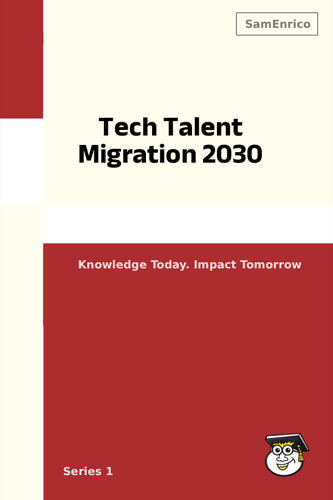
Tech Talent Migration 2030 eBook
Projects software engineer moves from India and Ch
Projects software engineer moves from India and China to Western hubs.
Formats
Free sample
Chapter 1: The Invisible Pipeline...–- In the summer of 2027, a twenty-six-year-old software engineer named Priya Mehta sat in her one-bedroom apartment in Pune, staring at two job offers on her laptop screen. The first was from a fast-growing Indian fintech unicorn, offering a base salary of 4.8 million rupees annually—approximately fifty-eight thousand US dollars, a sum that would have seemed unimaginable to her parents' generation. The second was from a mid-sized cloud infrastructure company in Austin, Texas, offering one hundred and forty thousand dollars, plus relocation, visa sponsorship, and a signing bonus. By every purely economic measure, the Austin offer was superior. But Priya was not conflicted about the money.
She was conflicted about something far more subtle: the shape of her future.Priya had graduated from the Indian Institute of Technology Bombay in 2023, the crown jewel of India's engineering education system, where admission is harder than Harvard's by nearly any statistical measure. She had spent four years watching older classmates leave for master's programs at Stanford, Carnegie Mellon, and ETH Zurich. She had watched them post photographs of California redwoods, Swiss Alps, and Toronto's winter lights. She had also watched a few return—not many, but enough to whisper warnings about loneliness, visa anxiety, and the strange sensation of being perpetually foreign. Her father, a retired civil servant, urged her to stay.
"India is growing," he said. "You can build something here." Her mother, who had never traveled outside Maharashtra, said nothing but packed her daughter's favorite spice box into a corner of her suitcase anyway, as if preparing for a departure she hoped would never come.Priya's story is not exceptional. By 2030, she will be one of nearly two hundred thousand Indian and Chinese software engineers who relocate to Western hubs each year, joining a global diaspora that has reshaped Silicon Valley, Seattle, London, Berlin, Sydney, and Singapore. Her story matters because it illuminates something that most migration narratives get wrong. The popular imagination still pictures the tech migrant as a desperate striver, escaping poverty or political persecution, clutching a one-way ticket and a dream.
That image belongs to the twentieth century. The twenty-first-century tech migrant—the one who will define the decade between 2025 and 2035—is more likely to be like Priya: educated at a world-class institution, employed at a competitive local salary, and possessed of enough savings to fund a master's degree or a six-month job search without sponsorship. She is not fleeing starvation. She is choosing acceleration.This chapter traces the legacy flows of software engineering talent from India and China to Western hubs between 1990 and 2025, constructing the historical foundation upon which the 2030 migration peak will be built. It explains how Bangalore and Shenzhen became the world's most prolific talent nurseries.
It documents the rise and gradual saturation of the H-1B visa system, the student-to-immigrant pathway, and the offshoring strategies of Western multinationals. It ends with a snapshot of 2025: millions of engineers trained, a growing frustration with visa backlogs and stagnating real wages, and the emergence of a sense—shared by engineers in Pune, Hyderabad, Bangalore, Beijing, and Shenzhen—that they have become perpetual outsiders in the very Western countries that recruited them. Finally, it introduces the three migration archetypes that will structure the rest of this book: The Settler, The Circulator, and The Portfolio Engineer.The Two Nurseries: How Bangalore and Shenzhen Became Talent Factories To understand tech migration in 2030, one must first understand the two engines that powered it: Bangalore and Shenzhen. Neither city was an obvious candidate for global tech dominance in 1990. Bangalore, a city of three million in southern India, was known for its pleasant climate, public sector research laboratories, and not much else.
Shenzhen, a fishing village of three hundred thousand just north of Hong Kong, had been designated a Special Economic Zone a decade earlier but remained a dusty frontier town of factories and migrant construction workers. Within thirty-five years, both would become among the most dynamic tech labor markets on earth.Bangalore's transformation began with a policy accident. In the 1980s, Texas Instruments established a presence there, attracted by the city's reliable electricity (relative to other Indian cities) and the availability of English-speaking electrical engineers. Other multinationals followed: Hewlett-Packard, Motorola, and IBM set up research and development centers, not yet full product teams, but enough to create a beachhead. The real explosion came after 1991, when India's economic liberalization dismantled the License Raj and allowed foreign direct investment to flow freely.
By 2000, Bangalore hosted R&D centers for nearly every major Western technology company. Infosys and Wipro, two Indian firms that would grow into global IT services giants, built sprawling campuses on the city's outskirts. The city's population tripled between 1990 and 2010, driven by internal migration from smaller towns across southern India.Shenzhen's trajectory was different but no less dramatic. Where Bangalore grew through English-speaking, Western-facing services, Shenzhen grew through hardware manufacturing and state-directed industrial policy. Foxconn, the Taiwanese contract manufacturer, built a megafactory in Longhua district that employed three hundred thousand workers at its peak, assembling i Phones, Play Stations, and Dell computers.
But Shenzhen was never just a factory town. The same policies that attracted Foxconn also attracted Huawei, Tencent, and ZTE—Chinese technology companies that would become global powers in their own right. By 2015, Shenzhen had more hardware startups than any city outside the San Francisco Bay Area. Its electronics markets, like Huaqiangbei, were legendary for their density of components, prototypes, and engineering talent willing to work through the night.Both cities shared a crucial characteristic: they produced far more engineers than their local economies could absorb at Western salaries. India's engineering colleges graduated 1.5 million students annually by 2020, a number that included everyone from IIT prodigies to graduates of unaccredited rural colleges with no laboratory equipment.
China's system was smaller but more selective, producing around 800,000 engineering graduates per year, with a much higher proportion possessing genuine hardware and software skills. Both systems produced a long tail of underemployed graduates and a sharp peak of world-class talent. That peak—the top five percent by skill—became the primary source of tech migration to Western hubs.The H-1B Era: America's Visa Lottery and Its Discontents For Indian engineers, the most visible pathway to the West was the H-1B visa. Created by the US Immigration Act of 1990, the H-1B allowed American companies to sponsor foreign workers in "specialty occupations" for three-year terms, renewable once. The annual cap was initially set at sixty-five thousand, a number that seemed generous at the time.
By 2000, it was grossly inadequate. The dot-com boom had created insatiable demand for software engineers, and American universities were not producing enough computer science graduates to fill the gap. Indian engineers, with their English fluency and American-style engineering curricula, were the obvious solution.The H-1B system worked well enough for the first decade, but it contained a fatal flaw for Indian applicants: per-country caps on green cards (permanent residency). While H-1B visas were allocated without regard to nationality, green cards were subject to a seven percent per-country limit. For Indian-born applicants, who constituted the largest national group in the employment-based green card backlog, this created a waiting period that stretched from years to decades.
By 2025, an Indian engineer who received an H-1B in 2015 would still be waiting for a green card, trapped…
This is the end of the free sample. Get the eBook to keep going. Buy now
About this book
Details
- Author
- Savoy Gearldine
- Publisher
- SamEnrico
- Language
- English
- Genre
- Non-Fiction, Forecast & Outlook, Tech
- Released
- 2026-06-09
- Pages (approx.)
- 146
- Available as
- eBook, Audiobook

Read better in the ZLOADR app
Your eBooks on your phone or tablet. Sign in with your SamEnrico account and start reading.
More by Savoy Gearldine
 The Allergic Child Sleep GuideSavoy Gearldine$11.99
 Calisthenics Nutrition HandbookSavoy Gearldine$11.99
 Singaporean Green Tax Credits GuideSavoy Gearldine$11.99
 Stress Management for Creative ProfessionalsSavoy Gearldine$11.99
 The Art of the Deal: How One Trade Changed the NBA ForeverSavoy Gearldine$11.99
 Riders of the Forgotten Trail: The Black Cowboys of the Chisholm TrailSavoy Gearldine$11.99
 PDP For Legal ProfessionalsSavoy Gearldine$12.99
 EE for One Year Grad ProgramsSavoy Gearldine$12.99
 Understanding Chromosome 2, Trisomy 2p13 P21Savoy Gearldine$17.99
 Customer Service & Sales RepresentativeSavoy Gearldine$11.99
 How to Start a Hobby in Outdoor/nature activitiesSavoy Gearldine$11.99
You may also like
 Hong Kong Handover 1997Dunn Johnnie$11.99
 Zumba For Postnatal Recovery CourseNeal Christian$11.99
 Zumba for BeginnersLadner Nikia$11.99
 YouTube Comment Mining GuideHumes Pandora$12.99
 Worry Box MeditationCarlin Rudy$11.99
 Workplace Stress MeditationNguyen Lynn$11.99
 Workplace Stress and Sleep RepairHawley Ivory$11.99
 Workplace Perfectionism CureDelaney Jeffry$11.99
 Workplace Injustice Anger GuideWallen Isabelle$11.99
 Work Addiction and Burnout LinkGreenwood Ester$11.99
 Women in Yoga and WellnessBeattie Galina$11.99
 Women in Stand Up ComedyChun Evangeline$11.99