
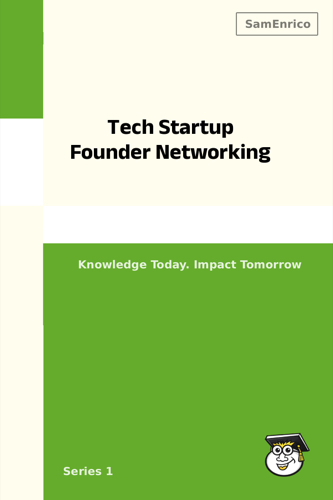
Tech Startup Founder Networking eBook
Meet co-founders, early employees, and angel inves
by Ocasio Londa
Meet co-founders, early employees, and angel investors through demo days and accelerators.
Formats
Free sample
Chapter 1: The Friendship Loop--–- The young founder stood at the edge of the demo day crowd, a stack of 200 freshly printed business cards clutched in his sweating palm. He had rehearsed his thirty-second pitch forty-seven times. He knew exactly what to say: "Hi, I'm building an AI platform for dental supply chains. We're raising a pre-seed round. Here's my card." He said those exact words to sixty-three strangers over the next two hours.
Sixty-three people smiled, nodded, took his card, and walked away. By the time he got home, his email inbox contained exactly zero new messages. His calendar contained zero new meetings. His bank account contained zero new commitments. He had done everything the traditional networking playbook prescribed, and he had absolutely nothing to show for it except a lighter cardholder and a deep, sinking sense of humiliation.This founder had fallen for the most expensive lie in startup culture.
The lie is simple and seductive: networking is a numbers game. Hand out enough cards. Say enough pitches. Shake enough hands. Eventually, someone will say yes.
This lie has destroyed more promising startups than any failed product launch ever has. It is the reason brilliant founders with working products and real customers still fail to find co-founders, early employees, or angel investors. They treat human relationships like vending machines. Insert a business card. Expect a term sheet.
And when nothing comes out, they kick the machine and blame the world.The truth is radically different. Networking is not a numbers game. It is a trust game. And the most successful founders in the world have learned a counterintuitive secret: the fastest way to get what you want is to stop asking for it entirely. This chapter introduces the Friendship Loop, a three-step psychological framework that transforms awkward, transactional pitching into genuine, productive relationships.
Every subsequent chapter in this book will build on this framework. Master the Friendship Loop, and you will never hand out another business card that does not lead somewhere meaningful.Understanding the Failure of Transactional Networking Before we can build something better, we must understand why the traditional approach fails so catastrophically. Transactional networking operates on a flawed model of human psychology. It assumes that people make decisions based on rational calculation of costs and benefits. If I offer you a compelling pitch about my startup, you will rationally evaluate the opportunity and, if it makes sense, agree to help me.
This model works beautifully in economics textbooks and fails miserably in real human interactions.The problem is that humans are not rational calculators. We are emotional, social, and deeply protective of our time and attention. When a stranger approaches us with a pitch, our brain does not process the content of the pitch first. It processes the threat. Is this person trying to take something from me?
Will this conversation drain my energy? Do I have a safe way to exit? By the time the founder says "I'm building an AI platform," the listener has already decided, subconsciously, whether to engage or escape. And most of the time, they choose escape.This is not because people are selfish or unkind. It is because modern life bombards us with requests.
Every conversation is a potential extraction. Someone wants our money, our time, our endorsement, our introduction. We build emotional armor to protect ourselves. That armor looks like polite nodding, fake smiles, and the universal escape phrase: "That sounds interesting. Send me an email." That email, of course, will never be opened.The transactional approach also fails because it ignores the fundamental asymmetry of startup networking.
You, the founder, need something urgently. Your potential co-founder, employee, or investor does not need you at all. They have jobs, families, hobbies, and existing commitments. You are asking them to add risk, work, and uncertainty to their lives. From their perspective, saying yes is costly.
Saying no is free. So they say no, or more often, they say nothing at all.The Friendship Loop flips this dynamic entirely. Instead of asking for something, you offer something. Instead of extracting value, you create value. Instead of being one more person who wants to take, you become the rare person who wants to give.
And when you give first, human psychology works in your favor. Reciprocity is one of the most powerful forces in social behavior. When someone gives us something, we feel an almost physical obligation to give something back. The Friendship Loop harnesses this force by design.Introducing the Friendship Loop: A Three-Step Framework The Friendship Loop consists of three steps, executed in sequence. Each step builds on the previous one.
Skip a step, and the loop breaks. Rush a step, and the trust never forms. But execute all three steps with genuine intention, and you will transform strangers into collaborators faster than any elevator pitch ever could.Step One: Give First. Before you ask for anything, you must provide value. This value can take many forms, but it must be real, specific, and offered without any visible expectation of return.
A piece of market intelligence. A warm introduction to someone useful. An hour of free consulting on a problem you genuinely know how to solve. Even sincere empathy and genuine curiosity about the other person's challenges counts as value, because most people rarely experience being truly listened to.The key is that your gift must be tailored to the recipient. Generic value is not value.
Sending someone a generic article about their industry is not a gift; it is noise. But finding a specific insight about their competitor's recent funding round, an insight they might have missed, and sharing it with a thoughtful note is a genuine gift. It shows you did your homework. It shows you care about their success, not just your own. It demonstrates that you are the kind of person worth knowing.Step Two: Storytelling with Vulnerability.
After you have given value, you earn the right to share your own situation. But how you share matters enormously. Most founders present a polished, invulnerable facade. They list their accomplishments, their traction metrics, their prestigious advisors. This approach signals strength, but it does not signal trustworthiness.
In fact, it often triggers suspicion. Perfection is suspicious. No real startup has everything figured out.Instead, share a "Hero's Struggle" narrative. Tell the truth about what you are failing to solve right now. Be specific.
"We have built a great product, and our first ten customers love it, but we cannot figure out how to price it for the enterprise market." Or "I am a technical founder who has shipped code, but I have no idea how to sell to Fortune 500 procurement departments." Or "We have traction, but I am burning out because I am doing everything myself, and I need a partner who can share the load."Vulnerability is magnetic because it is rare. When you admit a weakness, you signal that you are self-aware, honest, and safe to work with. You also invite collaboration. People love solving problems. When you present a specific, interesting problem, the other person's brain automatically starts searching for solutions.
They become invested in your success not because you asked them to be, but because you invited them into your…
This is the end of the free sample. Get the eBook to keep going. Buy now
About this book
Details
- Author
- Ocasio Londa
- Publisher
- SamEnrico
- Language
- English
- Genre
- Non-Fiction, Self-Help, Tech Startups
- Released
- 2026-06-08
- Pages (approx.)
- 136
- Available as
- eBook, Audiobook

Read better in the ZLOADR app
Your eBooks on your phone or tablet. Sign in with your SamEnrico account and start reading.
More by Ocasio Londa
 Loneliness Toastmasters GuideOcasio Londa$11.99
 Death and Dying TalksOcasio Londa$11.99
 Antwerp Heist Podcast PhenomenonOcasio Londa$11.99
 Senior Doctor Visit ConfidenceOcasio Londa$11.99
 Stress Multiple Sclerosis GuideOcasio Londa$11.99
 The Prevention ProtocolOcasio Londa$11.99
 Separation Anxiety TranceOcasio Londa$11.99
 Eye Fixation Trance MethodOcasio Londa$11.99
 The Vanishing of the SS Marine Sulphur Queen: A 50-Year MysteryOcasio Londa$11.99
 The Red Cliff Gambit: Zhuge Liang's Shadow War of DeceptionOcasio Londa$11.99
 Echoes of the Ice: The 1982 Discovery That Changed Climate Science ForeverOcasio Londa$11.99
 The Mineral Guide to TarapacaiteOcasio Londa$11.99