
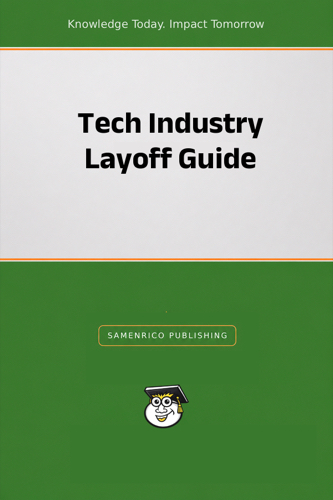
Tech Industry Layoff Guide eBook
Navigate mass layoffs in software, IT, and startup
Navigate mass layoffs in software, IT, and startup sectors.
Formats
Free sample
Chapter 1: The Permanent Shift...--The calendar invite arrived at 10:47 AM on a Tuesday. Subject line: "Quick Check-in – 11:00 AM." No agenda. No attachments. The organizer was someone from HR whom Sarah had never met. In the fifteen years she had spent climbing the ranks at Google, first as a junior product manager and finally as a Group PM leading a thirty-person team, she had never once received a meeting invitation from this particular woman.
That, more than anything else, was the signal. Not the hiring freeze two months earlier. Not the cryptic comment from her VP about "tough decisions ahead" during the last all-hands. Not even the quiet departure of two directors who had been with the company for a decade. It was the calendar invite from a stranger in HR.
Thirteen minutes later, Sarah became one of twelve thousand people laid off by Google in a single calendar year. She was not a poor performer. Her latest performance review had been "Exceeds Expectations." She had shipped three major features in the previous six months. None of it mattered.This book is written for Sarah. And for you.If you are reading these words, you are likely one of three people.
First, you might be someone who still has a job in tech but has watched colleagues vanish from Slack channels one by one, and you have begun to suspect that your own name is on a list somewhere. You are not paranoid. You are paying attention. Second, you might be someone who was laid off recently – perhaps this morning, perhaps last week – and you are currently staring at a laptop screen that still shows your company wallpaper but no longer grants you access to your email. You are cycling through shock, shame, and something that feels like grief.
Third, you might be someone who was laid off months ago, who has sent two hundred applications into the void and received seventeen automated rejections and three interviews that went nowhere, and you are beginning to wonder if tech has left you behind entirely. This book is for all three of you. But it makes a critical demand in return for its guidance: you must first accept a premise that most career advice books refuse to acknowledge. The premise is this – the era of job security in technology is not temporarily paused. It is dead.
And it is never coming back.The Great Recalibration Let us begin with a funeral. Bury the following beliefs right now, in this chapter, before you read another sentence. Belief one: layoffs are a cyclical phenomenon that happens during recessions and corrects itself during booms. This is a comforting myth propagated by people who lived through the dot-com crash of 2001 and the financial crisis of 2008, both of which were followed by robust recoveries. But the years 2023 through 2026 have revealed something different.
According to layoffs.fyi, the tech industry shed more than four hundred thousand jobs in 2023 alone. Another one hundred fifty thousand vanished in the first half of 2024. And the cuts continued into 2025 and 2026, not because of a recession – the broader economy remained stubbornly resilient – but because something structural had shifted. Belief two: if you are talented enough, you will always be safe. This is the meritocracy myth, and it is particularly seductive in tech, where we are told that the best engineers, the sharpest product managers, the most insightful data scientists will always find a home.
But the mass layoffs have been remarkably indiscriminate. Top performers have been cut alongside low performers. Teams with perfect execution records have been eliminated entirely. The people who survived were often not the most talented but the most strategically positioned – working on the right product at the right time in the right organizational structure. Belief three: artificial intelligence is a tool that will augment your work, not replace it.
This is the most dangerous myth of all, not because it is entirely false – AI does augment many roles – but because it has lulled an entire generation of tech workers into complacency while their tasks are systematically automated beneath them.The truth is harder but more liberating. We are not in a temporary downturn. We are in a permanent recalibration of the technology industry, driven by two forces that are not going to reverse. The first force is capital discipline. For more than a decade, from approximately 2010 to 2022, technology companies were rewarded by public markets for growth above all else.
A company could lose money on every customer as long as it was acquiring customers faster than its competitors. Venture capitalists funded startups with burn rates that would have been considered suicidal a generation earlier. But the interest rate environment changed, and with it, the calculus of capital. Investors began demanding profitability. They began scrutinizing headcount as a cost to be optimized rather than an asset to be accumulated.
And executives discovered something that would permanently reshape the industry: layoffs did not hurt their stock prices. In fact, when Meta announced its first major layoff in November 2022, cutting eleven thousand employees, its stock price rose by more than twenty percent over the following month. Wall Street had sent a clear message. Headcount reduction was not a sign of weakness. It was a sign of discipline.The second force is more profound and more permanent.
Artificial intelligence has begun to perform tasks that, until very recently, required human intelligence. Not all tasks, not yet, but a meaningful and growing subset. Basic coding – the kind of work that junior engineers do in their first eighteen months – can now be generated by large language models with surprising accuracy. Content generation, from marketing copy to documentation to first-draft design assets, is being automated at scale. Data analysis that once required a team of analysts can now be performed by a single person prompting an AI tool.
Quality assurance, test writing, customer support triage, even some aspects of project management – all of these are being transformed. The companies that survive and thrive will be those that embrace this transformation. And that means they will employ fewer people to do the work that ten years ago required a hundred.The Amazon Effect There is a concept that will appear repeatedly throughout this book, and it deserves to be named clearly. Call it the Amazon Effect. Amazon, more than any other technology company, has systematized the practice of annual headcount reductions as a management tool rather than a crisis response.
The company has long practiced a form of "unregretted attrition" – a term they coined internally – which means actively managing out the bottom tier of performers each year. But in the post-2022 era, Amazon and its imitators have expanded this practice dramatically. Annual layoffs of ten to fifteen percent of the workforce are no longer extraordinary events that generate headlines and hand-wringing. They are routine maintenance. They are budget exercises.
They happen in January, after the holiday season, and in July, after the mid-year review cycle. They are not accompanied by public apologies or CEO mea culpas. They are simply business as usual.Why does the Amazon Effect matter for you? Because it establishes a new baseline. If you work at a technology company today, you should assume, as a…
This is the end of the free sample. Get the eBook to keep going. Buy now
About this book
Details
- Author
- Pauley Madalene
- Publisher
- SamEnrico
- Language
- English
- Genre
- Non-Fiction, Self-Help
- Released
- 2026-06-10
- Pages (approx.)
- 130
- Available as
- eBook, Audiobook

Read better in the ZLOADR app
Your eBooks on your phone or tablet. Sign in with your SamEnrico account and start reading.
More by Pauley Madalene
 Carson DDT Industry Battle MemoirPauley Madalene$11.99
 Hormone Therapy for Prostate CancerPauley Madalene$11.99
 Toddler Tantrum Parent RagePauley Madalene$11.99
 Gratitude for RelationshipsPauley Madalene$11.99
 Creative Confidence for EngineersPauley Madalene$11.99
 Angels In America CastPauley Madalene$11.99
 The Healing Hands of the Black Diaspora: Medical Mavericks Who Shaped the WorldPauley Madalene$11.99
 The Beast of Belgrave Square: London’s Most Bizarre Art HeistPauley Madalene$11.99
 American Pit Bull Terriers: Understanding The BreedPauley Madalene$11.99
 How to Produce a Combi SteamerPauley Madalene$11.99
 Point of Sale for Pop Up RetailPauley Madalene$12.99
 Scholarship Document Prep GuidePauley Madalene$12.99
You may also like
 Hong Kong Handover 1997Dunn Johnnie$11.99
 Zumba For Postnatal Recovery CourseNeal Christian$11.99
 Zumba for BeginnersLadner Nikia$11.99
 YouTube Comment Mining GuideHumes Pandora$12.99
 Worry Box MeditationCarlin Rudy$11.99
 Workplace Stress MeditationNguyen Lynn$11.99
 Workplace Stress and Sleep RepairHawley Ivory$11.99
 Workplace Perfectionism CureDelaney Jeffry$11.99
 Workplace Injustice Anger GuideWallen Isabelle$11.99
 Work Addiction and Burnout LinkGreenwood Ester$11.99
 Women in Yoga and WellnessBeattie Galina$11.99
 Women in Stand Up ComedyChun Evangeline$11.99