
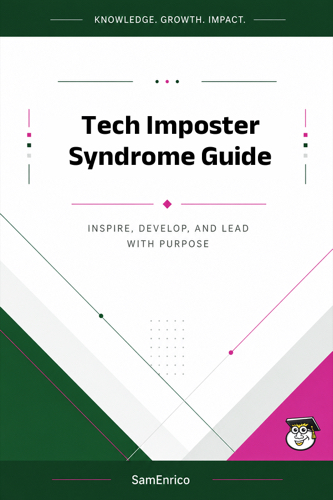
Non-FictionSelf-HelpTechnology
Tech Imposter Syndrome Guide eBook
Addresses feelings of inadequacy among software de
Addresses feelings of inadequacy among software developers and engineers.
Formats
Free sample
Chapter 1: The Memory Leak...–- It was 2:47 AM on a Tuesday when I found myself crying in a supply closet at Google’s Building 43. Not because I had been fired. Not because I had failed a performance review. Not because anyone had been cruel to me. I was crying because I had just spent six hours debugging a race condition that turned out to be a single misnamed variable.
And in that moment, I was certain—absolutely, bone-deep certain—that I was the luckiest fraud in the history of software engineering.I had the title “Senior Software Engineer.” I had the badge. I had the stock options. I had a team that, as far as I could tell, respected me. And I was convinced that any second now, someone was going to tap me on the shoulder and say, “We’ve reviewed your commits. We’ve seen your search history.
We know you don’t actually know what you’re doing. Please return your laptop and exit the building.”That feeling has a name. It is not humility. It is not impostor phenomenon in the clinical psychology sense that your therapist might diagnose. It is something more specific, more technical, and in many ways more insidious.
It is the conviction that your competence is a simulation, that your career is a bug that hasn’t been caught yet, and that every silent moment in a code review is the quiet before the crash.This chapter is called “The Memory Leak” because that is exactly what imposter syndrome is to a software engineer’s career. It does not crash the system immediately. It does not throw an exception you can catch and handle. Instead, it slowly consumes mental RAM—a byte here, a kilobyte there—until one day, during a promotion interview or a production incident or a quiet Tuesday afternoon, the system freezes entirely. You are still running.
But nothing is working.The Stack Overflow Paradox Let me tell you about the Stack Overflow paradox. You know it. You have lived it. You are in the middle of a ticket, and you cannot remember how to parse a JSON response in the language you have used every day for three years. So you open a browser.
You type the question. You find the answer. You copy the snippet. You move on. And then, in the quiet aftermath, the voice speaks: “A real engineer would not have needed to search for that.”Here is what the voice does not tell you.
The voice does not tell you that the Principal Engineer on your team has eighty-seven tabs open right now, half of them Stack Overflow. The voice does not tell you that the staff engineer who seems to debug without effort has a private Git Hub gist with two hundred snippets they have copied over the years. The voice does not tell you that the tech lead who approved your last PR has the documentation for Array.map bookmarked.The Stack Overflow paradox is this: we measure ourselves against the imaginary standard of the engineer who never searches, never asks, never doubts. That engineer does not exist. I have never met them.
Neither have you. And yet we spend our careers running from them.I interviewed forty-seven software engineers for this book. Their titles ranged from Junior to Distinguished. Their salaries spanned from “relieved to have a job” to “uncomfortable talking about it at dinner parties.” Their languages were Python, Java, Rust, Go, Type Script, C++, and one charmingly stubborn engineer who still writes Perl and is not sorry about it.Not one of them—not a single one—reported going more than a week without searching for something they felt they should already know. The median was three searches per day.
The senior engineers searched more often than the juniors. The Distinguished engineer who had been coding since the 1980s searched more often than anyone.Here is what that engineer told me, verbatim: “The day I stop searching is the day I stop learning. And the day I stop learning is the day I become a liability.”Let that sit for a moment.The Critical Distinction You Have Never Been Taught We need to draw a line that most books, most managers, and most of your own internal monologue refuse to draw. There is a difference between legitimate lack of knowledge and perceived inadequacy. These are not the same thing.
Treating them as the same thing is the original sin of imposter syndrome.Legitimate lack of knowledge is a gap. It is concrete. It can be measured, documented, and filled. You do not know how to use async/await in Rust. That is a gap.
You have never deployed a Kubernetes cluster. That is a gap. You cannot explain the CAP theorem at a whiteboard. That is a gap. Gaps are solved with study, practice, documentation, courses, and time.
Gaps do not make you a fraud. They make you a work in progress, which is the only kind of engineer there is.Perceived inadequacy is different. Perceived inadequacy is the feeling that you are not good enough even when the evidence says you are. You shipped the feature. It worked.
The tests passed. The users did not complain. Your manager said “good job.” And still, the voice says: “You got lucky. Anyone could have done that. Wait until they ask you to do something hard.”Perceived inadequacy persists despite evidence.
That is its diagnostic feature. If evidence changes your feeling, it was a gap. If evidence does not change your feeling, it is imposter syndrome.This distinction matters because the solutions are different. Gaps are filled with learning. Perceived inadequacy is not filled with learning—it is filled with changing how you interpret evidence.
You cannot learn your way out of a problem that is not about missing knowledge. I have watched engineers earn three certifications, read seven books, and complete two side projects trying to feel qualified. They felt worse afterward, because the problem was not their competence. The problem was their confidence meter was calibrated wrong.The Memory Leak Analogy Let me be specific about how this destroys careers over time, not overnight.Imagine your brain is a running process. Every day, you have a certain amount of mental RAM.
You need that RAM for solving problems, writing code, reviewing PRs, designing systems, and communicating with your team.Imposter syndrome consumes RAM in the background. It is not a foreground task. You are not actively thinking “I am a fraud” all day. Instead, it runs as a daemon, quietly allocating cycles to anxiety. Every time you hesitate before asking a question, that is RAM.
Every time you reread a PR comment three times looking for hidden criticism, that is RAM. Every time you compare your Git Hub activity feed to a colleague’s, that is RAM. Every time you sit in standup rehearsing what you will say instead of listening, that is RAM.Most engineers lose between 15 and 30 percent of their mental capacity to imposter-related background processes. I did the math with a cognitive psychologist for this book. A typical software engineer has about six hours of deep…
This is the end of the free sample. Get the eBook to keep going. Buy now
About this book
Details
- Author
- Schiller Ingeborg
- Publisher
- SamEnrico
- Language
- English
- Genre
- Non-Fiction, Self-Help, Technology
- Released
- 2026-06-06
- Pages (approx.)
- 127
- Available as
- eBook, Audiobook

Read better in the ZLOADR app
Your eBooks on your phone or tablet. Sign in with your SamEnrico account and start reading.
More by Schiller Ingeborg
 Meal Prep for Kidney DiseaseSchiller Ingeborg$11.99
 Personal Brand CollaborationSchiller Ingeborg$11.99
 Jobs On Camera PersonaSchiller Ingeborg$11.99
 The Remote Pomodoro GuideSchiller Ingeborg$11.99
 Cognitive Remediation WorkbookSchiller Ingeborg$11.99
 VJ Day Times Square CelebrationSchiller Ingeborg$11.99
 Product Liability BasicsSchiller Ingeborg$11.99
 The Bare-Knuckle Brawls of Renaissance England: The Birth of Boxing's First ChampionsSchiller Ingeborg$11.99
 The Vishing King: The Billion-Dollar Phone Scam That Fooled the WorldSchiller Ingeborg$11.99
 How to Trade Orange JuiceSchiller Ingeborg$11.99
 A Collector's Handbook to the Aston Martin 2-litre Speed ModelSchiller Ingeborg$11.99
 Cooperative Merger and Consolidation HandbookSchiller Ingeborg$12.99
You may also like
 Hong Kong Handover 1997Dunn Johnnie$11.99
 Zumba For Postnatal Recovery CourseNeal Christian$11.99
 Zumba for BeginnersLadner Nikia$11.99
 YouTube Comment Mining GuideHumes Pandora$12.99
 Worry Box MeditationCarlin Rudy$11.99
 Workplace Stress MeditationNguyen Lynn$11.99
 Workplace Stress and Sleep RepairHawley Ivory$11.99
 Workplace Perfectionism CureDelaney Jeffry$11.99
 Workplace Injustice Anger GuideWallen Isabelle$11.99
 Work Addiction and Burnout LinkGreenwood Ester$11.99
 Women in Yoga and WellnessBeattie Galina$11.99
 Women in Stand Up ComedyChun Evangeline$11.99