
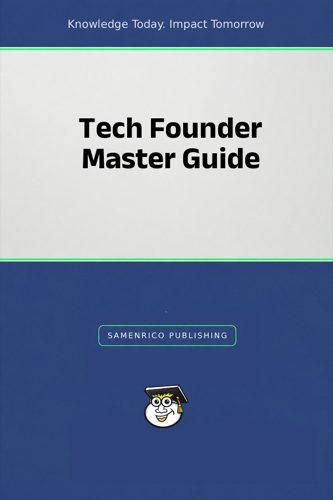
Tech Founder Master Guide eBook
Complete collection of tech visionaries Jobs, Gate
Complete collection of tech visionaries Jobs, Gates, Musk, Bezos.
Formats
Free sample
Chapter 1: The Wounded Engine...--What if the worst thing about you as a child—the loneliness, the stubbornness, the weird obsession that got you teased or ignored—is actually the engine that will make you rich?This is not a rhetorical question. It is the first diagnostic test of this book. Before you read another word, pause and answer honestly: What was the thing about you that did not fit? The thing your parents wished you would grow out of. The thing that made other kids look at you sideways.
The thing you learned to hide.Now hold that answer in your mind. Because Steve Jobs, Bill Gates, Elon Musk, and Jeff Bezos all had one. And they did not hide it. They fed it. They built empires around it.Most business books begin with tactics: fundraising, hiring, product-market fit.
This book begins with trauma. Not the clinical kind that requires therapy—though some of these founders arguably needed that too—but the specific, generative wound that becomes an entrepreneur's secret weapon. Every one of these four visionaries experienced a profound sense of being "different" in childhood. And every one of them learned, somewhere along the way, that their difference was not a bug to be patched but a feature to be amplified.This chapter will show you exactly how that transformation happened. We will examine the psychological formation of each founder—what broke them, what saved them, and what they built from the wreckage.
Then we will give you a framework to perform the same alchemy on your own childhood misfit traits. Because founder-market fit does not begin with a business plan. It begins with a wound that became a weapon.The Adoption That Became a Drive Steve Jobs was born in 1955 to Joanne Schieble and Abdulfattah Jandali, a Syrian teaching assistant. He was adopted almost immediately by Paul and Clara Jobs, a working-class couple from Mountain View, California. Jobs knew this from an early age.
He also knew—because children always know—that he had been given away.In Walter Isaacson's biography, Jobs described a childhood moment that crystallized everything: sitting on the lawn of his adopted parents' house, perhaps six or seven years old, telling a girl across the street that he was adopted. She asked what that meant. "It means your real parents gave you up," she said. Jobs ran into the house, crying. His adopted parents reassured him that he was chosen, not abandoned.
But the damage was done.Psychologists call this the "adoption wound"—the primal sense that you were rejected before you had any agency. For most people, this wound manifests as anxiety, people-pleasing, or fear of abandonment. For Jobs, it manifested as a lifelong, almost pathological need to prove his worth through world-changing products. The Apple II, the Macintosh, the i Pod, the i Phone—each was not just a device but a statement: I am valuable. I belong.
You were wrong to give me away.This connection between adoption and entrepreneurial drive is not merely anecdotal. Studies of founder psychology have found disproportionately high rates of adoption and early parental loss among successful entrepreneurs. The mechanism is straightforward: when the foundational structure of belonging is disrupted, the child learns to build their own structures. They become self-sovereign not by choice but by necessity.Jobs's adoption also created his famous "reality distortion field"—the ability to deny present reality in favor of a future he insisted into existence. When the Macintosh team said a feature was impossible, Jobs said it was possible.
When they said it would take six months, he said two weeks. This was not mere charisma. It was the deep, unconscious conviction that reality is negotiable because the reality he was given as a child—the reality of being given away—was unacceptable. He learned to reject reality early. He spent the rest of his life imposing his own.But adoption was only half the story.
Jobs was also a child of Silicon Valley before it was Silicon Valley. His adopted father, Paul, was a machinist who taught Steve to build things. They worked on cars together. Paul Jobs showed his son that the back of a fence—the part no one sees—mattered as much as the front. This lesson became the Macintosh's internal aesthetics, the invisible circuit boards laid out with geometric precision.
No customer ever saw them. Jobs demanded them anyway.So here is the paradox: Jobs was abandoned, then chosen, then taught craftsmanship. The abandonment gave him the hunger. The choosing gave him the narrative (I am special). The craftsmanship gave him the method.
Without any one of these three, there is no Apple.What is your version of this? Not adoption necessarily, but the specific disruption that taught you that you had to build your own table because no one would save you a seat at theirs.The Hyperkinetic Outsider Bill Gates was not adopted. He was not poor. He was not abandoned. And yet he was, by his own account, a misfit.Gates grew up in an upper-middle-class Seattle family.
His father was a prominent lawyer. His mother was a socialite who served on corporate boards. On paper, he had every advantage. But Bill Gates was a difficult child—"hyperkinetic," in the language of the time. He rocked.
He swayed. He annoyed his parents at the dinner table with his restless energy and obsessive focus on things that did not matter to anyone else.His parents sent him to a therapist. They were worried something was wrong with him.What was wrong with him, it turned out, was that he was wired for systems. While other children played, Gates read the World Book Encyclopedia from cover to cover—not once, but repeatedly. He taught himself programming at Lakeside School because the school had a computer terminal and he was allowed to use it at night.
He and Paul Allen, his future Microsoft co-founder, would skip class to code. They were not rebellious in the conventional sense. They were just somewhere else entirely.This is the second kind of childhood misfit: the one who is not broken by trauma but who simply does not fit into the social machinery of school, family, and peers. Gates was not sad. He was bored.
School was too slow. Rules were arbitrary. Social cues were inefficient. He was not trying to be difficult; the world was trying to be easy, and he found it exhausting.Gates's parents eventually stopped trying to fix him. Instead, they sent him to Lakeside, which had the resources to accommodate his obsession.
They allowed him to spend his nights at the computer terminal. They did not punish him for being different; they subsidized his difference. This is rare and crucial. Most parents of atypical children try to normalize them. Gates's parents, after a period of resistance, gave up and leaned in.The result was a founder who built the most successful software company in history by turning his hyperkinetic energy into systematic data-crunching.
Gates did not design beautiful products. He did not write the most elegant code. He was not a visionary in the Jobs sense. But he was obsessive about systems—about how…
This is the end of the free sample. Get the eBook to keep going. Buy now
About this book
Details
- Author
- Dooley Adelaida
- Publisher
- SamEnrico
- Language
- English
- Genre
- Non-Fiction, Biography, Complete
- Released
- 2026-06-09
- Pages (approx.)
- 151
- Available as
- eBook, Audiobook

Read better in the ZLOADR app
Your eBooks on your phone or tablet. Sign in with your SamEnrico account and start reading.
More by Dooley Adelaida
 Resume China Specific GuideDooley Adelaida$11.99
 Difficult Conversations Complete GuideDooley Adelaida$11.99
 Opioid Detox Comfort Measures WorkbookDooley Adelaida$11.99
 Forgiveness for Past AddictionsDooley Adelaida$11.99
 CRE Seller Financing GuideDooley Adelaida$11.99
 Chunking for ADHD LearnersDooley Adelaida$11.99
 Cactus Garden WalkDooley Adelaida$11.99
 Childhood Shadows Adult Light ManualDooley Adelaida$11.99
 The Green Sage of Timbuktu: Al-Hasan ibn Muhammad al-Wazzan's Botanical LegacyDooley Adelaida$11.99
 The Satellite That Connected the World: The Untold Story of Middle East's Space RevolutionDooley Adelaida$11.99
 The Last Flight of the Voyager: A 21st-Century OdysseyDooley Adelaida$11.99
 How to Become a Purification-operator HelperDooley Adelaida$11.99
You may also like
 Musician Master GuideHelms Letitia$11.99
 Retail Master GuideCoulter Trang$11.99
 War and Genocide MasterMasterson Ayesha$11.99
 Disaster Survivor Master GuideDenham Larisa$11.99
 Child Star Complete AnthologyRusso Alane$11.99
 VC Master GuideHoang Jamey$11.99
 Survivor Master GuideHightower Lissa$11.99
 Opposition Master GuidePressley Walton$11.99
 Turnaround Master GuideMusser Paris$11.99
 Pilot Master GuideCrews Robert$11.99
 Influencer Master GuideLott Na$11.99
 Vietnam War Master GuideElder Cheryll$11.99