
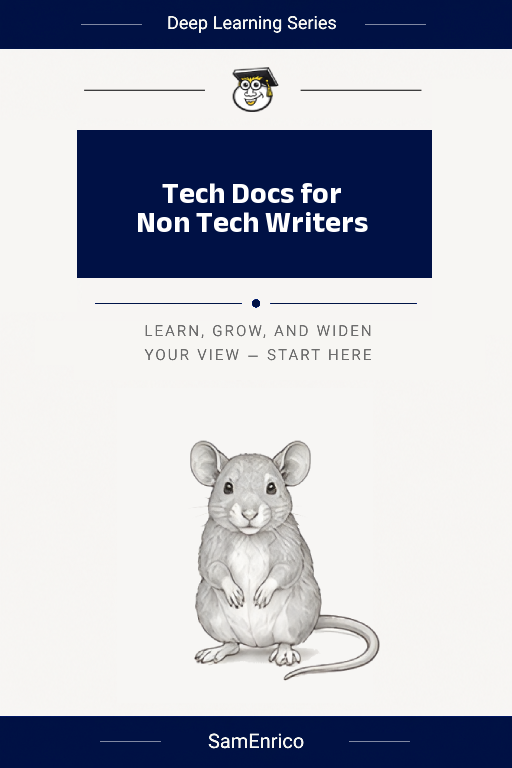
Tech Docs for Non Tech Writers Audiobook
Interview subject matter experts and translate tec
by Noonan Ta
Interview subject matter experts and translate technical information into plain English for users.
Formats
Free sample
Chapter 1: The Curse You Never Noticed--–- When Sarah, a senior cloud infrastructure engineer with fourteen years of experience, sat down to write documentation for her team's new deployment system, she did everything right. She opened a blank document. She listed every feature. She explained every configuration option. She included warnings about edge cases.
She even added a troubleshooting section for problems she knew users would encounter. The document ran forty-seven pages. It was, by every technical measure, flawless.Her users could not understand a single page of it.The first support ticket arrived within hours: "The documentation says to 'authenticate via the OIDC provider before initiating the deployment payload,' but I don't know what any of those words mean." The second ticket asked: "Where is the 'orchestration layer'? I can't find that button anywhere." The third ticket simply said: "I've been trying to follow this for four hours and I still haven't deployed anything."Sarah was baffled. She had explained everything.
Nothing she wrote was incorrect. The documentation contained all the information a user could possibly need. So why was everyone so confused?The answer, which no one had ever taught her, is a cognitive bias so powerful and so invisible that it has a name: the Curse of Knowledge. And until you understand it, every word you write for users will fail in exactly the same way.The Experiment That Explains Everything In 1990, a Stanford University graduate student named Elizabeth Newton designed a simple experiment that would become famous in psychology circles. She gave participants a list of well-known songs, including "Happy Birthday," "The Star-Spangled Banner," and "Jingle Bells." One group of participants—the "tappers"—were asked to tap out the rhythm of a chosen song on a table.
The other group—the "listeners"—were asked to guess the song based solely on the tapping.Before the experiment began, Newton asked the tappers to predict how often listeners would guess correctly. The tappers confidently predicted that listeners would get it right 50 percent of the time. They were off by a factor of twenty.The actual success rate was 2.5 percent.Think about that. The tappers heard the melody perfectly in their heads. Every tap was connected to a note, every pause was a rest, every rhythm was meaningful.
They could not hear what the listeners heard: random, disconnected tapping with no apparent pattern or meaning. The tappers were…
This is the end of the free sample. Get the Audiobook to keep going. Buy now
About this book
Details
- Author
- Noonan Ta
- Publisher
- SamEnrico
- Language
- English
- Genre
- Non-Fiction, Professional's Cheat Sheet, Knowledge Management
- Released
- 2026-05-30
- Pages (approx.)
- 128
- Available as
- eBook, Audiobook

Listen in the VoxFlicks app
Audiobooks and audio dramas wherever you go. Sign in with your SamEnrico account and press play.
More by Noonan Ta
 Gambling Addiction and Insulin ResistanceNoonan Ta$11.99
 The Food Comparison GuideNoonan Ta$11.99
 WFH Focus Music PlaylistNoonan Ta$11.99
 Two Part Tariff GuideNoonan Ta$11.99
 The Financial Genius of Abu Abd Allah ibn Sina: The Scholar Who Shaped Global TradeNoonan Ta$11.99
 How to Start a Boxed Game Business (Beginners Guide)Noonan Ta$11.99
 Operations ClerkNoonan Ta$11.99
 Learn to Play the TamburitzaNoonan Ta$11.99
You may also like
 Technical Writing for Non Tech WritersDickey Kristan$12.99
 Technical Documentation Structure GuideBoucher Randi$12.99
 Technical Documentation ChecklistPagan Melissia$12.99
 Technical Writing for BeginnersAcosta Winnifred$12.99
 Technical Documentation ToolsAugustine Onita$12.99
 Technical Documentation TemplateCantrell Ariel$12.99
 Technical Documentation Review GuideHollins Crissy$12.99
 Simplify Technical Language GuideBeattie Shemika$12.99
 Visuals in Technical Docs GuideAgnew Lanette$12.99
 Technical Documentation MistakesJacobson Lourie$12.99