
Non-FictionSelf-HelpTech Industry
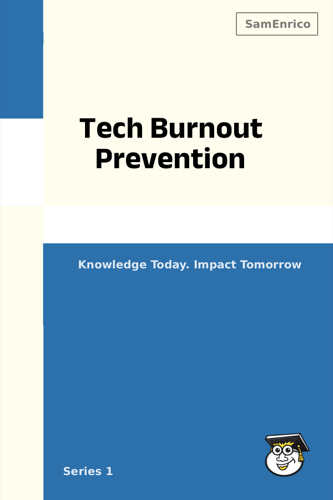
Tech Burnout Prevention eBook
Disconnect from devices and implement digital Sabb
Disconnect from devices and implement digital Sabbath.
Formats
Free sample
Chapter 1: The 24/7 Hangover...--–- The phone buzzes at 6:47 AM. You haven't opened your eyes yet, but your hand is already reaching for the nightstand. Three emails. Two Slack messages. One news alert about something terrible happening somewhere.
A like on a photo you posted twelve hours ago. A text from your sister that's just a laughing emoji. By the time your feet touch the floor, you have already processed more information than your great-grandparents did in an entire week.This is not a failure of willpower. This is not a character flaw. This is the 24/7 Hangover, and it is the defining psychological condition of the twenty-first century.The term "hangover" typically conjures images of headaches and regret after one too many drinks.
But the 24/7 Hangover is different. It does not come from alcohol. It comes from connectivity. It is the low-grade, ever-present exhaustion of a life lived in perpetual response mode—a life where the boundary between "on" and "off" has eroded to nothing. You are not drunk.
You are not even necessarily tired in the way that sleep can fix. You are simply... drained. A battery that never fully recharges because it never fully unplugs.Consider your morning. If you are like 80 percent of smartphone users, you checked your phone within fifteen minutes of waking.
Nearly half check it within five minutes. But here is what is rarely discussed: what happens inside your brain during those first moments of consciousness is not benign. It is not neutral. It is a cortisol spike before your feet have touched the floor.The Physiology of the First Scroll Dr. Daniela Kaufer, a neurobiologist at the University of California, Berkeley, has spent decades studying the effects of stress on the brain.
Her research reveals something unsettling: anticipation of a stressful event can be as damaging as the event itself. When you reach for your phone in the morning, you are not merely "checking in." You are activating your sympathetic nervous system—the "fight or flight" response—before your prefrontal cortex (the part of your brain responsible for rational thought) has fully woken up.The phone is a box of unknown contents. It could contain good news (a kind message from a friend) or bad news (an angry email from a boss) or neutral news (a weather alert) or no news at all (a spam notification). Your brain does not know which it will be. And because your brain is wired to prioritize threat detection over reward seeking, it assumes the worst.
Cortisol floods your system. Your heart rate increases slightly. Your muscles tense.And then you see the notification. It is just a like. Or a reminder about a meeting.
Or a news headline you cannot do anything about. The threat never materialized. But the cortisol is already there. It will take anywhere from twenty to ninety minutes for your stress hormones to return to baseline—unless, of course, you check your phone again before that happens.This is the mechanical heart of the 24/7 Hangover. It is not the total number of hours you spend on your phone that drains you.
It is the frequency of these micro-stress events. Each notification, each buzz, each red dot is a tiny cortisol spritzer. Individually, they are negligible. Collectively, over sixteen waking hours, they produce a chronic state of low-grade physiological stress. You are not anxious about anything in particular.
You are anxious about everything in general. That is the 24/7 Hangover.The Myth of Multitasking Perhaps the most persistent myth of the digital age is that some people can multitask effectively. This myth is sold to us as a desirable skill: the ability to juggle emails, Slack messages, spreadsheet work, and a video call simultaneously. The people who claim to do this well are often promoted, praised, and held up as models of efficiency.They are wrong. The science is unequivocal: the human brain cannot do two cognitive tasks at the same time.What we call "multitasking" is actually "rapid task-switching." The brain disengages from Task A, switches to Task B, then switches back.
Each switch costs time and cognitive energy. Dr. Gloria Mark, a professor of informatics at the University of California, Irvine, has studied workplace attention for more than two decades. Her research shows that the average knowledge worker switches tasks every three minutes and five seconds. After each switch, it takes an average of twenty-three minutes and fifteen seconds to return to the original task at full focus.Twenty-three minutes.That means if you check your email while writing a report, you are not "efficiently using downtime." You are resetting a twenty-three-minute timer every time you glance at your inbox.
Over the course of an eight-hour workday, the average person loses nearly three hours to the cognitive cost of task-switching alone. That is not productivity. That is productivity theater.The 24/7 Hangover is the subjective experience of that loss. You feel busy. You feel overwhelmed.
You feel like you have been working all day. But at 5:00 PM, you cannot point to a single thing you finished. Your to-do list is longer than it was at 9:00 AM. You are exhausted, and you have nothing to show for it.This is not a mystery. This is not a paradox.
This is the predictable output of a system designed to interrupt you constantly. You are not failing at work. Work is failing you.The 22 Percent Solution In 2015, a German consulting firm named Rewheel conducted an experiment. They asked one group of employees to stop sending or checking email after 6:00 PM. A control group continued their normal digital habits.
The results were striking: the group with the after-hours email boundary reported 22 percent lower burnout rates. They also reported higher job satisfaction, better sleep quality, and improved relationships with their families.Twenty-two percent.That is not a small effect. That is the difference between dreading Monday morning and being neutral about it. That is the difference between lying awake at 2:00 AM thinking about an email and falling asleep within fifteen minutes.The experiment was replicated in France, where a 2017 labor law gave employees the "right to disconnect." Companies with more than fifty employees are now required to negotiate after-hours digital boundaries with their workers. The result?
A measurable decrease in stress-related medical leave and a measurable increase in after-hours physical activity (people went for walks instead of answering emails).These studies share a common finding: the problem is not technology itself. The problem is the absence of boundaries around technology. When the workday never ends, the recovery period never begins. And without recovery, burnout is not a risk—it is a guarantee.The Self-Assessment: How Hungover Are You?Before we go any further, let us take stock of where you are. The following quiz is not a diagnostic tool.
It is a mirror. Answer honestly.Rate each statement from 0 (never) to 3 (almost always):I check my phone within five minutes of waking up. (__)I feel a small spike of anxiety when I see a notification. (__)I have scrolled through social media while in the bathroom at work. (__)I have answered an email while someone was speaking to me directly.
(__)I have felt "phantom vibrations" (thinking my phone buzzed when it didn't). (__)I have stayed up later than intended because…
This is the end of the free sample. Get the eBook to keep going. Buy now
About this book
Details
- Author
- Tuggle Mohammed
- Publisher
- SamEnrico
- Language
- English
- Genre
- Non-Fiction, Self-Help, Tech Industry
- Released
- 2026-06-08
- Pages (approx.)
- 130
- Available as
- eBook, Audiobook

Read better in the ZLOADR app
Your eBooks on your phone or tablet. Sign in with your SamEnrico account and start reading.
More by Tuggle Mohammed
 Healing the Alcoholic Brain: A Practical GuideTuggle Mohammed$11.99
 Workaholism Recovery for DoctorsTuggle Mohammed$11.99
 Preferred Equity Tranches DBTuggle Mohammed$11.99
 The Navigator of the Unknown: Ibn Battuta’s Uncharted OdysseyTuggle Mohammed$11.99
 Solution Marketing ManagerTuggle Mohammed$11.99
 How to Become a Gold BurnisherTuggle Mohammed$11.99
 Fintech API Integration Primer for ExportersTuggle Mohammed$12.99
 How to Produce Airport Shuttle and Taxi ServicesTuggle Mohammed$11.99
You may also like
 Hong Kong Handover 1997Dunn Johnnie$11.99
 Zumba For Postnatal Recovery CourseNeal Christian$11.99
 Zumba for BeginnersLadner Nikia$11.99
 YouTube Comment Mining GuideHumes Pandora$12.99
 Worry Box MeditationCarlin Rudy$11.99
 Workplace Stress MeditationNguyen Lynn$11.99
 Workplace Stress and Sleep RepairHawley Ivory$11.99
 Workplace Perfectionism CureDelaney Jeffry$11.99
 Workplace Injustice Anger GuideWallen Isabelle$11.99
 Work Addiction and Burnout LinkGreenwood Ester$11.99
 Women in Yoga and WellnessBeattie Galina$11.99
 Women in Stand Up ComedyChun Evangeline$11.99