
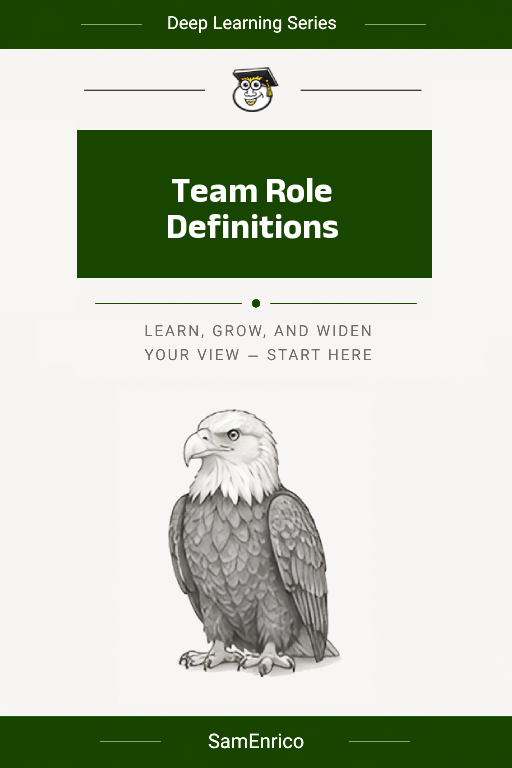
Non-FictionFirst 30 DaysTeam Structure
Team Role Definitions eBook
Define founder roles, responsibilities, and equity
Define founder roles, responsibilities, and equity split on a single governance page.
Formats
Free sample
Chapter 1: The Handshake Lie--It was 11:47 PM on a Tuesday when Michael realized he no longer had a company.He sat alone in the empty warehouse that had once been his startup's headquarters, surrounded by three whiteboards covered in growth projections, user acquisition funnels, and a half-finished feature roadmap that would never be built. Two months earlier, his co-founder Sarah had walked out after a screaming match over whether to accept a term sheet that would have valued their company at $40 million. Michael wanted to take it. Sarah wanted to wait for a better offer. There was no tie-breaker.
No written agreement. No clause that said what happened when two people who had started a company on a handshake and a dream suddenly stopped agreeing on anything.The term sheet expired. The lead investor called Michael and said, "Get your house in order, then call me." Sarah hired a lawyer. The engineering team, sensing the collapse, defected to a competitor. By the time Michael looked up from the wreckage, he had spent $80,000 in legal fees, lost his best friend, and owned 100 percent of a company worth exactly nothing."I thought we didn't need paperwork," he told me six months later over coffee.
"We were friends. We trusted each other. We shook hands."That handshake cost him everything.The Graveyard of Handshakes Michael's story is not an outlier. It is not a cautionary tale from the distant past or the result of unusual circumstances. It is, tragically, the most common story in entrepreneurship.Noam Wasserman, a professor at Harvard Business School, spent more than a decade studying over 10,000 founders and their startups.
His research, published in the seminal book The Founder's Dilemmas, uncovered a staggering statistic that should be tattooed on the inside of every founder's eyelids: nearly two-thirds of startup failures can be traced directly back to co-founder conflict.Not market competition. Not poor product-market fit. Not running out of cash, though those things often happen as a result of the conflict. The primary cause of death for most startups is the slow, painful unraveling of the relationship between the people who started it.Let that sink in.If you and your co-founders never had a single argument, your chances of success would be dramatically higher than the baseline. But you will have arguments.
You will disagree. The question is not whether conflict will arrive at your doorstep. The question is whether you have built a system to handle it before it burns your company to the ground.This chapter is about why most founders fail to build that system, why the natural human optimism of a handshake is actually a neurological trap, and why the single-page solution introduced in this book is the only antidote that has been proven to work across thousands of startups.The Optimism Bias: Why Your Brain Is Lying to You Right Now There is a reason you and your co-founders are not currently sitting in a room hashing out equity splits, vesting schedules, and what happens if someone wants to quit. It is not because you are lazy or naive. It is because your brain is chemically incapable of taking the threat seriously.Psychologists have identified a cognitive phenomenon called the optimism bias – the systematic tendency for human beings to believe that negative events are less likely to happen to us than to other people.
We know that divorce rates are 50 percent, but we believe our own marriage will last forever. We know that 80 percent of restaurants fail in the first five years, but we believe our new bistro will be the exception. We know that 65 percent of startups fail due to co-founder conflict, but we believe that we are different.Here is the neurological kicker: the optimism bias is not just a psychological quirk. It is rooted in the structure of your brain. Functional MRI studies have shown that when people imagine positive future events, the rostral anterior cingulate cortex and the amygdala (regions associated with emotional processing and reward anticipation) light up with activity.
When people imagine negative future events, those same regions show significantly less activation. Your brain is literally wired to make the future look brighter than it is, because that wiring helped your ancestors take risks that led to rewards.But that same wiring makes you terrible at preparing for disaster.When you shake hands with a co-founder and say, "We'll figure it out as we go," your brain is not making a rational calculation. It is taking a chemical shortcut. It is choosing the dopamine hit of a shared dream over the cortisol spike of a difficult conversation. And that choice, repeated thousands of times across thousands of startups, has created a graveyard of handshakes.The most successful founders are not the ones who trust their brains.
They are the ones who know their brains are lying to them and build systems to compensate.The Rich vs. King Dilemma Wasserman's research identified a fundamental tension that every founding team must confront, whether they know it or not. He calls it the Rich vs. King dilemma.At its simplest level, the dilemma is this: every decision you make as a founder trades off between two competing values. Do you want to build a company that makes you rich – maximizing financial value, bringing in investors, professionalizing management, and eventually exiting for a massive payday?
Or do you want to remain king – maintaining control, making all the decisions, and never answering to a board or a CEO you didn't personally hire?Most founders say they want both. Almost none get both.The reason is structural. As soon as you take outside investment, you lose control. Investors will demand board seats. They will have protective provisions that allow them to block certain decisions.
They may eventually fire you as CEO. The data is brutal: according to Wasserman's research, approximately 50 percent of founder-CEOs are replaced by the time their company reaches Series B.On the other hand, if you refuse to take investment and maintain control, you will almost certainly build a smaller company. You will grow more slowly. You may never achieve the scale that would make you truly rich. You will be king of a small hill instead of a citizen of a mountain range.The tragedy is that most founders never consciously choose between Rich and King.
They drift. They take a small investment from an angel, then a larger one from a venture fund, then suddenly realize they have been diluted to single-digit ownership and are one board vote away from being fired. Or they refuse all investment, then watch their competitors scale past them and eventually acquire their customer base for pennies on the dollar.The Governance Page forces you to make this choice explicit before you are in the heat of a funding negotiation or a boardroom coup. It asks: on a scale from "I want to maximize financial value at all costs" to "I want to maintain control even if it means less money," where does each founder stand? And what happens when those answers diverge?Because they will diverge.
And if you have not planned for that divergence, it will destroy you.The Three Famous Handshakes That Became Lawsuits To…
This is the end of the free sample. Get the eBook to keep going. Buy now
About this book
Details
- Author
- Hampton Everett
- Publisher
- SamEnrico
- Language
- English
- Genre
- Non-Fiction, First 30 Days, Team Structure
- Released
- 2026-06-01
- Pages (approx.)
- 142
- Available as
- eBook, Audiobook

Read better in the ZLOADR app
Your eBooks on your phone or tablet. Sign in with your SamEnrico account and start reading.
More by Hampton Everett
 Repair Attempts After FightsHampton Everett$11.99
 Academic Degrees Earned After FiftyHampton Everett$11.99
 Menopause And Fibroids GuideHampton Everett$11.99
 The Executive Personal BrandHampton Everett$11.99
 Weekly Mindfulness ReviewHampton Everett$11.99
 Sexual Confidence HypnosisHampton Everett$11.99
 Santiago Ramón Cajal NeuronHampton Everett$11.99
 The Torc of Power: Celtic Artistry and the Hallstatt EliteHampton Everett$11.99
 The Secret Sauce: How a Mom-and-Pop Diner Defied McDonald'sHampton Everett$11.99
 How to Produce Play Tents and TunnelsHampton Everett$11.99
 Brazil Social Media Dropshipping GuideHampton Everett$12.99
 Mastering Resm-i Arusane: Ottoman Marriage TaxHampton Everett$11.99
You may also like
 Hong Kong Handover 1997Dunn Johnnie$11.99
 Zumba For Postnatal Recovery CourseNeal Christian$11.99
 Zumba for BeginnersLadner Nikia$11.99
 YouTube Comment Mining GuideHumes Pandora$12.99
 Worry Box MeditationCarlin Rudy$11.99
 Workplace Stress MeditationNguyen Lynn$11.99
 Workplace Stress and Sleep RepairHawley Ivory$11.99
 Workplace Perfectionism CureDelaney Jeffry$11.99
 Workplace Injustice Anger GuideWallen Isabelle$11.99
 Work Addiction and Burnout LinkGreenwood Ester$11.99
 Women in Yoga and WellnessBeattie Galina$11.99
 Women in Stand Up ComedyChun Evangeline$11.99