
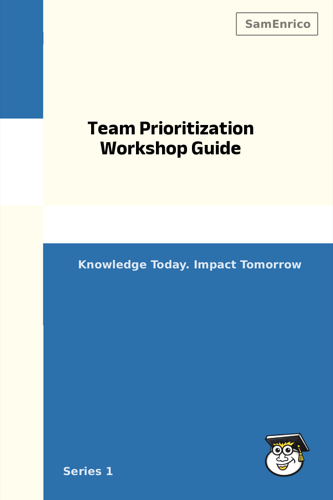
Team Prioritization Workshop Guide eBook
Facilitate group priority setting using Eisenhower
Facilitate group priority setting using Eisenhower and ABCDE methods with this collaborative workbook.
Formats
Free sample
Chapter 1: The Meeting That Never Ends--–- The conference room was called "Horizon." It had floor-to-ceiling windows, a polished mahogany table that could seat eighteen, and a whiteboard that had cost the company five thousand dollars. At 2:47 PM on a Tuesday, it contained fourteen exhausted people, three cold cups of coffee, and one question that none of them could answer: "What should we do first?"The marketing director, Priya, had her laptop open to a spreadsheet showing Q3 targets that were already 15 percent behind schedule. "The website redesign has to launch by October first," she said, for the fourth time. "Every week we delay, we lose momentum on the campaign."The engineering lead, Marcus, had his arms crossed. He had been silent for the last twenty minutes, but now he leaned forward.
"We can't launch a redesign on infrastructure that's held together with duct tape. The technical debt is going to cause an outage. It's not a matter of if—it's when.""Then when is that outage?" asked Sarah from sales. She wasn't being sarcastic. She genuinely wanted to know.
"Because I have a client who will sign a seven-figure deal next month, but only if we deliver the custom integration they've been asking for. If we push that to fix a hypothetical outage, we lose the deal.""It's not hypothetical," Marcus said. "The login service crashed twice last week.""For five minutes each time," Priya said."Five minutes of downtime costs us twelve thousand dollars in e-commerce revenue.""And delaying the redesign costs us visibility with the thirty percent of our market that doesn't know we exist yet."And on it went. Around the table. Around and around.
For three hours.This meeting actually happened. I've changed the names and the company, but the dynamic is real. It happens every day, in every industry, in every time zone. A room full of smart, well-intentioned people who cannot agree on what matters most—because everyone is right.The tragedy is that they were all correct. The website redesign was important.
The technical debt was urgent. The client integration was lucrative. The login bug was annoying. Every single person at that table had a legitimate claim that their work mattered.But nothing could be done first.This chapter is about why that happens. It's about the invisible forces that turn prioritization into paralysis.
And it's about the first step toward a solution—not a better spreadsheet, not a more persuasive argument, but a shared framework that transforms "my priority versus your priority" into "our priority."The Anatomy of a Prioritization Breakdown Let me walk you through what happened in that conference room. Not the surface conversation—the deeper dynamics that you've seen in your own meetings.The Loudest Voice Trap. Priya spoke first, spoke often, and spoke with data. She was passionate, prepared, and persuasive. Her voice set the anchor for the entire conversation.
Every subsequent proposal was compared to hers—not on its merits, but on its ability to match her energy. This is not a criticism of Priya. She was doing her job. But the structure of the meeting rewarded the loudest voice, not the most important work.The Recency Trap. When Marcus mentioned the login crash, it was fresh in everyone's mind because it had happened just three days earlier.
The website redesign had been in progress for six months. The client integration had been discussed for eight weeks. But the login crash—that felt urgent because it was recent. Our brains are wired to prioritize what's new, not what's important.The Consensus Trap. After two hours, someone said, "Can't we do all of these?" The team latched onto this false hope like a life raft.
They spent the next forty-five minutes trying to figure out how to do everything at once—which was impossible, but admitting impossibility felt like failure. The desire for consensus paralyzed them.The Everything Trap. They ended the meeting with a list of "priority one" items. There were eleven of them. Eleven items cannot all be priority one.
That's not prioritization; it's a wish list. But calling everything a priority felt decisive. It was anything but.These traps are not signs of a bad team. They are signs of a team without a shared framework. Give a team a common language for discussing priorities—a way to say "this is urgent but not important" or "the consequences of delaying this are severe"—and the traps dissolve.The Priority Paradox Here is the uncomfortable truth at the heart of this book: the more you try to prioritize everything, the less you actually prioritize anything.Let me say that again, because it's counterintuitive and important.
When you treat everything as a priority, you make nothing a priority. You spread your resources so thin that nothing gets the attention it deserves. You exhaust your team on low-value work while high-value work waits. You mistake activity for progress.This is the priority paradox.Most teams respond to the paradox by trying harder. They hold more meetings.
They create more spreadsheets. They ask for more data. They think that the problem is insufficient information—that if they just knew more, they could make the right choice.But the problem is not insufficient information. The problem is insufficient structure.Think about it. You already know which tasks are important.
You already know which ones are urgent. You already know which ones have severe consequences if delayed. The information is there. What's missing is a disciplined process for making trade-offs—a way to say "yes" to the most important work and "no" to the good work that isn't the best work.Drawing from bestselling books like The Skilled Facilitator by Roger Schwarz and Managing Priorities by Harry Max, the core insight is this: teams don't need smarter people. They need a shared framework.
A common language. A repeatable process that turns conflict from a barrier into an asset.The Hidden Cost of Bad Prioritization Before we dive into solutions, let's be honest about the cost of the status quo. Bad prioritization isn't just annoying. It's expensive.The Cost of Wasted Time. The meeting I described lasted three hours.
Fourteen people attended. That's forty-two person-hours. At an average loaded cost of $75 per hour (conservative for a tech company), that meeting cost over $3,000 in salary. And they made no decision. That $3,000 produced nothing.
Multiply that by the number of teams in your organization, and you're looking at millions of dollars in wasted labor.The Cost of Wasted Energy. Bad prioritization doesn't just waste time; it wastes motivation. Teams that can't agree on what matters eventually stop trying. They disengage. They stop bringing ideas to meetings because those ideas will just get lost in the noise.
The cost of this disengagement is invisible but enormous—lost innovation, lost initiative, lost passion.The Cost of Wasted Work. The worst cost is the work that gets done but shouldn't have. Teams that can't prioritize end up doing everything a little bit. They launch the redesign with the technical debt still present. They fix the login bug but break something else.
They build the custom integration but miss the deadline. The result is work that is half-finished, low-quality, and ultimately worthless.These…
This is the end of the free sample. Get the eBook to keep going. Buy now
About this book
Details
- Author
- Burleson Bryon
- Publisher
- SamEnrico
- Language
- English
- Genre
- Non-Fiction, Self-Help, Team Productivity
- Released
- 2026-06-06
- Pages (approx.)
- 116
- Available as
- eBook, Audiobook

Read better in the ZLOADR app
Your eBooks on your phone or tablet. Sign in with your SamEnrico account and start reading.
More by Burleson Bryon
 Technology Adoption MapBurleson Bryon$11.99
 Iranian Revolution Overthrow ShahBurleson Bryon$11.99
 Meditation For High Stress ProfessionalsBurleson Bryon$11.99
 GAD Avoidance Reduction GuideBurleson Bryon$11.99
 The Silent Depths: Diving into the Great Barrier Reef’s Hidden World (1920s)Burleson Bryon$11.99
 System Engineering Manager RadarBurleson Bryon$11.99
 Understanding Guanidinoacetate Methyltransferase DeficiencyBurleson Bryon$17.99
 BPO Performance MetricsBurleson Bryon$12.99
 Real Estate Holding LLC PrimerBurleson Bryon$12.99
 How to Become a Clay MakerBurleson Bryon$11.99
You may also like
 Eisenhower For Teams GuideCain Beatrice$11.99
 Pomodoro Team CoordinationViera Vaughn$11.99
 Managing Slack Distractions ManualLigon Ailene$11.99
 The Eisenhower Matrix for Teams GuideBerryman Mandie$11.99
 Pomodoro Group CollaborationMichaels Aleen$11.99
 Eisenhower Matrix For TeamsNegrete Wilda$11.99
 Team Weekly Review RitualChapa Danuta$11.99
 Pomodoro for Team CollaborationHenderson Marsha$11.99