
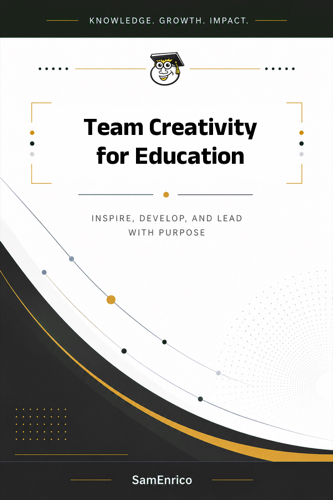
Team Creativity for Education eBook
Faculty collaborative lesson planning.
Faculty collaborative lesson planning.
Formats
Free sample
Chapter 1: The Sunday Night Trap--–- On a Sunday evening in late September, a middle school math teacher named Elena sits at her kitchen table. A half-empty mug of coffee has gone cold. Her laptop screen glows with a blank lesson plan template. Tomorrow morning, 28 eighth graders will walk into her classroom, and right now, she has nothing for them. Not because she is lazy.
Not because she is inexperienced. But because she has been staring at the same standard for forty-five minutes—”Understand that patterns of association can also be seen in bivariate categorical data by displaying frequencies and relative frequencies in a two-way table”—and every activity she can imagine feels flat. She could use the textbook worksheet. She has used it for four years. It works, in the sense that students fill in boxes and most get the answers right.
But Elena wants more than compliance. She wants the kind of lesson where students argue about numbers, where hands shoot up, where the bell feels like an interruption. Instead, she has a cold mug and a blinking cursor.Elena is not alone. In a high school across town, a history teacher named Marcus is doing the same thing. He is planning a unit on the transatlantic slave trade, and he has the opposite problem: too much material.
He has primary sources, maps, ship manifests, abolitionist speeches, and a documentary clip. He knows his students need to understand both the human horror and the economic mechanics. But he cannot figure out how to fit it all into three days without turning the unit into a numb march through slides. He considers cutting the math—the probability of survival, the insurance calculations, the profit margins—because it feels cold next to the narratives of suffering. But he suspects that the numbers are exactly what his data‑obsessed students need to understand scale.
He closes his laptop and opens it again. Nothing changes.What Elena and Marcus do not know is that they are fifty miles apart, working on the same problem from different angles. Elena needs a hook for bivariate data. Marcus needs a way to teach the slave trade without overwhelming his students. Neither one will sleep well tonight.
And neither one will think to call the other, because in the culture of teaching, planning is a solitary act. We close our doors. We work alone. We call it professionalism. But in that isolation, we also trap ourselves inside a single brain.The Cognitive Limits of the Lone Planner This book begins with a radical proposition: no single teacher is smart enough to plan the best possible lesson.
That is not an insult. It is a cognitive fact. Every human brain has blind spots. We favor the teaching methods we experienced as students. We overestimate the clarity of our own explanations.
We design activities that we would enjoy, not necessarily the ones that would reach a silent child in the back row. We forget what it felt like to not know the thing we have taught a hundred times. These are not failures of effort or talent. They are features of how brains work.The psychologist Daniel Kahneman spent a career documenting the systematic ways human thinking goes wrong. In his book Thinking, Fast and Slow, he distinguishes between System 1 (fast, automatic, pattern‑based) and System 2 (slow, deliberate, analytical).
When a teacher plans alone, System 1 runs the show most of the time. We reach for the worksheet we used last year because it is easy, not because it is good. We skip the complex simulation because it requires too much mental energy to invent from scratch. We tell ourselves we will improve it later, but later never comes because there is always another lesson to plan. The lone planner is not lazy.
The lone planner is cognitive exhausted before she even begins.Group planning changes the cognitive equation. When multiple brains attack a problem together, they bring different System 1 patterns and different System 2 analyses. One teacher notices a vocabulary word that will trip up English learners. Another spots a logical leap that will lose half the class. A third remembers a local dataset that makes the abstraction concrete.
These insights do not emerge from any single planner. They emerge from the collision of multiple minds. The psychologist Keith Sawyer, in his book Group Genius, calls this emergence: the unpredictable, often superior outcomes that arise when people think together. Emergent ideas are not averages of individual ideas. They are genuinely new.Consider the philosopher Arthur Koestler’s concept of bisociation.
Creativity, Koestler argued, does not come from thinking harder about one thing. It comes from thinking about two unrelated things at the same time and finding the hidden connection. A math teacher thinking alone sees bivariate data. A history teacher thinking alone sees the slave trade. Put them in a room together, and suddenly the probability of survival on a slave ship becomes a two‑way table.
The cold numbers become a story. The story becomes measurable. The lesson that neither teacher could build alone now exists.Three Myths That Keep Teachers Planning Alone If group planning is so powerful, why do most teachers plan alone? The answer is not malice or stupidity. It is a set of deeply held myths that feel like common sense.
This chapter dismantles three of them.Myth 1: Creative people work alone.The lone genius is a powerful cultural story. We imagine Einstein in the patent office, having his sudden insight about relativity. We picture J.K. Rowling in a train station, Harry Potter fully formed. But these stories are lies—or at least, they are severe simplifications.
Einstein’s papers emerged from years of correspondence with other physicists. Rowling’s editors shaped her manuscripts into bestsellers. Even the most solitary artists have collaborators, critics, and communities.In education, the myth of the lone genius teacher does real damage. It convinces novice teachers that their struggles are personal failures. It allows veteran teachers to hoard their best lessons as private property.
It excuses administrators from building collaborative structures. And it ignores the actual science of creativity. The psychologist Teresa Amabile spent decades studying what makes people creative in organizations. Her conclusion: creativity is overwhelmingly social. The most creative teams are not the ones with the highest IQs or the most experience.
They are the ones with the highest levels of idea exchange, constructive critique, and shared ownership of problems.Myth 2: Group work just averages out ideas.Every teacher has been in a bad committee meeting. A group of well‑intentioned people sit around a table, talk for an hour, and produce a plan that is worse than any individual would have produced alone. This experience leads many teachers to conclude that group planning is a waste of time. But the problem is not group planning. The problem is bad group planning.When a team has no structure for generating ideas, no protocol for giving feedback, and no psychological safety to disagree, the result is indeed a bland average.
The loudest voice wins. The safest idea survives. The meeting becomes a performance of politeness. But that is not what this book teaches. The chapters ahead…
This is the end of the free sample. Get the eBook to keep going. Buy now
About this book
Details
- Author
- Compton Shayla
- Publisher
- SamEnrico
- Language
- English
- Genre
- Non-Fiction, Self-Help, Education
- Released
- 2026-06-06
- Pages (approx.)
- 133
- Available as
- eBook, Audiobook

Read better in the ZLOADR app
Your eBooks on your phone or tablet. Sign in with your SamEnrico account and start reading.
More by Compton Shayla
 Postpartum Guilt and ShameCompton Shayla$11.99
 Mountain Lake Calm GuideCompton Shayla$11.99
 Commute Alternative Routes PeaceCompton Shayla$11.99
 Anger as Trauma ResponseCompton Shayla$11.99
 Career Pivot After 60Compton Shayla$11.99Career Pivot After 60Compton Shayla$11.99
 Breast Health For Trans MenCompton Shayla$11.99
 Persuasion for Project ManagersCompton Shayla$11.99
 The Golden Scalpel: Pioneers of Black MedicineCompton Shayla$11.99
 The Quantum Leap of William Harvey: Decoding the Heart's RhythmCompton Shayla$11.99
 How to Produce Cookware SetsCompton Shayla$11.99
 A Collector's Handbook to the Triumph Mk Ii TdcCompton Shayla$11.99
You may also like
 Hong Kong Handover 1997Dunn Johnnie$11.99
 Zumba For Postnatal Recovery CourseNeal Christian$11.99
 Zumba for BeginnersLadner Nikia$11.99
 YouTube Comment Mining GuideHumes Pandora$12.99
 Worry Box MeditationCarlin Rudy$11.99
 Workplace Stress MeditationNguyen Lynn$11.99
 Workplace Stress and Sleep RepairHawley Ivory$11.99
 Workplace Perfectionism CureDelaney Jeffry$11.99
 Workplace Injustice Anger GuideWallen Isabelle$11.99
 Work Addiction and Burnout LinkGreenwood Ester$11.99
 Women in Yoga and WellnessBeattie Galina$11.99
 Women in Stand Up ComedyChun Evangeline$11.99