
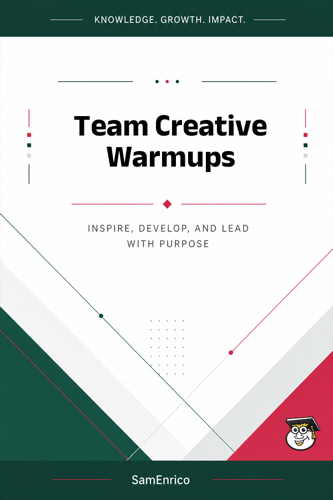
Team Creative Warmups eBook
Starts sessions with short exercises that limber u
Starts sessions with short exercises that limber up flexible thinking and loosen judgment.
Formats
Free sample
Chapter 1: The Efficiency Trap--–- The conference room was silent. Not the productive silence of deep thought, but the suffocating silence of people who have absolutely nothing to say. Eight experienced professionals sat around a polished oak table, each holding a marker, each staring at a blank whiteboard that read: "How might we increase customer engagement by 20 percent this quarter?" The project lead, a sharp woman named Priya with fifteen years of experience, had just asked for "creative ideas—no bad suggestions." And then the room died.No one spoke for forty-three seconds. Forty-three seconds in a business meeting feels like an eternity. People checked phones.
Someone refilled water. A man in the corner wrote "synergy" on his notepad, then crossed it out. Finally, the most senior person in the room—a vice president named Harold—cleared his throat and said, "We could send more emails." Everyone nodded. Someone wrote "more emails" on the whiteboard. The meeting continued for another ninety minutes.
They generated exactly four ideas, all variations of "more communication," and scheduled a follow-up meeting to "dive deeper."That team was not stupid. Those eight people included a data scientist, a behavioral psychologist, two product managers, a marketing director, and three engineers with patents to their names. Collectively, they had over 120 years of professional experience. Individually, each could have generated a dozen interesting ideas over coffee. But together, in that room, with a blank whiteboard and a high-stakes question, their brains froze solid.This is not a failure of intelligence.
It is a feature of how human brains work when they gather in groups—and it is the single greatest obstacle to creativity in the modern workplace.The Puzzle of the Frozen Team Let us name what just happened. That team experienced what this book calls The Freeze—a cognitive and social state in which groups become incapable of generating novel ideas under pressure. The Freeze is not laziness. It is not a lack of creativity. It is not incompetence.
It is a predictable neurological response to conditions that dominate most meetings: judgment, hierarchy, time pressure, and the silent fear of looking stupid.Consider what was happening inside Priya's head during those forty-three seconds. She was not thinking about customer engagement. She was thinking: If I speak first and my idea is bad, Harold will remember. If I speak and my idea is obvious, the engineers will think I'm shallow. If I say something wild, I will look unprofessional.
What if no one builds on my idea? What if they do and it goes somewhere I cannot control?The data scientist was thinking: I need data before I speak. My currency is evidence. Without numbers, my opinion has no weight. The most junior person was thinking: Absolutely not.
I will speak when someone asks me directly, and then I will agree with whoever spoke before me. The engineers were thinking: This problem is under-specified. We need requirements before we can ideate. And Harold, the vice president, was thinking: I should say something to get things moving. But if I speak first, I anchor the whole conversation.
Also, I genuinely do not know the answer.Eight smart people. Eight different flavors of paralysis. One frozen team.Think about your own experience. Have you sat in that room? Have you watched the whiteboard stay blank while the clock ran down?
Have you felt the pressure to say something—anything—just to break the silence, even if what you said was obvious and unhelpful? If you have worked in any organization for more than six months, you have. This scene plays out thousands of times every day in offices around the world.And here is the cruelest part: the more pressure there is to be creative, the more frozen teams become. A low-stakes brainstorming session about where to hold the holiday party might generate plenty of ideas. But ask that same team to solve a real business problem—one that affects performance reviews, bonuses, or the company's future—and the freeze sets in instantly.
The higher the stakes, the colder the room.The solution is not "try harder to be creative" or "hire more creative people" or "read a book about innovation." The solution is simpler, faster, and more counterintuitive than any of those: teams need to warm up.What This Book Is (And Is Not)Before we go any further, let me be perfectly clear about what you are holding.This book is not a creativity textbook. You will not find dense academic citations on every page, though the science we do present is real and will be summarized where it matters. You will not be asked to read case studies from companies you have never heard of. You will not complete personality assessments or learn your "creative type" through a twenty-question quiz.This book is not a brainstorming guide. Brainstorming—the classic "generate as many ideas as possible without criticism"—has its place.
But it is not a warmup. Brainstorming is the main event. And the main event fails when the performers are cold. You would not ask a violinist to play a concerto without tuning first. You would not ask a basketball player to shoot free throws without warming up her shoulders.
Why would you ask a team to brainstorm without preparing their brains?This book is not a team-building manual. You will not be asked to fall backward into anyone's arms or share your deepest childhood trauma. The exercises in these pages are not about bonding for bonding's sake. They are about cognitive preparation—getting a group of human brains into a state where they can actually do the creative work they were hired to do. If bonding happens as a side effect, wonderful.
But it is not the goal.What this book is is a practical, science-grounded, exercise-filled field guide to one specific intervention: the creative warmup. You will learn why teams freeze, how to prevent freezing, and exactly what to do in the first three minutes of any meeting to unlock flexible thinking and loosen judgment. You will finish this book with a toolkit of warmups ranging from sixty seconds to thirty minutes, a clear framework for matching warmups to team states, and a daily ritual that transforms how your team thinks together.But we must start with the science. Because if you do not understand why warmups work, you will abandon them the first time they feel silly. And they will feel silly.
That is part of the point. The discomfort of silliness is the feeling of your brain shifting gears.The Efficiency Trap: Why Your Brain Resists Creativity Here is the fundamental problem: your brain is not designed to be creative. It is designed to keep you alive.Evolution did not reward the hominid who spent twenty minutes generating novel uses for a rock while a saber-toothed cat approached. Evolution rewarded the hominid who saw the cat, felt fear, and acted on a proven escape pattern. Run.
Hide. Fight. These worked. Contemplating alternative uses for the rock got you eaten.The human brain is an efficiency machine. It takes shortcuts, relies on existing patterns, and conserves energy whenever possible.
This is called cognitive economy, and it is why you can drive to work without remembering any of the turns.…
This is the end of the free sample. Get the eBook to keep going. Buy now
About this book
Details
- Author
- Manning Bradley
- Publisher
- SamEnrico
- Language
- English
- Genre
- Non-Fiction, Self-Help, Warmup Activities
- Released
- 2026-06-09
- Pages (approx.)
- 152
- Available as
- eBook, Audiobook

Read better in the ZLOADR app
Your eBooks on your phone or tablet. Sign in with your SamEnrico account and start reading.
More by Manning Bradley
 Grit for Students with ADHDManning Bradley$11.99
 Half Smile for AnxietyManning Bradley$11.99
 Microstress Detection GuideManning Bradley$11.99
 London Staffing SolutionsManning Bradley$11.99
 Morning Visualization GuideManning Bradley$11.99
 Offering Choices GuideManning Bradley$11.99
 POLST Form GuideManning Bradley$11.99
 The Symphony of the Deep: How Western Composers Conquered the Ocean’s SoulManning Bradley$11.99
 The Philosophers of Axum: Wisdom from the Horn of AfricaManning Bradley$11.99
 Service Providers Guide to FacialistsManning Bradley$11.99
 A Collector's Handbook to the Matra-simca BagheeraManning Bradley$11.99
 YouTrack JetBrains AgileManning Bradley$12.99