
Non-FictionSelf-HelpKnowledge Transfer
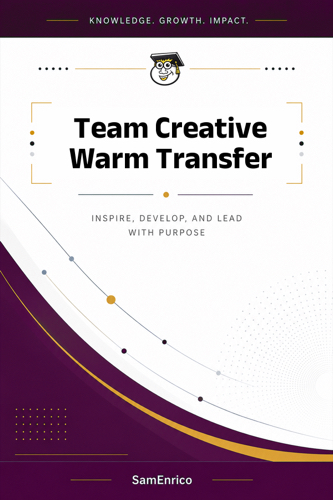
Team Creative Warm Transfer eBook
Hands off creative projects at optimal points for
by Cheek Alaina
Hands off creative projects at optimal points for continuity.
Formats
Free sample
Chapter 1: The Corpse in the Inbox--The email arrived at 11:47 PM on a Tuesday. Forty-seven attachments. No body text. The subject line read: “Final final v3 - FOR REAL THIS TIME.”The creative director who sent it had been working on the campaign for eleven weeks. She had missed three deadlines, alienated two junior designers, and canceled a vacation.
She was proud of the work. She should have been. The concept was brilliant—a Super Bowl spot that wove nostalgia with humor in a way no one had attempted. The agency had bet its quarterly bonus on it.She attached the files, closed her laptop, and went to sleep believing she had just delivered a masterpiece.The person on the receiving end opened that email the next morning. She was a senior art director at the production house responsible for animating the spot.
She had been waiting for this handoff for two weeks. The deadline was already compressed. She scrolled through the attachments—Photoshop files, Illustrator vectors, a thirty-page style guide, three conflicting mood boards, a spreadsheet of hex codes that contradicted the PDFs, and a folder labeled “Old Versions - Ignore” that contained fifteen subfolders.She closed the email. She walked to the kitchen. She poured a cup of coffee and stared at the wall for six minutes.
Then she opened the first file and began the slow, agonizing process of reverse-engineering what the original creator had intended.The spot launched six weeks late. It cost $200,000 more than budgeted. The client was unhappy. The creative director blamed the production house. The production house blamed the creative director.
And the animator? She updated her portfolio and accepted a job at a competitor three weeks later.No one at the agency ever talked about what happened. But everyone knew. The handoff had failed. The project had died not because the idea was bad, not because the budget was too small, not because the timeline was unrealistic.
It died because one person could not let go at the right moment, and another person inherited a corpse instead of a living thing.This chapter is about that moment. About what kills creative work in the space between people. And about the single most counterintuitive truth in creative collaboration: the best time to hand off a project is when you are most afraid to.The Anatomy of a Cold Stop Let us name the villain before we learn to defeat it.A Cold Stop is what happens when creative momentum dies during a handoff. It is not a single event but a cascade of failures: the outgoing person dumps files without context, the incoming person inherits work without understanding, assumptions go unstated, questions go unasked, and the project enters a kind of creative purgatory where everyone is working but nothing is advancing.Cold Stops have a recognizable signature. The project misses its next deadline.
The work that comes back looks nothing like what was intended. Rework balloons. Blame cycles begin. People start saying things like “I thought you were handling that” and “No one told me” and “This isn’t what I asked for.”But here is what most people misunderstand about Cold Stops. They are not caused by bad documentation.
They are not caused by lazy teammates. They are not caused by tight deadlines or thin budgets.Cold Stops are caused by untimely departure.You can have perfect documentation. You can have the most diligent, thoughtful, generous team in the world. But if you let go of a project at the wrong moment—too early, when nothing is decided, or too late, when everything is locked—the handoff will fail. Not because anyone did anything wrong.
Because the timing was wrong.This is the central argument of this book: Creative continuity is not a function of documentation quality. It is a function of transfer timing.The Case of the Feature Rebuilt Three Times Consider a second case study, this one from software development.A product manager named Priya led the design of a new onboarding flow for a fintech app with two million users. She was meticulous. She wrote user stories, conducted twelve interviews, built a prototype, tested it with fifty users, and documented every decision in a Confluence wiki that ran to forty-three pages.When she went on maternity leave, she handed off the project to a senior designer named Marcus. She sent him the wiki link, a folder of Figma files, and a Loom video walking through her thinking.
She believed she had done everything right.Marcus opened the wiki. He read the first five pages. He skimmed the next ten. He closed the browser tab and never returned to it. Not because he was lazy, but because the document was overwhelming.
Every decision had been preserved. Every alternate path was documented. Every user quote was included. The completeness of the documentation was precisely what made it unusable. Marcus could not tell which decisions were foundational and which were provisional.
He could not tell which user quotes had driven the final design and which had been discarded. He was drowning in information but starving for insight.He built what he thought Priya wanted. When she returned from leave, she looked at his work and felt a sensation she would later describe as “grief.” The design was not wrong, exactly. It was just not hers. The logic was different.
The priorities had shifted. The warmth of the original had been replaced by something competent but cold.They spent six weeks rebuilding it together. Then a new engineer joined the team, and the handoff happened again. And again, the work was rebuilt.Three times. Same feature.
Same documentation. Same outcome.The problem was not Priya’s thoroughness. The problem was that she had handed off at the wrong moment—after the design was fully baked, when there was no room for Marcus to make it his own. She had handed off a corpse.Defining the Warm Transfer If a Cold Stop is a corpse, a Warm Transfer is a living thing.A Warm Transfer is not defined by documentation. It is defined by state.
Specifically, the state of the incoming creative at the moment of handoff. In a Warm Transfer, the incoming person has:Momentum – They are not starting from zero. The project has forward energy, and they can feel it.Context – They understand not just what was decided, but why. They know which decisions are flexible and which are fixed.Emotional investment – They care about the outcome. They feel ownership before they have written a single line of code or moved a single pixel.Notice what is not on that list.
Perfect documentation is not required. Exhaustive specifications are not required. What is required is a specific psychological state in the person receiving the work.This has profound implications. It means that a handwritten note on a napkin can be a better handoff than a fifty-page PDF—if that napkin creates momentum, context, and emotional investment. It means that a five-minute conversation can be superior to a week of documentation—if that conversation transfers the right state.The Warm Transfer is the central unit of creative continuity.
Every chapter in this book is about how to achieve it, scale it, and protect it.The Paradox of the Messy…
This is the end of the free sample. Get the eBook to keep going. Buy now
About this book
Details
- Author
- Cheek Alaina
- Publisher
- SamEnrico
- Language
- English
- Genre
- Non-Fiction, Self-Help, Knowledge Transfer
- Released
- 2026-06-07
- Pages (approx.)
- 124
- Available as
- eBook, Audiobook

Read better in the ZLOADR app
Your eBooks on your phone or tablet. Sign in with your SamEnrico account and start reading.
More by Cheek Alaina
 TM for CEOsCheek Alaina$11.99
 Google Trends Validation GuideCheek Alaina$11.99
 Startup Employee Stress GuideCheek Alaina$11.99
 Fasting Side Effects GuideCheek Alaina$11.99
 End Zone Celebration of SuccessCheek Alaina$11.99
 Introverted Teen ConfidenceCheek Alaina$11.99
 HGH And NADCheek Alaina$11.99
 The Fur Trade Pioneers: Canada’s Path to DestinyCheek Alaina$11.99
 Silicon Shadows: The Infamous iPhone 4 Antenna ScandalCheek Alaina$11.99
 The Grand Design: How the West Built the Modern WorldCheek Alaina$11.99
 Growing SchizanthusCheek Alaina$11.99
 Coastal and Marine Surveying with DronesCheek Alaina$11.99
You may also like
 Hong Kong Handover 1997Dunn Johnnie$11.99
 Zumba For Postnatal Recovery CourseNeal Christian$11.99
 Zumba for BeginnersLadner Nikia$11.99
 YouTube Comment Mining GuideHumes Pandora$12.99
 Worry Box MeditationCarlin Rudy$11.99
 Workplace Stress MeditationNguyen Lynn$11.99
 Workplace Stress and Sleep RepairHawley Ivory$11.99
 Workplace Perfectionism CureDelaney Jeffry$11.99
 Workplace Injustice Anger GuideWallen Isabelle$11.99
 Work Addiction and Burnout LinkGreenwood Ester$11.99
 Women in Yoga and WellnessBeattie Galina$11.99
 Women in Stand Up ComedyChun Evangeline$11.99