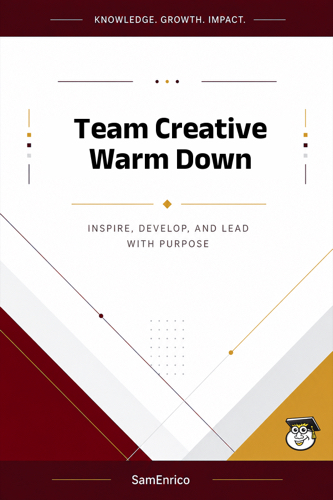
Team Creative Warm Down eBook
Close sessions with reflection on process and appr
by Mojica Zonia
Close sessions with reflection on process and appreciation for contributions.
Formats
Free sample
Chapter 1: The Fruit and the Seeds...--–- Most teams celebrate the fruit and burn the seeds. They throw parties for the launched app, the published campaign, the delivered prototype. They pop champagne when the product goes live. They take team photos with the finished work. And then, within weeks, the same team is fractured, exhausted, and leaking talent.
The manager stands in front of a whiteboard for the next kickoff, staring at unfamiliar faces, wondering where everyone went. The answer is simple: they left because no one harvested the seeds.This is the central paradox of creative work. The very thing that makes creative collaboration exhilarating—the intensity, the shared purpose, the late-night breakthroughs, the collective ownership—also makes it fragile. When a project ends without a deliberate closing ritual, the intensity doesn't dissipate cleanly. It curdles.
The shared purpose becomes a vacuum. The late-night camaraderie becomes a ghost. And the collective ownership becomes a silent ledger of unspoken grievances, unpaid debts of gratitude, and unlearned lessons that will be repeated in the next project, and the next, until the team dissolves.I have seen this pattern repeat across every creative industry I have studied: advertising agencies losing their best art directors three months after a Cannes win; software development teams fragmenting six weeks after a successful product launch; architecture firms watching junior associates burn out after delivering a landmark building; film crews never speaking to each other again after wrapping a hit show. The common denominator is not failure. It is the absence of closure.
These teams succeeded at the work and failed at the transition. They finished. But finishing is not the same as closing.This chapter introduces the foundational problem that the entire book exists to solve: the gap between completing a project and truly closing it. We will explore the psychological mechanism that keeps projects alive in our brains long after they should be done, the distinction between what most teams chase and what they actually lose, and the case study that convinced me that creative teams need a warm-down as much as athletes need a cool-down. By the end of this chapter, you will understand why "just finishing" is actually a form of failure disguised as success—and why the seeds you leave unharvested will poison your next project.The Zeigarnik Effect: Why Your Brain Refuses to Let Go In the 1920s, a young Russian psychologist named Bluma Zeigarnik noticed something peculiar while sitting in a café in Vienna.
The waiters seemed to have an extraordinary memory for unpaid orders—they could recite a table's entire bill from memory without writing anything down. But as soon as the bill was paid, the same waiters could not remember a single item from that same table. Zeigarnik, who was studying at the University of Berlin under the famous Gestalt psychologist Kurt Lewin, turned this observation into a series of experiments that would forever change our understanding of memory and motivation.Zeigarnik asked participants to complete a series of simple tasks—stringing beads, solving puzzles, arithmetic problems. For half the tasks, she allowed participants to finish. For the other half, she interrupted them before completion.
Later, when asked to recall the tasks, participants remembered the interrupted tasks approximately twice as well as the completed ones. The unfinished tasks remained active in memory. The finished tasks were filed away and forgotten.This became known as the Zeigarnik Effect, and it has profound implications for creative teams. When a project ends without a structured closing ritual, your brain treats every unresolved thread as an incomplete task. The client feedback you never fully processed.
The thank-you you never said. The frustration you never voiced. The lesson you learned but never wrote down. The colleague whose contribution went unrecognized. Each of these becomes an "open loop" that your brain holds onto, consuming cognitive energy, generating low-grade anxiety, and bleeding attention away from the next project.I have watched this play out in team after team.
A designer who never received acknowledgment for a critical last-minute fix spends the next three months feeling vaguely resentful, unable to articulate why. A developer whose clever workaround saved a deadline but was never mentioned in the post-launch celebration finds themselves disengaged during the next sprint. A project manager who absorbed an unfair amount of stress to protect the team from client pressure quietly burns out and leaves six months later, and no one can figure out why they seemed so "suddenly" unhappy. These are not mysteries. These are open loops.The Zeigarnik Effect explains why a project that ended three months ago can still cause arguments in a team meeting.
It explains why a successful launch doesn't feel like a release but rather like a strange, hollow emptiness. It explains why teams that skip the warm-down carry the weight of every past project into every future one. Your brain does not distinguish between "the project is done" and "the project is closed." It only knows that unfinished business remains unfinished. And until you explicitly close the loops, they stay open.The Fruit and the Seeds: A Distinction That Changes Everything Here is the distinction at the heart of this book, and I want you to hold it tightly because every chapter that follows will return to it. There is a difference between the fruit of a project and the seeds.
The fruit is what you deliver: the launched app, the published campaign, the finished film, the delivered prototype, the signed-off design. The fruit is tangible. It is measurable. It is what gets celebrated at the launch party. It is what goes into your portfolio.
It is what the client pays for.The seeds are what you grow: the team growth, the process wisdom, the cultural capital, the relational trust, the lessons about what worked and what didn't, the specific knowledge of who excels at what, the undocumented workarounds that saved the project, the tacit understanding of how to work together effectively. The seeds are intangible. They are hard to measure. They never get celebrated. They never go into your portfolio.
But they are the only reason the next project will be better than the last one.Most teams chase the fruit and burn the seeds. They pour all their energy into the deliverable. They celebrate the launch. And then they walk away, leaving the seeds to rot on the ground. The team disbands.
The lessons are never captured. The relationships, stretched to their limit during the intensity of the project, are never repaired or reinforced. The knowledge of what almost broke them—and what saved them—evaporates within weeks.A small number of teams do the opposite. They harvest the seeds. They build deliberate rituals for extracting every lesson, expressing every gratitude, and closing every loop.
They understand that the fruit feeds the client, but the seeds feed the team. And a team that is fed will produce more fruit, faster, with less waste, for years to come. A team that is starved of seeds will eventually stop producing altogether.Consider two identical teams working on two identical projects. Both deliver excellent fruit. Team A celebrates the launch and moves on.
Team A's members feel a brief rush of satisfaction, followed by a vague sense of emptiness, followed by the slow…
This is the end of the free sample. Get the eBook to keep going. Buy now
About this book
Details
- Author
- Mojica Zonia
- Publisher
- SamEnrico
- Language
- English
- Genre
- Non-Fiction, Self-Help, Closure
- Released
- 2026-06-10
- Pages (approx.)
- 127
- Available as
- eBook, Audiobook

Read better in the ZLOADR app
Your eBooks on your phone or tablet. Sign in with your SamEnrico account and start reading.
More by Mojica Zonia
 The Work Byron KatieMojica Zonia$11.99
 Growth Mindset In PovertyMojica Zonia$11.99
 Evening Commute Wind DownMojica Zonia$11.99
 Atacama Desert TrekMojica Zonia$11.99
 Outsourcing for WritersMojica Zonia$11.99
 Mindfulness for Remote WorkersMojica Zonia$11.99
 The Phoenix and the Moonflower: A Love Written in Fire and PetalsMojica Zonia$11.99
 The Medici of the East: How a Japanese Industrialist Built the World’s Greatest Art CollectionMojica Zonia$11.99
 The Essential Guide to Christmas: JazzMojica Zonia$11.99
 Soybeans: Combine Settings & Shatter ReductionMojica Zonia$11.99
 UK Director Credit Separation HandbookMojica Zonia$12.99
 Marketing Channel Selection MatrixMojica Zonia$12.99