
Non-FictionSelf-HelpFailure Culture
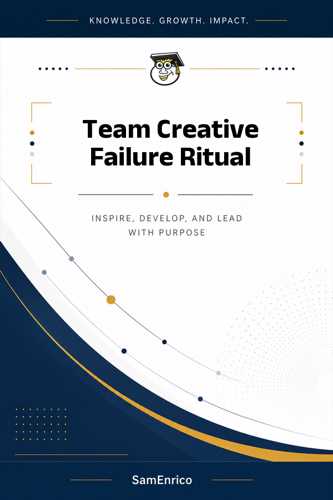
Team Creative Failure Ritual eBook
Normalizes and learns from failed creative attempt
by Rios Sergio
Normalizes and learns from failed creative attempts together.
Formats
Free sample
Chapter 1: The Perfection Paradox--The meeting had been going well. Too well, actually.Maya, the creative director of a forty-person branding agency, had just presented the team’s latest campaign concept to the executive committee. The slides were beautiful. The mockups were polished. The room nodded in all the right places.
But when the CEO asked a simple question—“What could go wrong here?”—the temperature dropped. No one answered. A junior designer shifted in her chair. The senior copywriter studied his shoes. And Maya, who had built her career on bold ideas, found herself saying something she immediately regretted: “We’ve stress-tested everything.
It’s solid.”She hadn’t stress-tested everything. She had, in fact, ignored three red flags raised by that same junior designer two weeks earlier, because surfacing those risks would have slowed down the launch. And slowing down meant missing the quarterly revenue target. And missing the target meant disappointing the board. And disappointing the board meant…The loop stopped there, because the loop was fear.Four months later, the campaign launched.
It flopped. Not a small flop—a spectacular, expensive, client-firing, agency-blamed, Maya-considering-her-career-choices flop. The post-mortem lasted six hours. Six hours of parsing blame, reconstructing timelines, and listening to consultants use the phrase “learnings” without ever actually learning anything. No one mentioned the junior designer’s warnings.
No one asked why those concerns had been buried. And Maya, who had once been celebrated as a rising star, was quietly removed from leadership meetings.The tragedy was not the failure. The tragedy was that the failure taught them nothing.The Silent Killer You Never See Coming This book is about a problem that every creative team faces but almost no one names: success-induced paralysis. It is the silent killer of innovation, and it lives in the very organizations that pride themselves on being bold.Here is the paradox, and it is worth reading twice: The more successful a team becomes, the more terrified it grows of the very thing that made it successful in the first place—taking creative risks.Consider the evidence. A team that has just won an industry award does not become more experimental afterward.
It becomes more cautious. A department that just hit its quarterly numbers does not double down on moonshots. It doubles down on what already worked. A leader who has never been publicly wrong does not suddenly become vulnerable. They become more careful, more controlling, and more silent about their doubts.This is not a character flaw.
It is neurology.The Amygdala’s Hostile Takeover Deep inside your brain, tucked behind your ears and roughly the size and shape of an almond, lives a structure called the amygdala. Its job is survival. It does not care about your career, your creative aspirations, or your team’s quarterly goals. It cares about one thing: keeping you alive long enough to reproduce.The amygdala is exquisitely sensitive to threat. Not just physical threat—social threat.
And for the human animal, which survived for hundreds of thousands of years by staying in good standing with the tribe, social threat feels like physical threat.When you anticipate public blame—being called out in a meeting, mocked in a Slack channel, or silently judged by colleagues—your amygdala treats that anticipation the same way it would treat a predator lunging from the bushes. It initiates a cascade of stress hormones. Cortisol spikes. Adrenaline floods your system. Your heart rate increases.
And crucially, your prefrontal cortex—the part of your brain responsible for creative thinking, long-term planning, and nuanced problem-solving—begins to shut down.This is not metaphor. This is measurable physiology.Functional MRI studies have shown that social pain (being excluded, blamed, or criticized in front of peers) activates the same neural regions as physical pain. Your brain literally cannot distinguish between a broken arm and a public shaming. And when that pain is anticipated, your brain’s threat-detection system hijacks your creative faculties before you have even opened your mouth.The result is what organizational psychologist Amy Edmondson calls “psychological safety”—or rather, the lack of it. Teams that lack psychological safety do not lack talent, intelligence, or motivation.
They lack the one condition that makes creativity possible: the ability to take a risk without fearing that the cost of failure will be your reputation, your relationships, or your role.The Aviation Paradox: Why Pilots Learn and Doctors Don’t To understand what is possible, we have to look at an industry that has mastered the art of learning from failure: commercial aviation.In 1978, United Airlines Flight 173 was approaching Portland, Oregon, when the crew noticed a problem with the landing gear. The indicator light showed that the gear had not locked into place. The pilot, Malburn Mc Broom, did what any reasonable person would do: he delayed landing to troubleshoot. He circled the airport. He had the crew run checklists.
He radioed maintenance. And he circled some more.Fifty-six minutes later, the plane ran out of fuel and crashed into a suburban neighborhood. Ten people died.The investigation revealed something shocking: the landing gear problem was minor. The plane could have landed safely at any time. But the crew had become so focused on troubleshooting that they forgot to monitor their fuel levels.
They had failed at the most basic task of aviation: flying the plane.Here is what happened next. The National Transportation Safety Board did not fire the surviving crew members. They did not blame the pilot for his “error.” They did not write a report that sat on a shelf. Instead, they used the accident to redesign cockpit protocols across the entire industry. They mandated “Crew Resource Management” training—a systematic approach to team communication and decision-making.
They created checklists for fuel monitoring. They changed the culture.And here is the result: in the decades since, commercial aviation has become so safe that you are more likely to be struck by lightning on your way to the airport than to die in a crash. When a failure happens in aviation—even a near-miss—it is reported, analyzed, and shared across the industry within weeks. Pilots are not punished for reporting errors. They are expected to report them.
The question is never “Who caused this?” but “What can we learn?”Now contrast that with another high-stakes, complex industry: healthcare.A 2016 study published in the BMJ estimated that medical error is the third-leading cause of death in the United States, responsible for more than 250,000 deaths annually. That is the equivalent of two fully loaded jumbo jets crashing every single day. Every. Single. Day.Why does healthcare not learn from failure the way aviation does?
The reasons are many, but one stands out: shame and litigation risk. When a nurse makes a medication error, they do not report it to a central database. They hide it, because reporting could mean losing their license. When a surgeon has a complication, they do not discuss it openly in a team meeting. They bury it, because complication rates are public and affect hospital rankings.
When a resident notices a dangerous pattern, they do not speak up. They stay silent, because speaking up means challenging authority.The result is…
This is the end of the free sample. Get the eBook to keep going. Buy now
About this book
Details
- Author
- Rios Sergio
- Publisher
- SamEnrico
- Language
- English
- Genre
- Non-Fiction, Self-Help, Failure Culture
- Released
- 2026-06-08
- Pages (approx.)
- 127
- Available as
- eBook, Audiobook

Read better in the ZLOADR app
Your eBooks on your phone or tablet. Sign in with your SamEnrico account and start reading.
More by Rios Sergio
 Rewiring Limiting Beliefs CourseRios Sergio$11.99
 Intermittent Fasting for Weight LossRios Sergio$11.99
 Writing Thesis Without BurnoutRios Sergio$11.99
 HGH Puberty Growth SpurtRios Sergio$11.99
 TM for EngineersRios Sergio$11.99
 Rookie Season Survival GuideRios Sergio$11.99
 Romanian Green Tax HandbookRios Sergio$11.99
 HGH And Vitamin DRios Sergio$11.99
 The Golden Horde’s Blood Price: Timur’s Conquest of Delhi and the Cost of EmpireRios Sergio$11.99
 Chalk & Fire: The Unsung Rebellion of the 1992 Los Angeles UprisingRios Sergio$11.99
 The Last Beacon of Ionia: A Siren’s Lament in the Age of DustRios Sergio$11.99
 Pop Up Email List BuildingRios Sergio$12.99
You may also like
 Hong Kong Handover 1997Dunn Johnnie$11.99
 Zumba For Postnatal Recovery CourseNeal Christian$11.99
 Zumba for BeginnersLadner Nikia$11.99
 YouTube Comment Mining GuideHumes Pandora$12.99
 Worry Box MeditationCarlin Rudy$11.99
 Workplace Stress MeditationNguyen Lynn$11.99
 Workplace Stress and Sleep RepairHawley Ivory$11.99
 Workplace Perfectionism CureDelaney Jeffry$11.99
 Workplace Injustice Anger GuideWallen Isabelle$11.99
 Work Addiction and Burnout LinkGreenwood Ester$11.99
 Women in Yoga and WellnessBeattie Galina$11.99
 Women in Stand Up ComedyChun Evangeline$11.99