
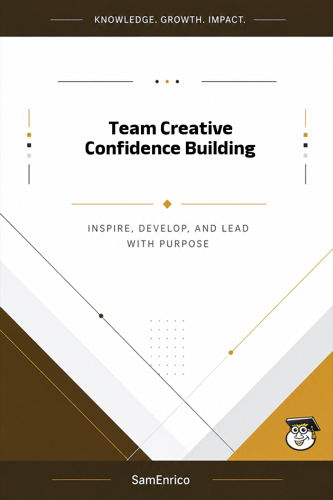
Non-FictionSelf-HelpCreative Confidence
Team Creative Confidence Building eBook
Overcome fear of judgment to unlock group creativi
Overcome fear of judgment to unlock group creativity using this practical guide.
Formats
Free sample
Chapter 1: The $8 Billion Silence--–- On October 28, 1999, seventeen people sat around a conference table at the Jet Propulsion Laboratory in Pasadena, California. They had flown in from across the country—engineers from Lockheed Martin, navigation specialists from NASA, project managers from both organizations. The room was windowless, climate-controlled, and smelled faintly of burned coffee and anxious sweat.What they were about to discuss would determine the fate of a $125 million spacecraft that had been traveling through the solar system for nearly ten months.The Mars Climate Orbiter was twenty-four hours away from entering orbit around the Red Planet. For 286 days, it had performed flawlessly, executing trajectory corrections with the precision of a Swiss watch. But in the past seventy-two hours, something had gone terribly wrong.
Telemetry data showed the spacecraft was drifting—not much, just a few kilometers here and there—but enough to concern the navigation team.A young engineer named John had run the numbers three times. Each time, he arrived at the same conclusion: the Orbiter was going to enter the Martian atmosphere at an altitude of approximately fifty-seven kilometers. The safe range was between eighty and one hundred kilometers. At fifty-seven kilometers, the spacecraft would burn up like a meteor.John had the data. Eleven other people in that room also had the data, or access to it.
They had seen the same numbers, run the same models, arrived at the same terrifying conclusion.Six of them said nothing.The one person who did speak—a mid-level navigation specialist named Sam—was told, in so many words, to sit down and stop being difficult. The meeting moved on. The Orbiter entered the Martian atmosphere the next day at precisely fifty-seven kilometers. It disintegrated on contact. The $125 million spacecraft became a cloud of debris scattered across the Martian surface, visible only to the satellites that would never get the chance to photograph it.The investigation that followed uncovered something far more disturbing than a simple engineering error.
It turned out the problem had been known for months. A fundamental mismatch in measurement units—metric versus imperial—had been flagged in internal documents, discussed in meetings, and even mentioned in emails. But no one had escalated it. No one had stood up in a crowded room and said, "Stop. This is wrong.
We need to fix this now."The report used careful, bureaucratic language: "failure to share critical information," "insufficient assertiveness," "cultural factors that discouraged individuals from speaking up." But the people who lived through it used different words. They said the team had been too polite. Too hierarchical. Too afraid of looking stupid in front of their peers.Seventeen brilliant people. One obvious problem.
Sixteen people who knew the truth. One person who tried to speak.And a $125 million silence.The Paradox You Live Every Day You have never lost $125 million in a single afternoon. But you have sat in meetings where someone proposed an obviously flawed idea, and you said nothing. You have watched a project drift toward failure, knowing exactly what was wrong, and stayed quiet. You have left a conference room thinking, Why didn't anyone say what we were all thinking?
And then you realized: I didn't say it either.This is the central paradox of team creativity. Individually, you have ideas. Privately, you recognize problems. Alone, you generate solutions that could save time, money, reputation, and maybe even spacecraft.But when you gather with other people—smart, well-intentioned, experienced people—those ideas vanish. They retreat behind a wall of politeness, hierarchy, and fear.
The group that should be smarter than any individual becomes dumber than the dumbest person in the room.This book is about why that happens and what to do about it. But before we get to solutions, we need to sit with the problem. Because until you truly understand how fear silences your smartest people, you will keep implementing "innovation programs" that fail, holding "brainstorming sessions" that produce nothing new, and wondering why your team's collective intelligence is so much lower than the sum of its parts.The answer is not that your people lack creativity. The answer is that your environment has trained them to hide it.The Biology of Silence Let us start with a disturbing fact about your brain.When you anticipate being judged by your peers—laughed at, dismissed, interrupted, or simply ignored—the same neural circuits activate as when you anticipate physical pain. The anterior cingulate cortex, the insula, the dorsal anterior cingulate—these are the regions that light up when you stub your toe or burn your hand on a hot stove.They also light up when you raise your hand in a meeting and no one acknowledges you.This is not a metaphor.
This is neuroscience. Social rejection triggers the same physiological response as physical injury. Your brain literally cannot tell the difference between being punched and being publicly shot down.Here is what that means for your team. Every time you ask someone to share a half-formed idea, challenge a senior leader's assumption, or propose a direction different from the group's consensus, you are asking them to voluntarily experience something their brain treats as physical pain. And they have spent their entire lives learning to avoid pain.The result is a phenomenon called social threat response.
When a team member perceives a threat to their social standing—their reputation, their relationships, their sense of competence—their body prepares for battle. Cortisol rises. Heart rate increases. The prefrontal cortex, responsible for creativity and complex problem-solving, essentially goes offline. Blood flow redirects to survival regions of the brain.In other words, the moment someone feels judged, they become literally less intelligent.This explains a pattern you have probably witnessed a hundred times.
A quiet person in a meeting finally speaks up with an idea that is, admittedly, a little rough around the edges. Someone—usually a senior person, often without thinking—says, "That won't work because..." The quiet person withdraws. They do not speak again for the rest of the meeting. And the next meeting, they do not speak at all.From the outside, it looks like the quiet person lacks confidence or ideas. From the inside, it feels like survival.
Their brain made a calculation: Speak again, experience pain again. Stay silent, stay safe.This is not weakness. This is biology. And it is happening in your team every single day.The Quiet Team vs. The Safe Team One of the most dangerous misconceptions in modern work culture is the belief that a quiet team is a happy team.
Managers pride themselves on running "low-drama" meetings where everyone gets along, no one disagrees, and decisions happen quickly.This is not a healthy team. This is a quiet team—and quiet teams are almost never creative.Let us distinguish between two very different states:Quiet Team Safe Team Conflict level Low Moderate Politeness High Low Candor Low High Idea generation Low High What members feel Anxious, bored, disengaged Challenged, respected, energized What members say"I agree with whatever.""I disagree, and here's why."Outcome Incremental thinking Breakthrough ideas A quiet team is not a team that has nothing to say. A quiet team is a team that has learned that speaking…
This is the end of the free sample. Get the eBook to keep going. Buy now
About this book
Details
- Author
- Ayers Breanna
- Publisher
- SamEnrico
- Language
- English
- Genre
- Non-Fiction, Self-Help, Creative Confidence
- Released
- 2026-06-07
- Pages (approx.)
- 152
- Available as
- eBook, Audiobook

Read better in the ZLOADR app
Your eBooks on your phone or tablet. Sign in with your SamEnrico account and start reading.
More by Ayers Breanna
 SAS Iranian Embassy SiegeAyers Breanna$11.99
 Menopause Anger TriggersAyers Breanna$11.99
 Caffeine and Academic Stress HandbookAyers Breanna$11.99
 The Workaholic's Nutrition FixAyers Breanna$11.99
 Hanuman’s Leap: The Monkey God’s Divine MentorshipAyers Breanna$11.99
 The Black Blizzard: Oklahoma’s Forgotten Dust Bowl ExodusAyers Breanna$11.99
 Understanding Fucosidosis Type 1Ayers Breanna$17.99
 How to Become a Music GrapherAyers Breanna$11.99
 USSD Based Customer GuideAyers Breanna$12.99
 Peak Booking Hours GuideAyers Breanna$12.99
 Baseball Diamond Dragging/chalkingAyers Breanna$11.99
You may also like
 Hong Kong Handover 1997Dunn Johnnie$11.99
 Zumba For Postnatal Recovery CourseNeal Christian$11.99
 Zumba for BeginnersLadner Nikia$11.99
 YouTube Comment Mining GuideHumes Pandora$12.99
 Worry Box MeditationCarlin Rudy$11.99
 Workplace Stress MeditationNguyen Lynn$11.99
 Workplace Stress and Sleep RepairHawley Ivory$11.99
 Workplace Perfectionism CureDelaney Jeffry$11.99
 Workplace Injustice Anger GuideWallen Isabelle$11.99
 Work Addiction and Burnout LinkGreenwood Ester$11.99
 Women in Yoga and WellnessBeattie Galina$11.99
 Women in Stand Up ComedyChun Evangeline$11.99