
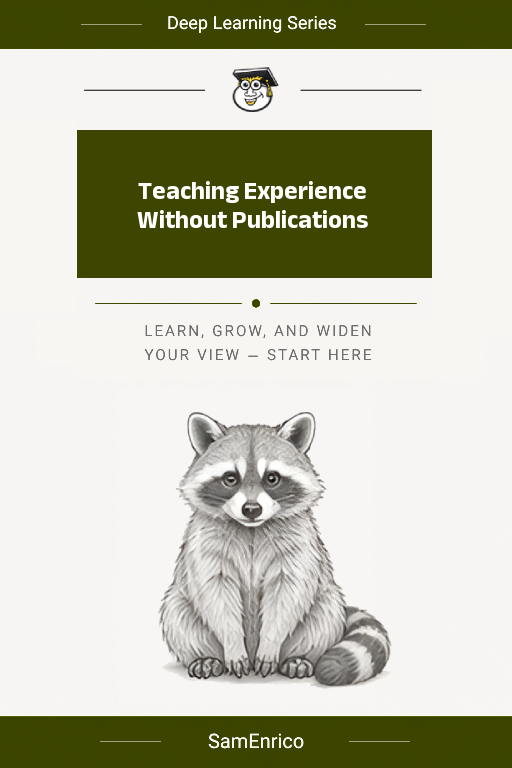
Teaching Experience Without Publications eBook
Present course development and lecturing as eviden
Present course development and lecturing as evidence of subject mastery and communication skills.
Formats
Free sample
Chapter 1: The Plateau Paradox...–- Maria had taught Introduction to Biology forty-seven times. Forty-seven times over twelve years as an adjunct. She knew the textbook by page number. She could recite the stages of mitosis in her sleep. Her student evaluations were consistently above departmental averages.
And yet, when a tenure-track position opened at her own institution—where she had covered courses during three maternity leaves, two sabbaticals, and one unexpected medical leave—she was not even granted an interview. The candidate they hired had three years of teaching experience (less than one-tenth of Maria’s) but nine publications, four of them in mid-tier journals. The search committee chair, a decent man who clearly felt uncomfortable, took her aside after the rejection letter arrived. “Maria,” he said, keeping his voice low in the hallway, “we know you’re a better teacher than the person we hired. Everyone knows that.
But we couldn’t prove it. Your CV looked like you’d been doing the same thing for twelve years. His CV looked like a scholar in training.” Maria walked back to her windowless office—the one she shared with three other adjuncts—sat down, and for the first time in her career, wondered if the last twelve years had been a waste.This book is for Maria. It is for the postdoc who has taught nineteen courses as instructor of record but cannot get a single campus interview. It is for the graduate student who has won three teaching awards but whose CV is returned with the same feedback: “We need to see more evidence of scholarly productivity.” It is for the adjunct, the lecturer, the visiting assistant professor, and the contingent faculty member who knows—knows in their bones—that they have mastered their subject and can communicate it to anyone, but who has been told, implicitly or explicitly, that teaching does not count.The problem is not Maria.
The problem is not you. The problem is a measurement system that confuses years of sitting in a classroom with evidence of expertise. That system assumes that a publication list—which measures your ability to survive peer review—is the only legitimate proof that you know your subject. And it assumes that teaching—which measures your ability to change how other people think—is merely the transmission of other people’s research. Both assumptions are wrong.
Both assumptions are destroying academic careers. And both assumptions can be dismantled, systematically and strategically, using the tools in this book.Before we build those tools, however, we must confront a harder truth. It is a truth that Maria did not want to hear in that hallway, and that you may not want to hear now. But hearing it is the difference between another twelve years of plateau and a fundamental shift in how you present yourself to the world.Here it is: Experience is not expertise.Those forty-seven iterations of Introduction to Biology? They were not forty-seven opportunities for growth.
For Maria, they were forty-seven repetitions of the same performance, with minor tweaks around the edges. She used the same textbook for eleven years. She updated her slides only when the publisher released a new edition. She gave the same midterm, year after year, changing a few questions but never fundamentally rethinking what the exam was supposed to measure. She was not a bad teacher.
She was, by all accounts, a good one—clear, organized, fair, kind. But she had stopped growing in year three. Years four through twelve were not twelve years of learning. They were the same year, repeated ten times.This is the Plateau Paradox. It is the central insight from decades of research on expertise and deliberate practice, most famously studied by psychologist Anders Ericsson (whose work on “deliberate practice” was popularized in Malcolm Gladwell’s Outliers).
Ericsson and his colleagues found that in field after field—violin performance, chess, surgery, competitive swimming, and yes, teaching—the relationship between years of experience and actual performance is surprisingly weak. After an initial period of rapid improvement (typically two to three years), most professionals plateau. They stop getting better. They simply get more comfortable with their current level of mediocrity.Why? Because routine experience does not produce expertise.
Deliberate practice produces expertise. And deliberate practice is something most teachers never do.Let us define these terms with precision, because they will appear throughout this book.Routine experience is what happens when you show up, do your job, and leave. You teach the class. You answer emails. You grade the papers.
You repeat the same explanations, use the same examples, and rely on the same jokes. You are not trying to get better in any measurable way. You are simply doing. Routine experience feels like work, and it is exhausting, but it is not growth. It is maintenance.
Most teachers with ten years of experience have, in reality, one year of experience repeated ten times.Deliberate practice is something else entirely. Deliberate practice is structured, intentional, and uncomfortable. It requires you to identify a specific aspect of your performance that needs improvement. It requires you to design an activity that targets that aspect. It requires you to seek feedback on that activity, ideally from someone with expertise.
And it requires you to reflect on the results and adjust. Deliberate practice is not fun. It is not what you do after a long day of teaching. It is what you do when you have decided that being “good enough” is not good enough.Here is the difference in concrete terms. A teacher engaged in routine experience finishes a lecture on cellular respiration and thinks: “That went fine.
Students seemed engaged. Next topic.” A teacher engaged in deliberate practice finishes the same lecture and thinks: “I noticed that seven students in the third row looked confused when I explained the electron transport chain. I am going to watch the recording of that segment. I will count how many times I used the word ‘complex’ without defining it. Tomorrow, I will test two different analogies (one about a water wheel, one about a relay race) and see which one produces better performance on a three-question exit poll.”Do you see the difference?
The first teacher is accumulating hours. The second teacher is building evidence of expertise. And that evidence—not the hours—is what search committees are actually looking for, whether they know it or not.The Expert Teacher Framework Over the past thirty years, educational researchers have identified the specific competencies that separate expert teachers from experienced-but-plateaued teachers. Drawing on the work of John Hattie (visible learning), Lee Shulman (pedagogical content knowledge), and Charlotte Danielson (framework for teaching), I have distilled these competencies into four core elements. These elements form the Expert Teacher Framework, and they will structure everything in this book.Element 1: Deep content knowledge.
This is the obvious one. Expert teachers know their subject. They know it not just as a list of facts, but as a interconnected web of concepts, principles, and debates. They can move from a specific example to a general principle and back again. They know the history of their discipline’s key ideas.
They know what is settled and what is contested. Without deep content knowledge, you cannot teach well. But—and this is…
This is the end of the free sample. Get the eBook to keep going. Buy now
About this book
Details
- Author
- Mosher Fidelia
- Publisher
- SamEnrico
- Language
- English
- Genre
- Non-Fiction, Student's Shortcut
- Released
- 2026-05-30
- Pages (approx.)
- 150
- Available as
- eBook, Audiobook

Read better in the ZLOADR app
Your eBooks on your phone or tablet. Sign in with your SamEnrico account and start reading.
More by Mosher Fidelia
 Minimum Viable Product TestingMosher Fidelia$11.99
 Legal Professional Stress GuideMosher Fidelia$11.99
 Intermittent Fasting Success StoriesMosher Fidelia$11.99
 The Bully Proof TeenMosher Fidelia$11.99
 Mitch McConnell GridlockMosher Fidelia$11.99
 Collaborative Observation MethodMosher Fidelia$11.99
 TM for TradersMosher Fidelia$11.99
 Nicotine Replacement Adherence PlanMosher Fidelia$11.99
 HGH And BodybuildingMosher Fidelia$11.99
 The Silk Road in the Sky: The Forgotten Flight of the Kashgari AviatorsMosher Fidelia$11.99
 The Manchurian Candidate: The Untold CIA ExperimentsMosher Fidelia$11.99
 Orpheus and the Lyre That Moved the GodsMosher Fidelia$11.99
You may also like
 LSE Online Program LengthAgee Letisha$11.99
 Harvard Extension School for Working AdultsRoush Yer$11.99
 LSE Online Reading ListAshford Ludivina$11.99
 LSE Online Language RequirementsWhitten Daphine$11.99
 LSE Online Class SizeHughey Garret$11.99
 LSE Online Alumni MentorshipWild Lyla$11.99
 London School of Economics Alumni NetworkDutton Chantal$11.99
 Harvard Extension School Student SupportCantrell Christene$11.99
 Harvard Extension School Library AccessSantana Adah$11.99
 Harvard Extension School Degree CompletionBray Wyatt$11.99
 Harvard Extension School Course AuditingAbbott Craig$11.99
 Harvard Extension School Extension DiplomaNew Joane$11.99