
Non-FictionStudent's ShortcutTeaching
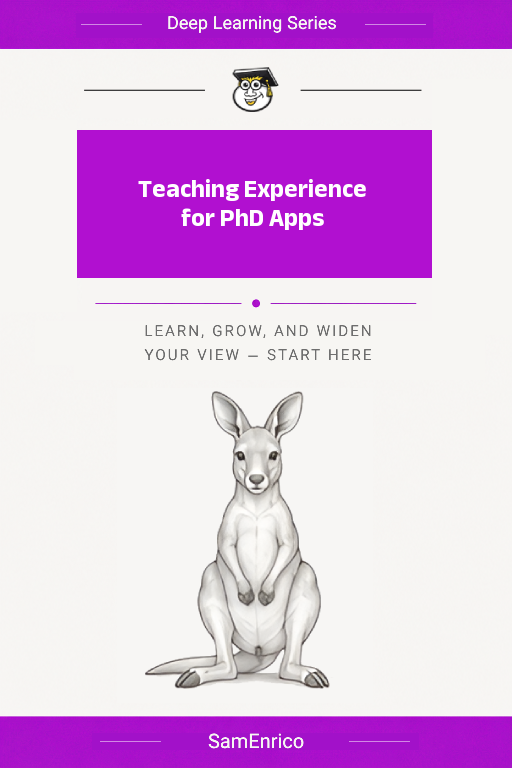
Teaching Experience for PhD Apps eBook
Leverage TA roles, tutoring, or workshop leading t
Leverage TA roles, tutoring, or workshop leading to show communication and mentoring skills.
Formats
Free sample
Chapter 1: The Soft-Skills Trap--–- You have been lied to. Not maliciously, but systematically. Your undergraduate advisor told you to focus on grades. Your research mentor told you that publications open doors. Your peers told you that the Ph D application is a beauty contest for the most impressive CV.
They were all wrong in the same way: they mistook visibility for value.The truth is this: every year, hundreds of applicants with perfect GPAs, glowing letters, and multiple co-authored papers receive rejection letters. Meanwhile, applicants with decent but unspectacular records—people who spent their undergraduate years leading discussion sections, tutoring struggling students, or running writing workshops—get accepted, funded, and fast-tracked.This is not an accident. This is the Soft-Skills Trap.Admissions committees are not looking for the smartest person in the room. They are looking for the person they want to spend five to seven years working with. They are looking for someone who can explain complex ideas without condescension, who can manage conflict without burning bridges, who can give feedback that motivates rather than crushes.
In short, they are looking for someone who can teach.This chapter dismantles the myth that teaching experience is a "lesser" activity compared to research. It introduces the concept of pedagogical storytelling—the art of reframing every tutoring session, every TA recitation, every workshop you have ever led as evidence of leadership, mentorship, and communication. You will learn to identify the teaching culture of your target Ph D programs using the Program Matching Matrix, a unified framework that eliminates the confusion of conflicting advice. You will complete a skill translation table that converts mundane classroom tasks into admissions committee language. And you will confront Imposter Syndrome not by pretending it doesn't exist, but by building a confidence scaffold that bridges the gap between self-doubt and authoritative action.By the end of this chapter, you will never look at a TA position the same way again.
You will see it not as a distraction from your research, but as the single best predictor of your success as a future colleague.The Myth of Research Supremacy Let us begin with a story.In 2019, a Ph D applicant named Elena submitted her materials to six top-tier programs in political science. Her profile was immaculate: a 3.9 GPA, two years of undergraduate research, a co-authored paper in an undergraduate journal, and a summer fellowship at a prestigious institute. Her letters of recommendation were effusive. Her statement of purpose was polished by three professors.She was rejected from all six programs.A year later, she reapplied. The only substantive change to her application was that she had added a section detailing her experience as a peer tutor in quantitative methods.
She had tutored only eight students over two semesters. She had not published anything new. Her GPA had not changed. She was accepted to four of the six programs, two with full funding.What happened? Did admissions committees suddenly decide that eight tutoring sessions outweighed two years of research?
No. What changed was that Elena learned how to frame her tutoring as evidence of something committees actually care about: the ability to transfer knowledge, to diagnose misunderstanding, to persist through confusion.Elena's first application screamed, "I am smart." Her second application whispered, "I can help you be smart too." The committee chose the whisper.This is the myth of research supremacy: the belief that the quantity and prestige of your research output determines your admissions fate. It is a myth propagated by professors who succeeded under an old system, by peers who are equally confused, and by a culture that fetishizes publication counts. But admissions committees are not hiring a research machine. They are admitting a future colleague—someone who will teach undergraduates, mentor junior students, collaborate on grants, and eventually advise dissertations of their own.The evidence is striking.
A 2020 survey of Ph D admissions committee chairs across fifty universities asked a simple question: "Which factor most often distinguishes between similarly qualified applicants?" The top answer, cited by sixty-three percent of respondents, was not GPA, not GRE scores, not publication record. It was "evidence of effective communication and mentoring skills."Think about that. Sixty-three percent of the people who decide your fate are actively looking for teaching experience. They just do not expect you to know that. They expect you to show up with a list of publications and a plea.
The applicant who brings a teaching portfolio instead wins by default.Pedagogical Storytelling: The Art of Reframing If teaching experience is so valuable, why do most applicants hide it? Because they have never learned to tell the right story about it.Consider two ways of describing the same experience:Version A (the typical CV bullet): "Held office hours for Introduction to Psychology. Graded exams and assignments. Recorded attendance."Version B (pedagogical storytelling): "Provided individualized mentoring to fifteen students per week, identifying patterns of misunderstanding and developing targeted explanations that improved exam performance by an average of one letter grade."Both describe the same job. One sounds like clerical work.
The other sounds like leadership.Pedagogical storytelling is the discipline of translating teaching tasks into the language of mentorship, communication, and problem-solving. It is not lying. It is not exaggeration. It is simply recognizing that the skills you developed in front of a classroom are exactly the skills committees are desperate to find.Let us break down the translation. Every teaching task has a hidden competency:Teaching Task Hidden Competency Admissions Language Grading papers Pattern recognition, consistency, fairness"Evaluated 45 summative assessments using criterion-referenced rubrics; identified common error patterns and created targeted intervention materials"Leading a discussion section Facilitation, group management, real-time adaptation"Facilitated 90-minute discussion sessions for 25 students, managing diverse participation styles and redirecting off-topic contributions"Tutoring one-on-one Diagnostic questioning, patience, individualized instruction"Conducted diagnostic assessments to identify conceptual bottlenecks; developed personalized learning plans that addressed root causes of misunderstanding"Creating a lesson plan Curriculum design, backward mapping, objective setting"Designed 50-minute active learning session using Bloom's Taxonomy; aligned activities with measurable learning outcomes"Handling a grade dispute Conflict resolution, documentation, emotional regulation"Resolved grade disputes through structured documentation and restorative conversation; maintained positive student relationship post-resolution"Notice what happened.
The tasks did not change. The framing did. And that framing is not marketing spin. It is a more accurate description of what you actually did. Grading is pattern recognition.
Office hours are mentoring. Disputes are conflict resolution. You were not just a TA. You were a leadership laboratory.The Program Matching Matrix: One Framework to Rule Them All Here is where most advice about Ph D applications goes wrong. A well-meaning mentor tells you, "Emphasize your teaching experience!" without asking the crucial question: what kind of teaching experience, for what kind of program?The Program Matching Matrix solves this problem.
It consolidates all the tailoring advice that appears in scattered form throughout most application guides—advice about program culture, experience types, teaching personas, and funding priorities—into a single, usable tool.The matrix has three axes:Axis 1: Program Type R1 Research-Intensive: These programs (e.g., University of Michigan, UCLA, University of Texas) prioritize research output above all. But even here, teaching matters—specifically, teaching that demonstrates you can handle large courses…
This is the end of the free sample. Get the eBook to keep going. Buy now
About this book
Details
- Author
- Odonnell Bertie
- Publisher
- SamEnrico
- Language
- English
- Genre
- Non-Fiction, Student's Shortcut, Teaching
- Released
- 2026-06-01
- Pages (approx.)
- 156
- Available as
- eBook, Audiobook

Read better in the ZLOADR app
Your eBooks on your phone or tablet. Sign in with your SamEnrico account and start reading.
More by Odonnell Bertie
 Fibromyalgia and Vitamin DOdonnell Bertie$11.99
 The Action Over Feeling MethodOdonnell Bertie$11.99
 News Induced AngerOdonnell Bertie$11.99
 The Tibetan Buddhist NunOdonnell Bertie$11.99
 Polyphasic Sleep Nap GuideOdonnell Bertie$11.99
 The Multilingual Speaker GuideOdonnell Bertie$11.99
 Sponsor Relationship GuideOdonnell Bertie$11.99
 Transplant Near Death MasterOdonnell Bertie$11.99
 Holbrooke BosniaOdonnell Bertie$11.99
 The Mind of a Mastermind: Unraveling the Psychology of the BTK KillerOdonnell Bertie$11.99
 The Lioness of Punt: Queen Hatshepsut's Lost ExpeditionOdonnell Bertie$11.99
 The Last Whisper of the Whistling Language: A Vanishing CodeOdonnell Bertie$11.99
You may also like
 Hong Kong Handover 1997Dunn Johnnie$11.99
 Zumba For Postnatal Recovery CourseNeal Christian$11.99
 Zumba for BeginnersLadner Nikia$11.99
 YouTube Comment Mining GuideHumes Pandora$12.99
 Worry Box MeditationCarlin Rudy$11.99
 Workplace Stress MeditationNguyen Lynn$11.99
 Workplace Stress and Sleep RepairHawley Ivory$11.99
 Workplace Perfectionism CureDelaney Jeffry$11.99
 Workplace Injustice Anger GuideWallen Isabelle$11.99
 Work Addiction and Burnout LinkGreenwood Ester$11.99
 Women in Yoga and WellnessBeattie Galina$11.99
 Women in Stand Up ComedyChun Evangeline$11.99