
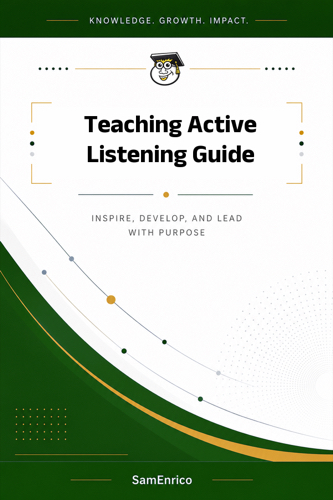
Teaching Active Listening Guide eBook
Hears student questions and struggles effectively.
Hears student questions and struggles effectively.
Formats
Free sample
Chapter 1: The Listening Gap--Ask any seasoned teacher what they wish they had learned in graduate school, and the answer rarely involves lesson planning, assessment design, or classroom technology. Again and again, teachers name the same quiet regret: I wish someone had taught me how to truly listen to what my students were not saying.This is not a confession of failure. It is an acknowledgment of a strange and persistent blind spot in educational training. We train teachers to speak clearly, to question strategically, to explain concepts from multiple angles, and to manage the chaos of thirty simultaneous souls. We train them in everything except the one skill that determines whether all that speaking lands on fertile ground or falls on stone.
We train them to broadcast but not to receive.The result is a profession full of well-intentioned monologists. Teachers who can deliver a flawless explanation of the quadratic formula but cannot hear the quiet terror in a student’s voice when they ask, “Can you show that one more time?” Teachers who can lead a masterful Socratic seminar but cannot detect the difference between a student who is thoughtfully silent and one who has learned that silence is the safest form of self-protection. Teachers who leave every day exhausted, wondering why their carefully crafted lessons did not reach the students who needed them most.The answer, more often than not, sits in a skill we never taught them to develop: the skill of active listening.This book exists to close that gap. But before we can build a new practice, we must understand what listening actually is, why it has been systematically undervalued in education, and how a single shift in your listening posture can transform not only your students’ learning but also your own experience of teaching. This chapter lays the foundation for everything that follows.
It defines active listening as a pedagogical force, distinguishes it from the passive hearing that masquerades as listening in most classrooms, and establishes the empirical case for why this skill belongs at the center of your teaching practice.The Most Underrated Skill in Education Let us begin with a provocative claim: Listening is the most underrated skill in education.Consider the evidence of its neglect. Walk into almost any teacher preparation program and examine the curriculum. You will find courses on classroom management, on literacy instruction, on differentiation, on educational psychology, on assessment design, and on content-specific pedagogy. You will almost never find a course titled “Listening for Learning” or “Diagnostic Listening in the Classroom.” The skill that determines whether a teacher can identify a student’s misconception before it calcifies, whether they can de-escalate a brewing conflict before it erupts, whether they can build the trust that makes intellectual risk-taking possible—this skill is left to chance, to personality, to “soft skills” that are assumed but never explicitly taught.This neglect is not accidental. It flows from a deeper cultural assumption about what teaching is.
The dominant metaphor for teaching in Western education is transmission. Knowledge exists in the teacher’s mind. The teacher’s job is to transmit that knowledge into the student’s mind. The student’s job is to receive it. In this transmission model, the teacher’s primary duty is to speak clearly, and the student’s primary duty is to listen well.
The teacher is the active agent; the student is the passive recipient.But here is the inversion that changes everything: In a classroom designed for genuine learning, the teacher must listen more carefully than the students.Why? Because learning is not the transfer of information but the construction of meaning. Students do not arrive as empty vessels waiting to be filled. They arrive with existing mental models, partial understandings, misconceptions, emotional blocks, and buried questions. A teacher who only transmits cannot know what is happening inside those thirty different minds.
A teacher who listens diagnostically can see the learning process in real time, catch errors at their origin, and adjust instruction before the gap widens beyond repair.This is not a sentimental argument about “caring for students,” though that matters. This is a cold, empirical, results-driven argument. The schools and teachers who produce the strongest learning gains are not necessarily the ones with the most charismatic lectures or the most rigorous assignments. They are the ones with the most accurate models of student thinking—and you cannot build an accurate model of student thinking without listening.Hearing Versus Active Listening: A Crucial Distinction To move forward, we must draw a sharp line between two very different activities: hearing and active listening.Hearing is passive. It is physiological.
It is what your ears do automatically when sound waves enter your ear canal. You can hear a student speak while mentally planning your next lesson. You can hear a student ask a question while already formulating your answer. You can hear a student express confusion while silently rehearsing the explanation you are about to deliver. Hearing requires no intentionality, no presence, no genuine reception of the other person’s meaning.Active listening is none of these things.
Active listening is intentional, interpretive, responsive, and diagnostic. It requires you to temporarily suspend your own agenda—your need to cover the material, your desire to correct the error, your impulse to move the discussion forward—in order to enter the student’s mental and emotional world. Active listening asks not “What do I want to say next?” but “What is this student actually experiencing right now?”This distinction is not academic hair-splitting. It has direct, observable consequences for student learning. Consider two parallel classroom scenarios.Scenario A: Hearing in action.
A student says, “I don’t get why the Civil War happened.” The teacher hears the words and responds immediately, “The Civil War happened because of slavery, states’ rights, and economic differences. Let me list them for you.” The teacher has heard the question but has not listened to what the student needs. The student may not need a list. The student may be revealing that they do not understand how multiple causes interact, or that they are embarrassed to admit they missed the previous three classes, or that they are asking a surface question to mask a deeper confusion about historical causality. The teacher’s immediate answer has closed the conversation, and the student’s underlying struggle remains untouched.Scenario B: Active listening in action.
The same student says, “I don’t get why the Civil War happened.” The teacher pauses, makes eye contact, and says, “Tell me more about what feels confusing.” The student hesitates, then says, “I mean, I know slavery was involved, but my textbook says states’ rights too, and I don’t know how both things can be true at once.” Now the teacher has received something entirely different from the surface question. The student does not need a list of causes. They need help understanding causal pluralism—how multiple, even contradictory-seeming factors can all be true and all matter. The teacher’s active listening has revealed the real learning gap, and the teacher can now address it directly.The difference between these two scenarios is not a difference in content knowledge or teaching technique. It is…
This is the end of the free sample. Get the eBook to keep going. Buy now
About this book
Details
- Author
- Mccall Saundra
- Publisher
- SamEnrico
- Language
- English
- Genre
- Non-Fiction, Self-Help, Education
- Released
- 2026-06-09
- Pages (approx.)
- 146
- Available as
- eBook, Audiobook

Read better in the ZLOADR app
Your eBooks on your phone or tablet. Sign in with your SamEnrico account and start reading.
More by Mccall Saundra
 Immigrant Education Tutoring Business GuideMccall Saundra$11.99
 Creative Constraint GuideMccall Saundra$11.99
 The Broken GuitarMccall Saundra$11.99
 Sensitive Information PenaltiesMccall Saundra$11.99
 Huston Dynasty - Anjelica HustonMccall Saundra$11.99
 Soccer Injury Prevention GuideMccall Saundra$11.99
 Peer Mentorship CirclesMccall Saundra$11.99
 Assertiveness For Family ConversationsMccall Saundra$11.99
 Ticking Toward Tomorrow: The Timekeepers Who Built the Modern WorldMccall Saundra$11.99
 Midnight in the Mediterranean: The Vanishing of the Emerald EmpressMccall Saundra$11.99
 Blood Moon Conspiracy: The Jaguar Priest’s GambitMccall Saundra$11.99
 Short-Form UGC Monetization ModelsMccall Saundra$11.99
You may also like
 Hong Kong Handover 1997Dunn Johnnie$11.99
 Zumba For Postnatal Recovery CourseNeal Christian$11.99
 Zumba for BeginnersLadner Nikia$11.99
 YouTube Comment Mining GuideHumes Pandora$12.99
 Worry Box MeditationCarlin Rudy$11.99
 Workplace Stress MeditationNguyen Lynn$11.99
 Workplace Stress and Sleep RepairHawley Ivory$11.99
 Workplace Perfectionism CureDelaney Jeffry$11.99
 Workplace Injustice Anger GuideWallen Isabelle$11.99
 Work Addiction and Burnout LinkGreenwood Ester$11.99
 Women in Yoga and WellnessBeattie Galina$11.99
 Women in Stand Up ComedyChun Evangeline$11.99