
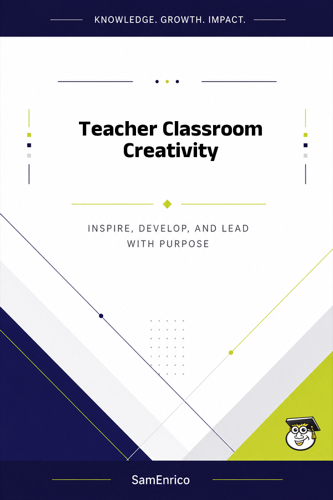
Non-FictionSelf-HelpEducational Creativity
Teacher Classroom Creativity eBook
Design engaging lessons using this practical creat
Design engaging lessons using this practical creativity guide for educators.
Formats
Free sample
Chapter 1: The Creativity Myth--–- Every teacher has heard the whisper. It comes in the faculty lounge, during a late-night grading session, or in the moment before a difficult lesson. The whisper says: “I’m just not the creative type.” It sounds like humility. It sounds like honesty. But it is neither.
It is the most expensive lie in education, and it has cost millions of students the engaging, memorable lessons they deserve.The lie has a genealogy. It descends from a romantic myth that creativity is a genetic gift—a lightning bolt that strikes only a chosen few who are born with paintbrushes in their hands or symphonies in their heads. We imagine the lone genius: Shakespeare at his desk, Einstein in the patent office, Frida Kahlo at her easel. These figures are real, but the myth they anchor is not. The myth says that if you do not see yourself in their reflection—if you cannot draw, compose, or write poetry—then creativity is not for you.
You are a technician. A deliverer of standards. A keeper of the script.This chapter dismantles that myth not with slogans but with psychological research, classroom evidence, and a radical reframing of what creativity actually is. By the time you finish these pages, you will no longer be able to say “I’m not creative” with a straight face. You will see that creativity is not a lightning bolt.
It is a muscle. And you have been using it every single day without even noticing.The Two Creativities: Big-C and Little-CThe psychological literature makes a distinction that changes everything. On one side stands Big-C Creativity—the kind that rewrites history. Beethoven’s Ninth Symphony. Einstein’s theory of relativity.
The invention of the smartphone. Big-C Creativity is rare, revolutionary, and almost always the product of years of domain-specific expertise plus a dash of historical luck. Only a handful of humans in any generation produce Big-C work. If that is your definition of creativity, then of course you do not qualify. Neither do I.
Neither do 99.999 percent of the people who have ever lived.But there is another creativity, and it is the one that actually matters for teachers. Little-C Creativity is the everyday, problem-solving, improvisational act of adapting to circumstances. It is the workaround. The on-the-fly revision. The unexpected analogy that makes a confused student’s eyes light up.
Little-C Creativity happens when you reorder a lesson because the fire alarm interrupted your perfect plan. It happens when you notice that half the class is glassy-eyed and you pivot to a different explanation without skipping a beat. It happens when you take a worksheet that is crushingly boring and add a single question that turns it into a mystery.Here is the truth that will change your teaching life: you already do Little-C Creativity constantly. You just have not called it creativity. You have called it “surviving,” “managing,” or “being flexible.” But survival is creativity under pressure.
Management is creativity with groups of unpredictable humans. Flexibility is creativity in motion.Consider the anatomy of a typical class period. A student asks a question you did not anticipate. In that moment, you have three options. You can say “That’s not on the test” (compliance).
You can say “Good question, let’s move on” (avoidance). Or you can say “That’s interesting—let’s see what the class thinks” (Little-C Creativity). That third option is not magic. It is a creative act. You have taken an unexpected input and generated a novel response that serves the learning goal.
That is the definition of creativity: novel and useful problem-solving.Teachers do this dozens of times per day. When you rephrase a concept for the third time using a different metaphor. When you notice that two students are about to conflict and you insert a redirecting comment that saves the moment. When you realize that the video you planned to show has technical difficulties and you instantly invent a live demonstration instead. All of this is creativity.
You have just been trained to not see it.The Compliance Trap If creativity is so common, why do so few classrooms feel creative? The answer is not a lack of creative teachers. The answer is a system that systematically punishes Little-C Creativity while rewarding its opposite. That opposite is compliance.Let us define this term with precision because it will appear throughout this book. Compliance is behavioral obedience without cognitive engagement.
A compliant student follows directions, completes assignments, and remains quiet when asked. From the outside, a compliant classroom looks orderly. From the inside, it is often hollow. Compliance asks nothing of the mind except submission. It is the enemy of creativity not because it is mean but because it is easy.
Compliance is easy to teach, easy to manage, and easy to assess. Creativity is messy, unpredictable, and requires trust.The tragedy is that many teachers mistake compliance for learning. A silent classroom feels safe. A classroom where every student is working on the same worksheet in the same way feels controlled. But control is not learning, and silence is not understanding.
The most dangerous classroom is not the one that is obviously out of control. The most dangerous classroom is the one where students have learned to perform obedience while their minds wander elsewhere.This book will never ask you to abandon all structure. Chaos is not creativity, and we will devote an entire chapter to building the norms that make creative classrooms actually work. But the first step is recognizing that compliance and commitment are not the same thing. Compliance is doing what you are told because you fear the consequence.
Commitment is doing the work because you see its value. You cannot force commitment through compliance. You can only invite it through creativity.The Creative Audit: Seeing What You Already Have Before we build anything new, we need to take inventory of what you already possess. The Creative Audit is a guided self-assessment designed to reveal the hidden creative strengths you have been dismissing as ordinary. Find a notebook or open a new document.
Answer the following questions as honestly as you can.Question One: When have you solved a classroom problem in an unexpected way? Do not be modest. Think of the time you rearranged the seats to break up a cliquish dynamic. Think of the time you invented a hand signal to quiet the class without shouting. Think of the time you turned a canceled assembly into an impromptu debate.
Each of these is a creative solution. Write it down.Question Two: What do colleagues come to you for? If other teachers ask for your advice on classroom management, you have creative relational skills. If they ask for your bulletin board ideas, you have visual creativity. If they ask for your explanations of difficult concepts, you have analogical creativity.
Other people see your creativity even when you do not. Listen to what they ask you for.Question Three: When have you adapted a lesson for a student with different needs? Differentiation is creativity under constraint. Every time you modified an assignment for an English language learner, created a visual scaffold for…
This is the end of the free sample. Get the eBook to keep going. Buy now
About this book
Details
- Author
- Beatty Temeka
- Publisher
- SamEnrico
- Language
- English
- Genre
- Non-Fiction, Self-Help, Educational Creativity
- Released
- 2026-06-06
- Pages (approx.)
- 158
- Available as
- eBook, Audiobook

Read better in the ZLOADR app
Your eBooks on your phone or tablet. Sign in with your SamEnrico account and start reading.
More by Beatty Temeka
 Beginner Meditation ObstaclesBeatty Temeka$11.99
 Coping With Sudden Pet DeathBeatty Temeka$11.99
 The Validating Children's Emotions GuideBeatty Temeka$11.99
 Complicated Grief in ChildrenBeatty Temeka$11.99
 The Charioteers of Olympia: Breaking the Gender Barrier in Ancient GreeceBeatty Temeka$11.99
 How to Start a Do-it-yourself Machinery and Equipment Hire Business (Beginners Guide)Beatty Temeka$11.99
 Chemistry ProfessorBeatty Temeka$11.99
 Procurement Policy AutomationBeatty Temeka$12.99
 Expense Reporting AI ToolsBeatty Temeka$12.99
You may also like
 Hong Kong Handover 1997Dunn Johnnie$11.99
 Zumba For Postnatal Recovery CourseNeal Christian$11.99
 Zumba for BeginnersLadner Nikia$11.99
 YouTube Comment Mining GuideHumes Pandora$12.99
 Worry Box MeditationCarlin Rudy$11.99
 Workplace Stress MeditationNguyen Lynn$11.99
 Workplace Stress and Sleep RepairHawley Ivory$11.99
 Workplace Perfectionism CureDelaney Jeffry$11.99
 Workplace Injustice Anger GuideWallen Isabelle$11.99
 Work Addiction and Burnout LinkGreenwood Ester$11.99
 Women in Yoga and WellnessBeattie Galina$11.99
 Women in Stand Up ComedyChun Evangeline$11.99