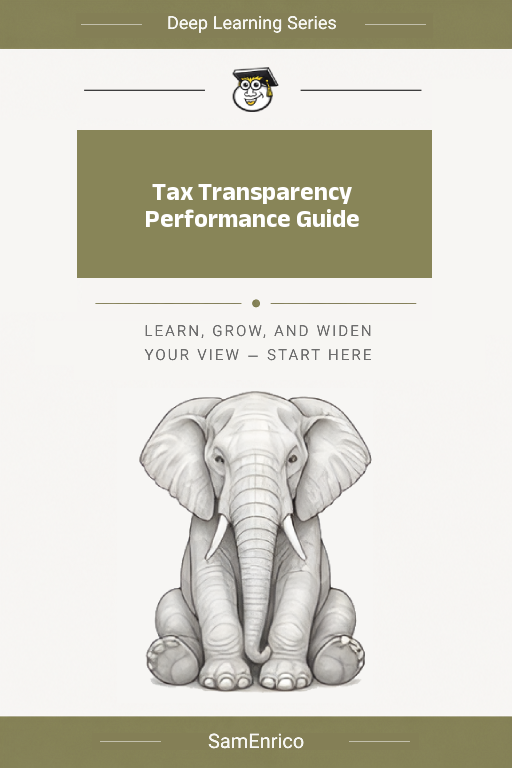
Tax Transparency Performance Guide eBook
Compares public firms on country-by-country report
Compares public firms on country-by-country reporting, effective tax rates, and tax haven use disclosure quality.
Formats
Free sample
Chapter 1: The Reputation Tax--–- In 2012, a group of British parliamentarians sat in a wood-paneled room in London and did something that would forever change the relationship between multinational corporations and the public. They summoned the executives of Google, Amazon, and Starbucks to appear before the Public Accounts Committee. The crime? Paying almost no tax on billions in UK sales. The witnesses shifted uncomfortably as MP Margaret Hodge, a fierce Labour politician with a reputation for extracting uncomfortable truths, leaned into her microphone and asked a question that would echo across boardrooms for the next decade: "Do we not have a moral obligation to pay tax?"The Google executive paused.
He adjusted his glasses. Then he gave an answer that became the most expensive sentence in modern corporate tax history: "We pay the tax that is required."That answer was technically true. It was also, in the court of public opinion, a catastrophic miscalculation. What followed was a cascade of consumer boycotts, newspaper exposés, parliamentary inquiries, and eventually, a complete rewiring of the global tax system. The "Double Irish" and "Dutch Sandwich" structures that had saved companies billions were publicly dissected, named, and shamed.
Starbucks saw its UK sales drop precipitously after a Reuters investigation revealed that the coffee giant had paid just £8.6 million in corporate income tax on over £3 billion in UK sales over fourteen years. The hashtag #Starbucks Tax Shame trended. Customers switched to independent coffee shops. Reputational damage that no tax department had ever modeled became very, very real.This chapter argues that we have entered a new era. The "low-tax" strategy that defined corporate finance from 1990 to 2015 is dead.
It has been replaced by the "right-tax" strategy: paying a defensible, sustainable, and transparent rate that aligns with where value is actually created. A low Effective Tax Rate is no longer viewed by the market as a sign of a savvy Chief Financial Officer. It is viewed as a risk premium—a signal that the company may be hiding something, inviting regulatory scrutiny, short-seller attacks, and ESG rating downgrades. If your cash Effective Tax Rate falls into the Yellow, Orange, or Red zones we will define shortly, you need a compelling, verifiable, substance-based justification. Otherwise, you are not saving taxes.
You are accumulating risk.The Anatomy of a Reputational Meltdown To understand why tax transparency has moved from a niche concern to a mainstream investment criterion, we must first understand the anatomy of a reputational tax scandal. These events follow a predictable pattern, and once you understand the pattern, you can see it coming from years away.The first phase is the Structural Phase. A company designs a legally compliant tax structure that shifts profits from high-tax jurisdictions where sales occur to low-tax jurisdictions where substance is minimal. This structure is blessed by elite law firms and major accounting firms. Internal memos declare it "defensible." The board approves it.
The company saves hundreds of millions annually. Everyone congratulates themselves.The second phase is the Exposure Phase. A journalist, whistleblower, or activist investor obtains documents that reveal the structure. Sometimes this happens via a leak (Lux Leaks, Paradise Papers, Panama Papers). Sometimes it happens via a parliamentary inquiry that compels disclosure.
Sometimes it happens because a former employee becomes a whistleblower. The exposure is always shocking to the public, even though the structure has existed for years.The third phase is the Outrage Phase. Social media ignites. Hashtags trend. Customers threaten boycotts.
Politicians demand hearings. The company's stock price dips, often by 3-8 percent in the immediate aftermath. But the real damage is longer-term: brand erosion, difficulty recruiting talent, and a permanent reputational discount.The fourth phase is the Regulatory Phase. Lawmakers, embarrassed by the exposure, pass new legislation. The OECD launches the Base Erosion and Profit Shifting project.
The European Union mandates public Country-by-Country Reporting. The G7 agrees to a global minimum tax. The structure that was perfectly legal yesterday is banned tomorrow.The fifth and final phase is the Reckoning Phase. The company dismantles the structure, pays back taxes, issues a contrite statement, and hires a new head of tax who promises transparency. The stock price recovers.
But the reputational stain remains, embedded in Wikipedia entries and news archives forever.Consider the case of Starbucks. The company had done nothing illegal. Its structure, which involved paying royalties to a Dutch subsidiary for use of its intellectual property, was compliant with every applicable law. But when Reuters calculated that Starbucks had paid just 1.5 percent of its UK profits in taxes over fourteen years, the public did not care about legal technicalities. They cared about fairness.
Starbucks was forced to make a £20 million voluntary tax payment to the UK treasury—not because they owed it, but because the reputational damage was costing them more than the payment itself. That is the definition of a risk premium.The Death of the Low-Tax Strategy For a generation, corporate tax strategy was dominated by a simple goal: minimize cash taxes paid, anywhere, by any legal means necessary. This was not a fringe view. It was taught in business schools. It was rewarded with bonuses.
It was celebrated in earnings calls. A low Effective Tax Rate was a badge of honor, proof that management was sophisticated, aggressive, and shareholder-friendly.Warren Buffett himself famously said that his ideal investment was a business that paid no taxes. And for decades, that was rational advice. Tax was viewed as a deadweight cost—a transfer from shareholders to governments that should be minimized like any other expense. The only stakeholders who cared about tax were the tax authorities themselves, and they were perpetually outgunned by the armies of accountants and lawyers employed by multinationals.But three forces converged in the 2010s to kill the low-tax strategy: technology, transparency, and values.Technology enabled journalists and activists to analyze corporate tax data at scale.
Where previously a complex tax structure could hide in the footnotes of an annual report read by almost no one, now algorithms could scan thousands of reports simultaneously, flagging anomalies and mismatches. The Luxembourg Leak, for example, involved 28,000 pages of tax rulings that were analyzed by a consortium of journalists using custom-built software. What would have taken a decade of manual review took months.Transparency became a regulatory mandate. The European Union's Fourth Anti-Money Laundering Directive required public registers of beneficial ownership. The Accounting Directive required extractive industries to disclose payments to governments.
And most consequentially, the EU's Public Country-by-Country Reporting Directive (2021/2101) now requires large multinationals to publicly disclose, in a machine-readable format, the taxes they pay, profits they book, and employees they employ in every jurisdiction—including the tax havens. The era of the "secret" tax structure ended on June 22, 2021, when that directive was signed into law.Values shifted. The generation of consumers and employees entering the workforce in the 2010s had grown up in the aftermath of the 2008 financial crisis. They were skeptical of corporate power. They viewed tax avoidance not as clever but as unethical.
A 2020 survey by the Chartered Institute of Taxation found that 68 percent of UK adults believed that tax avoidance by multinationals was morally wrong, even when legal. The same survey found that 57 percent…
This is the end of the free sample. Get the eBook to keep going. Buy now
About this book
Details
- Author
- Collazo Connie
- Publisher
- SamEnrico
- Language
- English
- Genre
- Non-Fiction, Strategic Atlas, Tax Transparency
- Released
- 2026-06-01
- Pages (approx.)
- 145
- Available as
- eBook, Audiobook

Read better in the ZLOADR app
Your eBooks on your phone or tablet. Sign in with your SamEnrico account and start reading.
More by Collazo Connie
 Laci Peterson Victim Family JourneyCollazo Connie$11.99
 Anxiety Reading Body Language GuideCollazo Connie$11.99
 Peg System for PIN CodesCollazo Connie$11.99
 Remote Review Neurodivergent GuideCollazo Connie$11.99
 The Retirement Financial Planning GuideCollazo Connie$11.99
 The Phantom of the Grand Guignol: Paris' Theater of Terror and TriumphCollazo Connie$11.99
 Infection ControlCollazo Connie$11.99
 Dot Eu Domain Registration GuideCollazo Connie$12.99
 Understanding Partial Deletion of YCollazo Connie$17.99
 How to Start a Household Vacuum Cleaner Manufacturing BusinessCollazo Connie$11.99