
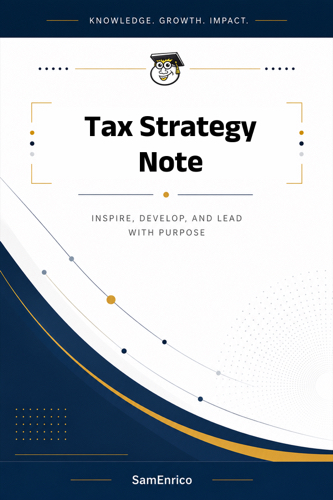
Non-FictionFirst 30 DaysTax Planning
Tax Strategy Note eBook
Briefly outline tax approach and obligations.
by Reyna Renate
Briefly outline tax approach and obligations.
Formats
Free sample
Chapter 1: The Second Paycheck--For most people, April 15th feels like a mugging. You worked for that money. You earned it, deposited it, budgeted it, and spent some of it. Then the government sends you a letter—or worse, you log into your tax software and watch the refund you were expecting turn into a balance due. Your stomach drops.
You ask yourself the same question millions of Americans ask every spring: Where did all my money go?The answer is simple. You have a silent business partner you never chose. That partner takes between thirty and fifty percent of everything you earn, depending on your income level and where you live. And unlike every other business partner in the world, this one does not negotiate, does not send you a profit-and-loss statement, and does not ask permission before withdrawing its share. It just takes.This chapter is about waking up to that reality.
Not to depress you. To empower you. Because once you understand that taxes are not an act of God or an unavoidable cost of citizenship, but rather a negotiable expense—like rent, inventory, or payroll—you can start doing something about it.The wealthy figured this out generations ago. They don't pay less in taxes because they earn less. They don't pay less because they cheat.
They pay less because they plan. They treat tax as a strategic variable, not a historical bill. And by the time you finish this chapter, you will understand the single most important mindset shift that separates those who overpay from those who keep what they earn.Let's start with a story.The Two Bakers Maria and Jennifer are sisters. Both are thirty-eight years old. Both are single mothers.
Both started home bakeries during the pandemic, and by 2025, both are earning exactly $200,000 in net profit before taxes. They live in the same state, have similar expenses, and work roughly the same number of hours.Maria files her taxes the way most small business owners do. She waits until March, gathers her receipts into a shoebox, and hands them to a local preparer who charges three hundred dollars. She operates as a sole proprietor, which means she reports her $200,000 profit on Schedule C of her personal tax return. She pays self-employment tax on every dollar—fifteen point three percent on the first $168,600, then two point nine percent on the rest.
She also pays federal income tax at ordinary rates, plus state income tax. Her effective combined rate is about forty percent. She writes a check for roughly $80,000.Jennifer does things differently. Not illegally. Not aggressively.
Just intentionally. In January of her first year in business, she met with a tax coach who walked her through the next twelve months. She formed an S Corporation, which costs a few hundred dollars in filing fees and requires running payroll, but she learned how to do both. She pays herself a reasonable salary of $80,000, and the remaining $120,000 of profit comes to her as distributions that are not subject to self-employment tax.She also opened a Solo 401(k) in November, after her accountant projected her year-end profit. She contributed $69,000 to that account before December 31st, which is the maximum allowed in 2025 for someone her age.
That contribution reduced her taxable income dollar for dollar. Finally, she bought a new delivery van in December and used Section 179 to deduct the entire $50,000 cost in the current year, rather than depreciating it over five years.Here is what happened. Maria paid about $80,000 in combined federal, state, and self-employment taxes. Jennifer paid about $38,000. Same income.
Same business. Same year. A difference of $42,000.That is not a typo. Forty-two thousand dollars. A down payment on a house.
Two years of college tuition. A fully funded emergency fund. Gone, because one person knew the rules and the other did not.The Silent Partner Reframe If you take nothing else from this book, take this: the government is not taking your money. You are giving it away, by default, because you have not learned the strategies that keep it in your pocket.Every dollar you earn is an opportunity. You can spend it.
You can save it. You can invest it. Or you can hand it over to the IRS. The default setting—the outcome you get if you do nothing—is handing it over. The tax code is designed to collect as much as possible from passive participants.
It rewards those who engage with it intentionally.Think of it this way. If you walked into a car dealership and the salesperson said, "The price is $50,000, but if you fill out these three forms, you can get it for $30,000," you would fill out the forms. You would not say, "No thanks, I prefer to pay full price." Yet that is exactly what millions of self-employed people do with their taxes every year. The forms exist. The strategies are legal.
The savings are real. The only thing standing between you and a lower tax bill is knowledge and action.The Three Ds: Deadlines, Documentation, Declaration Before we get into the exciting strategies—the S corporations, the retirement plans, the real estate loopholes—we need to cover the boring stuff. Because the most brilliant tax strategy in the world is worthless if you fail to comply with the basic obligations that keep you out of trouble.Every taxpayer, whether you earn $30,000 or $30 million, is subject to what I call the Three Ds. Miss any one of them, and even a perfectly correct return can trigger penalties, interest, and unwanted attention from the IRS.Deadlines are the easiest to remember and the easiest to mess up. The individual tax filing deadline is April 15th, unless you file for an extension.
But estimated tax payments are due four times per year: April 15th, June 15th, September 15th, and January 15th of the following year. (We will cover estimated taxes in detail in Chapter 12, but for now, just know that if you are self-employed, you cannot wait until April to pay. You must pay as you earn.)Documentation is where most people fail. The IRS does not take your word for anything. If you claim a deduction, you need proof.
That means receipts, bank statements, mileage logs, and contemporaneous records. A receipt you dig out of your glovebox during an audit is fine. A receipt you recreate from memory after the audit notice arrives is not. The difference between a successful audit and a disastrous one is almost always documentation.Declaration means reporting all your income, from all sources, accurately. The IRS receives copies of every W-2 and 1099 issued to you.
If you fail to report income that appears on one of those forms, the IRS's automated matching system will flag your return within months. The penalty for a simple omission is interest and a small late-payment fee. The penalty for willful omission is potential criminal charges. Do not play games with declaration.The Rearview Mirror Trap Here is the most common mistake I see among business owners who come to me for help. They treat tax planning as something you do after the year is over.
They wait until February or March, download their bank statements, and ask their accountant to "see what they owe." Then…
This is the end of the free sample. Get the eBook to keep going. Buy now
About this book
Details
- Author
- Reyna Renate
- Publisher
- SamEnrico
- Language
- English
- Genre
- Non-Fiction, First 30 Days, Tax Planning
- Released
- 2026-06-07
- Pages (approx.)
- 107
- Available as
- eBook, Audiobook

Read better in the ZLOADR app
Your eBooks on your phone or tablet. Sign in with your SamEnrico account and start reading.
More by Reyna Renate
 Meditation for Needle PhobiaReyna Renate$11.99
 Car Mindfulness Practice GuideReyna Renate$11.99
 Anticipatory Grief ReliefReyna Renate$11.99
 Postpartum Therapy OptionsReyna Renate$11.99
 Constraints for CoachesReyna Renate$11.99
 Oral Contraceptive Breast RiskReyna Renate$11.99
 Assertiveness for Nonprofit WorkersReyna Renate$11.99
 The Copycat Killers of Japan: The Aum Shinrikyo LegacyReyna Renate$11.99
 The Diamond Snatchers: How a Global Kidnapping Ring Shattered the Jewel Trade (1970s)Reyna Renate$11.99
 How to Start a Agricultural Hand Tools, Not Power-driven Business (Beginners Guide)Reyna Renate$11.99
 How to Produce Paella PansReyna Renate$11.99
 How to Produce a Convection MicrowaveReyna Renate$11.99
You may also like
 Hong Kong Handover 1997Dunn Johnnie$11.99
 Zumba For Postnatal Recovery CourseNeal Christian$11.99
 Zumba for BeginnersLadner Nikia$11.99
 YouTube Comment Mining GuideHumes Pandora$12.99
 Worry Box MeditationCarlin Rudy$11.99
 Workplace Stress MeditationNguyen Lynn$11.99
 Workplace Stress and Sleep RepairHawley Ivory$11.99
 Workplace Perfectionism CureDelaney Jeffry$11.99
 Workplace Injustice Anger GuideWallen Isabelle$11.99
 Work Addiction and Burnout LinkGreenwood Ester$11.99
 Women in Yoga and WellnessBeattie Galina$11.99
 Women in Stand Up ComedyChun Evangeline$11.99