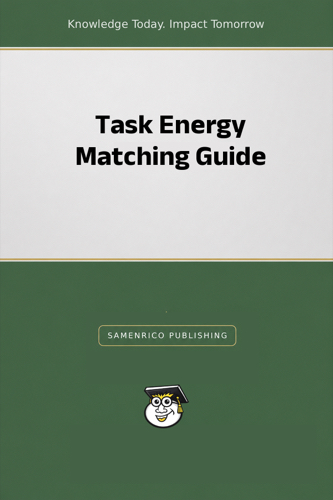
Task Energy Matching Guide eBook
Align your highest cognitive tasks with your perso
Align your highest cognitive tasks with your personal peak energy hours.
Formats
Free sample
Chapter 1: The 3 PM Lie--The spreadsheet had seventeen tabs, each one a knife twist of nested formulas and cross-sheet dependencies. Sarah had been staring at cell F42 for forty-three minutes. The number didn't balance. It hadn't balanced an hour ago when she first noticed the discrepancy, and it still didn't balance now, despite three complete recalculations and a desperate pivot table she'd built as a Hail Mary.What made it worse—what made her want to close her laptop and walk into the ocean—was that she knew this model. She'd built it from scratch six months ago.
She understood every assumption, every variable, every single relationship between every single cell. Or she had, back when she'd built it at 9:30 on a Tuesday morning with a clear head and a quiet office.Now it was 3:17 PM on a Thursday. She'd just come from back-to-back meetings that had eaten her entire morning and most of her afternoon. Her inbox had 147 unread messages. The Slack notification in the corner of her screen wouldn't stop pulsing.
She'd had a turkey sandwich at her desk twelve minutes ago because there was no time for a real lunch, and now her body was staging a quiet rebellion, flooding her with the kind of fatigue that made her eyelids feel like sandbags.She was trying to do the hardest cognitive work of her week during the lowest energy window of her day. And she had no idea.This is not a story about laziness, poor time management, or lack of discipline. Sarah is one of the most conscientious analysts at her firm. She regularly works fifty-five hour weeks. She never misses a deadline.
Her performance reviews use words like "exceptional" and "indispensable."But like millions of knowledge workers around the world, Sarah has been sold a lie. The lie says that all hours are created equal. That a 3 PM hour is the same as a 9 AM hour. That if you just try harder, push through, apply enough willpower, you can do anything at any time.The truth is uglier and more liberating: you have been trying to run a cognitive marathon during the biological equivalent of low tide. And the reason you feel exhausted, frustrated, and secretly convinced that everyone else has figured out something you haven't—is not because you're broken.
It's because you've been fighting your own biology every single day, and biology always wins.The Universal Assumption That's Ruining Your Productivity Every productivity system you've ever encountered—from Getting Things Done to the Eisenhower Matrix to Pomodoro to time blocking to the countless apps and planners and methods that promise to transform your relationship with work—rests on a single unexamined assumption. The assumption is so deeply embedded that most people don't even recognize it as an assumption. They take it as fact, like gravity or the passage of time.The assumption is this: All hours are interchangeable.Think about it. When you create a to-do list, do you assign different items to different times of day based on anything other than urgency? When you block out your calendar, do you consider whether your brain will be capable of creative synthesis at 2 PM versus 10 AM?
When you agree to a meeting at 8 AM, do you pause to ask whether that's when your cognitive engine is just warming up or already redlining?Of course you don't. No one does. Because the entire architecture of modern work—the 9-to-5 schedule, the back-to-back meeting culture, the expectation of constant responsiveness, the glorification of the "early riser" and the shame of the "night owl"—is built on a factory-era model of human performance. A model designed for assembly lines, not prefrontal cortices.On an assembly line, an hour at 8 AM produces exactly the same output as an hour at 3 PM. The machine doesn't get tired.
It doesn't experience decision fatigue. It doesn't have a working memory capacity that fluctuates by 40% depending on sleep quality and time of day. The machine just runs, at constant capacity, until you turn it off.You are not a machine. You have never been a machine. And the fundamental error of every productivity system you've tried is that they treat you like one.The Real Story: Why Your Brain Has Its Own Schedule Your brain runs on rhythms.
Not the kind you tap your foot to, but biological oscillations that govern everything from when you feel most alert to when you're most likely to make mathematical errors. The two most important rhythms for knowledge work are circadian and ultradian, and understanding them is the first step toward stopping the fight you're losing every day.Circadian rhythms operate on a roughly 24-hour cycle. They're why you feel sleepy at night and alert during the day (unless you're an owl, in which case your cycle is shifted later—more on that in a moment). Your circadian rhythm determines the broad contours of your energy: when you naturally wake, when you naturally feel most awake, and when you naturally begin to wind down.But circadian rhythms only tell part of the story. The more relevant rhythm for daily task management is the ultradian rhythm—shorter cycles that repeat throughout the day, typically every 90 to 120 minutes.
If you've ever noticed that you can focus intensely for about an hour and a half before your attention starts to scatter, you've experienced an ultradian cycle in action.Here's what happens during a typical ultradian cycle: You begin at a state of moderate alertness. As you engage with a task, your focus deepens. Your brain ramps up production of neurotransmitters associated with attention and problem-solving. For about 60 to 90 minutes, you're operating at high cognitive capacity. Then, gradually, performance begins to degrade.
Your attention wanders. Small errors creep in. What felt manageable ten minutes ago now feels like wading through cement.This is not a bug. This is not a sign that you need more coffee or better discipline. This is your brain's natural recovery signal, telling you that it's time to shift to a different kind of activity—or better yet, to take a true break.Most people ignore this signal.
They push through, fueled by caffeine and guilt, and they mistake the resulting struggle for proof that they aren't working hard enough. But the research is unequivocal: after about 90 minutes of sustained cognitive effort, your performance on complex tasks begins a steady decline. The decline isn't linear—it accelerates. By the two-hour mark, you're operating at a fraction of your peak capacity, even if you feel "in the zone."This isn't speculation. It's neurobiology.
Your brain consumes an enormous amount of energy—about 20% of your body's total caloric expenditure, despite being only 2% of your body weight. Sustained focus depletes glucose and neurotransmitters in the prefrontal cortex, the part of your brain responsible for executive function, complex reasoning, and impulse control. When those resources run low, your brain quite literally cannot perform at the same level, no matter how much willpower you throw at the problem.The Three Hidden Costs of Working Against Your Energy Let's return to Sarah and her spreadsheet. She's trying to debug a complex financial model at 3:17 PM, likely near the end of an ultradian…
This is the end of the free sample. Get the eBook to keep going. Buy now
About this book
Details
- Author
- Cleveland Karl
- Publisher
- SamEnrico
- Language
- English
- Genre
- Non-Fiction, Business Brief, Task Management
- Released
- 2026-06-07
- Pages (approx.)
- 150
- Available as
- eBook, Audiobook

Read better in the ZLOADR app
Your eBooks on your phone or tablet. Sign in with your SamEnrico account and start reading.
More by Cleveland Karl
 The Military Parent Stress GuideCleveland Karl$11.99
 Trauma Dream Characters GuideCleveland Karl$11.99
 Behavioral Addiction in Law SchoolCleveland Karl$11.99
 The Skywalkers of the Altai: Prehistoric Pioneers of the HeavensCleveland Karl$11.99
 The Hollow Crown: Merlin’s Last ProphecyCleveland Karl$11.99
 Understanding Hereditary AtaxiaCleveland Karl$17.99
 Cloud Computing Workforce OutlookCleveland Karl$12.99
 Closing Deal Script HandbookCleveland Karl$12.99
 Angel FundingCleveland Karl$11.99
 How to Start a Press for Chipboard Business (Beginners Guide)Cleveland Karl$11.99