
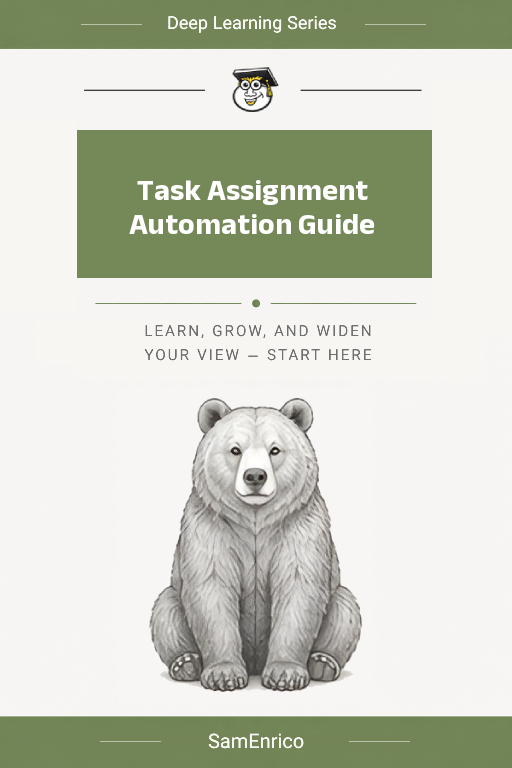
Non-FictionAI OperatorTask Management
Task Assignment Automation Guide eBook
Use AI to automatically assign operational tasks b
Use AI to automatically assign operational tasks based on team member skills and availability.
Formats
Free sample
Chapter 1: The 11 PM Reckoning--It was 11:17 PM on a Tuesday when Mariana’s phone buzzed for the seventh time in ninety minutes. A warehouse fire in Indiana. Not a drill. Forty-seven customer orders needed rerouting. Twelve support agents needed reassignment to handle the inevitable wave of angry calls.
Three logistics specialists were already at 150 percent capacity, and her Slack was a screaming rainbow of urgent messages, half-finished thoughts, and the single most expensive phrase in modern management: “Who is free to take this?”She scrolled. She tagged. She checked calendars. She overrode conflicts. She double-assigned one person to two incompatible tasks because she was exhausted and her brain had stopped cross-referencing.
At 11:47 PM, she hit send on the final reassignment, closed her laptop, and stared at the ceiling. Somewhere in Indiana, a fire was still burning. But Mariana was running on fumes, and somewhere in the mess of 2 AM texts and cc’d emails, she knew she had made at least three decisions that tomorrow’s post-mortem would flag as mistakes.Six months later, the same warehouse caught fire again. This time, Mariana was asleep. Her phone did not buzz.
At 11:17 PM, an AI-powered task assignment system detected the disruption, recalculated skills and availability across the entire operations team, and reassigned every affected task in eleven seconds. Three people received new assignments. None of them were overloaded. The system logged every decision, and at 8 AM, Mariana reviewed a one-page summary over coffee. The fire had been handled.
She never knew it happened until the report.The difference between those two nights is not technology. It is the difference between managers who delegate and managers who design systems that delegate for them. This book is for the second group.The Hidden Catastrophe of Manual Assignment Let us name the enemy. Manual task assignment—the act of a human manager deciding who does what, when, and in what order—is one of the most expensive, underestimated, and psychologically corrosive activities in modern organizations. It is the tax you pay for not having a system.Research drawn from organizational psychology and operations research quantifies this tax.
A manager making an assignment decision loses an average of twenty-three minutes to context switching. Not the assignment itself—twenty-three minutes to reorient from whatever they were doing, assess the task, check availability, recall skills, negotiate with reluctant team members, and then reorient back to their original work. Do this ten times a day, and you have lost nearly four hours to friction. Do this across a team of ten managers, and you have lost a full workweek of cognitive capacity every single week. That is the hidden cost no budget line item captures.But the costs go deeper than time.
Recency bias—the psychological tendency to assign work to whoever responded first to a “who is free?” message—systematically rewards the most interruptible, not the most qualified. The person who happened to be looking at Slack when the question appeared gets the task, regardless of whether they have the right skills, the bandwidth, or the interest. Over weeks and months, this creates a perverse incentive structure: the fastest fingers get the work, while deep workers who silence notifications are punished with lighter loads and professional invisibility.Then there is the delay tax. The gap between task creation and assignment in manual systems averages ninety-seven minutes across the organizations studied for this book. In that ninety-seven minutes, the task sits in a limbo of “someone should do this.” Deadlines erode.
Dependencies stall. The person who eventually receives the task has lost the running start they could have had. Multiply this across hundreds of tasks per week, and you are looking at days of cumulative delay.Mariana’s 11 PM reckoning was not exceptional. It was Tuesday.What Flash Teams Teach Us About the Possible In 2015, a team of researchers at MIT’s Center for Collective Intelligence introduced a concept that was dismissed as academic fantasy: the Flash Team. The idea was simple and radical.
Instead of static organizational charts—those quarterly-updated PDFs that are obsolete the moment they are printed—organizations could assemble teams algorithmically for specific tasks. A project arrives. The system reads its requirements. It scans a database of skills, availability, and past performance. It proposes a team.
The team executes. The team dissolves. The next project arrives, and a different team forms.The critics said it would never work. Humans need stability. Teams need trust.
You cannot algorithmically assemble rapport.The critics were wrong. By 2018, platforms like Upwork and Toptal had proven that algorithmic team assembly works for freelance work. By 2021, internal tools at companies like Microsoft and Google were quietly using similar logic to route software bugs to the right engineer, support tickets to the right agent, and design requests to the right creative. By 2024, the technology had matured to the point where Flash Teams were not just possible but superior to static structures for task-based work.Here is what a Flash Team looks like in practice. A task arrives—say, “investigate why customer conversion dropped 12 percent on the mobile checkout page.” The system does not simply assign this to “whoever is free.” It decomposes the task into sub-skills: data analysis, frontend debugging, UX review, A/B testing design, stakeholder communication.
It queries the skills ontology (which we will build in Chapter 2) and finds that Priya has the data analysis expertise, Marcus has the frontend debugging history, Elena has conducted three UX reviews this quarter, and David has the stakeholder communication skills. It checks availability: Marcus is at 120 percent capacity, so the system flags him as overloaded and looks for an alternative. It finds Jamal, who has frontend skills and is only at 60 percent capacity. The team is assembled. All of this happens in under two seconds.The tasks are assigned.
The system does not ask permission for routine assignments—it simply does them. For complex or high-stakes tasks, it proposes and waits for approval. The humans work. The task completes. The team dissolves.
The next task arrives, and a different constellation forms.This is not science fiction. This is the state of the art, and every tool you need to build it exists today, much of it open source. The barrier is not technology. The barrier is managerial imagination and the courage to stop doing something that has never worked well.Automation, Agentic AI, and Why the Difference Matters Before we go further, we need to be precise about our terms. This book uses three distinct definitions, and they are not interchangeable.
Confusing them is the fastest way to build a system that fails.Automation is the simplest layer. Automation means if-then rules. If a password reset request arrives, assign it to the newest hire. If a task is marked urgent, assign it to the most senior available person. Automation is deterministic, predictable, and brittle.
It works for routine, low-variance work, and it fails spectacularly when exceptions appear. Most organizations stop here, and most organizations are disappointed.Agentic AI is the next layer. An agentic system does not follow fixed rules. It reasons. Given a task, a set of available people, their skills, their current workloads, their deadlines, and their stated preferences, an agentic AI…
This is the end of the free sample. Get the eBook to keep going. Buy now
About this book
Details
- Author
- Michaud Porsha
- Publisher
- SamEnrico
- Language
- English
- Genre
- Non-Fiction, AI Operator, Task Management
- Released
- 2026-05-30
- Pages (approx.)
- 137
- Available as
- eBook, Audiobook

Read better in the ZLOADR app
Your eBooks on your phone or tablet. Sign in with your SamEnrico account and start reading.
More by Michaud Porsha
 Building Teen ResilienceMichaud Porsha$11.99
 MBSR for Panic Disorder GuideMichaud Porsha$11.99
 Ayurvedic Ghee GuideMichaud Porsha$11.99
 Teen Self Esteem and Porn LiteracyMichaud Porsha$11.99
 Nordic Region Talent Import ForecastMichaud Porsha$11.99
 The Tsar of Light: Lomonosov and the Enlightenment of Imperial RussiaMichaud Porsha$11.99
 Vocational CounselorMichaud Porsha$11.99
 Understanding Microcephaly Albinism Digital Anomalies SyndromeMichaud Porsha$17.99
 How to Start a Hobby in PianoMichaud Porsha$11.99
 China Ghana Dropshipping Cash FlowMichaud Porsha$12.99
You may also like
 Hong Kong Handover 1997Dunn Johnnie$11.99
 Zumba For Postnatal Recovery CourseNeal Christian$11.99
 Zumba for BeginnersLadner Nikia$11.99
 YouTube Comment Mining GuideHumes Pandora$12.99
 Worry Box MeditationCarlin Rudy$11.99
 Workplace Stress MeditationNguyen Lynn$11.99
 Workplace Stress and Sleep RepairHawley Ivory$11.99
 Workplace Perfectionism CureDelaney Jeffry$11.99
 Workplace Injustice Anger GuideWallen Isabelle$11.99
 Work Addiction and Burnout LinkGreenwood Ester$11.99
 Women in Yoga and WellnessBeattie Galina$11.99
 Women in Stand Up ComedyChun Evangeline$11.99