
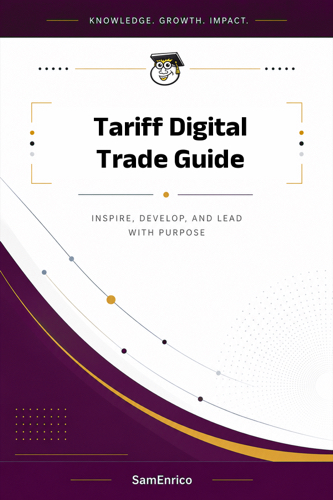
Non-FictionBusiness Brief / Digital
Tariff Digital Trade Guide Audiobook
Examines customs treatment of software, data trans
Examines customs treatment of software, data transfers, and digital services.
Formats
Free sample
Chapter 1: The Box That Broke Tariffs---- In 1985, a shipping container arrived at the Port of Los Angeles carrying 10,000 floppy disks from Japan. Each disk contained a newly developed spreadsheet software program. The customs officer on duty faced a straightforward question: what was the value of these goods, and what duty rate applied? The officer consulted the Harmonized System – the global language of tariffs – found Heading 8524 (media for recording sound or other phenomena), applied a duty of 3.9%, and the shipment cleared within hours. The system worked exactly as designed.-- Thirty-seven years later, a software developer in Bangalore clicked "upload" on a file transfer service.
A spreadsheet program – functionally identical to the one on those floppy disks – traveled across undersea fiber-optic cables to a customer in Chicago. The transfer took four seconds. No customs officer was notified. No duty was paid. No tariff classification was assigned.
The same product, the same commercial transaction, the same two countries. One incurred tariffs. The other incurred nothing.-- That difference – between a physical box and an ephemeral file – is the single most consequential loophole in modern trade law. It is not a loophole by accident. It is a loophole by design, preserved by a 1998 political compromise that was supposed to last eighteen months and has now survived twenty-six years.
And it is about to collapse.-- This chapter explains how customs regimes built for the age of steamships and pallets failed to adapt to the age of fiber optics and cloud servers. It introduces the foundational problem of classification – what is a "good" when there is nothing to touch? – and the principle of functional equivalence that will guide this book. Most importantly, it establishes the central tension that every subsequent chapter will explore: the digital economy has outgrown the legal container that was supposed to hold it.The Container That Built Global Trade-- To understand why digital products break tariffs, one must first understand how tariffs work for physical goods. The Harmonized System (HS) – administered by the World Customs Organization (WCO) in Brussels – is arguably the most successful international legal instrument you have never heard of.
First implemented in 1988, the HS assigns every physical product traded across borders a six-digit code (sometimes extended to ten or twelve digits for national specificity). Cotton T-shirts: 6109.10. Flat-screen televisions: 8528.72. Frozen beef cuts: 0202.30.-- The genius of the HS is its granularity. A product's code determines…
This is the end of the free sample. Get the Audiobook to keep going. Buy now
About this book
Details
- Author
- Oglesby Stephany
- Publisher
- SamEnrico
- Language
- English
- Genre
- Non-Fiction, Business Brief / Digital
- Released
- 2026-06-07
- Pages (approx.)
- 144
- Available as
- eBook, Audiobook

Listen in the VoxFlicks app
Audiobooks and audio dramas wherever you go. Sign in with your SamEnrico account and press play.
More by Oglesby Stephany
 Tobacco Cessation Journal MethodOglesby Stephany$11.99
 IBS Prucalopride GuideOglesby Stephany$11.99
 Managing Workplace Pressure GuideOglesby Stephany$11.99
 The Fall of the Master: How a Genius Coach's Methods Destroyed a DynastyOglesby Stephany$11.99
 How to Become a Radiologic TechnologistOglesby Stephany$11.99
 Limitation of Liability Drafting GuideOglesby Stephany$12.99
 How to Produce Appliques and PatchesOglesby Stephany$11.99
 Voice Stress AnalysisOglesby Stephany$11.99
You may also like
 Hong Kong Handover 1997Dunn Johnnie$11.99
 Zumba For Postnatal Recovery CourseNeal Christian$11.99
 Zumba for BeginnersLadner Nikia$11.99
 YouTube Comment Mining GuideHumes Pandora$12.99
 Worry Box MeditationCarlin Rudy$11.99
 Workplace Stress MeditationNguyen Lynn$11.99
 Workplace Stress and Sleep RepairHawley Ivory$11.99
 Workplace Perfectionism CureDelaney Jeffry$11.99
 Workplace Injustice Anger GuideWallen Isabelle$11.99
 Work Addiction and Burnout LinkGreenwood Ester$11.99
 Women in Yoga and WellnessBeattie Galina$11.99
 Women in Stand Up ComedyChun Evangeline$11.99