
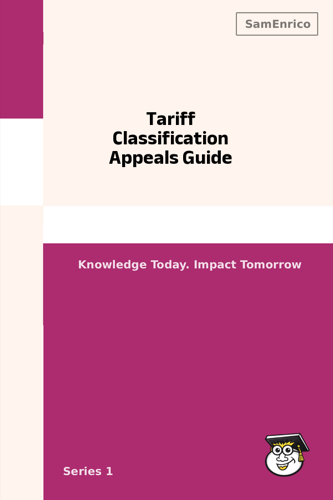
Non-FictionBusiness BriefCustoms Appeals
Tariff Classification Appeals Guide eBook
Challenge adverse customs rulings using this pract
Challenge adverse customs rulings using this practical binding ruling protest handbook.
Formats
Free sample
Chapter 1: The Classification Trap--–- The email arrived at 4:47 PM on a Friday, three days before a long holiday weekend. Sarah Chen, the compliance director for a mid-sized electronics distributor, almost missed it. Her inbox was flooded with the usual end-of-week noise—shipping updates, broker confirmations, a reminder about the company picnic. But this one was different. The subject line read: "CBP Notice of Action CF-29 – Immediate Attention Required."She opened it and read the first sentence twice.
Then a third time. Her stomach dropped.Customs and Border Protection had completed a classification review of her company's imported power adapters—thousands of units shipped over the previous eighteen months. The agency had determined that the adapters were not, as declared, "electrical transformers for data processing equipment" at 2.6% duty. Instead, CBP was reclassifying them as "power supply units for general use" at 7.5% duty. The proposed additional duties totaled $847,000.
The notice gave her ten days to respond.Sarah had done everything right. She had obtained a binding ruling before the first shipment. She had documented the technical specifications. She had worked with a licensed customs broker. And now, sitting in her home office as the sun dipped below the horizon, she realized that "binding" did not mean what she thought it meant.This book is for Sarah.
And for everyone else who has received that email, that letter, that phone call. The one that says: We think you got it wrong. And we want millions of dollars.If you are reading this, you are likely an importer, a customs broker, a trade compliance professional, an in-house counsel, or a business owner who ships goods across international borders. You may have just received an adverse ruling. You may be anticipating an audit.
Or you may simply want to understand how to protect your company from a financial disaster you did not see coming.Here is the truth that the trade compliance industry does not advertise: Tariff classification is not a science. It is an argument.Two reasonable people—two customs officers, two judges, two lawyers—can look at the exact same product, the exact same technical specifications, the exact same regulatory text, and reach completely different conclusions about the correct tariff code. And when that happens, the difference is not academic. It is measured in dollars. Often millions of dollars.This chapter will introduce you to the fundamental problem that makes tariff classification so dangerous, the structural reasons why adverse rulings are more common than you think, and the mental framework you need to transform yourself from a passive victim of CBP's decisions into an active, strategic challenger.The Myth of Certainty Every importer begins with a seductive belief: that tariff classification is a matter of looking up a product in a book, finding the right description, and moving on.
After all, the Harmonized Tariff Schedule of the United States (HTSUS) appears to be a straightforward reference document. It has headings, subheadings, statistical suffixes. It looks like a telephone directory or a library catalog. Surely, the thinking goes, someone has already figured this out.This belief is reinforced by the customs brokerage industry, which understandably markets itself as a provider of expertise and certainty. Brokers study classification.
They take exams. They obtain licenses. They develop software tools that purport to classify products automatically. All of this creates an illusion of precision—the sense that for any given product, there is one correct code, and the only challenge is finding it.That illusion is dangerous.The reality is that the HTSUS is a legal document written in deliberately broad language. Its drafters could not possibly anticipate every product that would ever cross an international border.
The result is a system of classification built on interpretive rules that often conflict with one another. The same product can reasonably fit under two, three, or even four different headings depending on which interpretive principle you emphasize.Consider a simple example: a handheld device that reads temperature, displays the time, and connects to a smartphone via Bluetooth. Is it a thermometer? A clock? A data transmission device?
A composite machine? Each answer leads to a different tariff code, a different duty rate, and potentially a different regulatory regime. And here is the kicker: you could be wrong even if you followed every rule correctly. Because "correct" in tariff classification is not determined by logic alone. It is determined by whoever has the authority to make the final decision.That authority usually belongs to Customs and Border Protection.The Three Ways You Can Be Wrong Before we discuss how to challenge an adverse ruling, you need to understand how you got into a position to need a challenge in the first place.
There are three distinct paths to an adverse classification ruling, and each requires a different defensive strategy.Path One: The Simple Mistake The first path is what most people imagine when they think about classification errors: someone made an obvious mistake. A data entry clerk typed the wrong number. A supplier provided an incorrect description. A broker misread a heading. These errors are embarrassing but often straightforward to fix—if they are caught before liquidation.
Unfortunately, most importers discover simple mistakes only when CBP does, and by then, the clock may have run out.Simple mistakes are the least common cause of major disputes, not because importers are careful but because CBP audits typically focus on ambiguity, not typos. A transposed digit is usually corrected with a Post Summary Correction (which we will cover in Chapter 4). The real danger lies elsewhere.Path Two: The Genuine Ambiguity The second path is where most adverse rulings originate: the classification question has no single correct answer, and CBP has adopted a different interpretation than yours. This is not a mistake. It is a disagreement between reasonable parties about the meaning of ambiguous text.The HTSUS is filled with terms that have no objective definitions.
What does "essential character" mean? Which component of a multifunction device is "principal"? When does a part become a "goods" in its own right? These are not factual questions that can be answered by measuring something. They are legal questions that require argument, precedent, and judgment.When CBP issues an adverse ruling in a case of genuine ambiguity, the agency is not saying you were wrong.
It is saying that it has the power to adopt its interpretation over yours. And under the current legal framework, that power is substantial—but not absolute.Path Three: The Changed Interpretation The third path is the most frustrating and the least understood. Sometimes, CBP changes its mind about how to classify a product category. A ruling that was valid for years is suddenly revoked or modified. A new Informed Compliance publication announces a different interpretation of a heading.
A court decision in an unrelated case prompts the agency to revisit longstanding practices.When this happens, importers who relied on the old interpretation find themselves retroatively exposed. Products that cleared customs without incident for a decade are suddenly subject to new duties, new penalties, or new enforcement actions. The law does not always protect importers from these interpretive shifts, but there are strategies—discussed in Chapter 5—for arguing that you reasonably relied…
This is the end of the free sample. Get the eBook to keep going. Buy now
About this book
Details
- Author
- Dodson Carina
- Publisher
- SamEnrico
- Language
- English
- Genre
- Non-Fiction, Business Brief, Customs Appeals
- Released
- 2026-06-07
- Pages (approx.)
- 154
- Available as
- eBook, Audiobook

Read better in the ZLOADR app
Your eBooks on your phone or tablet. Sign in with your SamEnrico account and start reading.
More by Dodson Carina
 The Body Scan for MusiciansDodson Carina$11.99
 Executive Kidnap Travel Security BriefingDodson Carina$11.99
 BPH Acute Urinary Retention GuideDodson Carina$11.99
 Congress Member Online FundraisingDodson Carina$11.99
 Miles Beyond the Sky: The Cosmic Jazz Odyssey of Miles DavisDodson Carina$11.99
 The Last Dive of the Deepstar Africa: A Submersible's Descent into the UnknownDodson Carina$11.99
 Dubai Arabic Language GuideDodson Carina$12.99
 Supply Chain KPI Reset GuideDodson Carina$12.99
 Understanding Congenital Sucrose Isomaltose MalabsorptionDodson Carina$17.99
 Surgical TechnologyDodson Carina$11.99
 How to Become a Motor-power ConnectorDodson Carina$11.99
You may also like
 Hong Kong Handover 1997Dunn Johnnie$11.99
 Zumba For Postnatal Recovery CourseNeal Christian$11.99
 Zumba for BeginnersLadner Nikia$11.99
 YouTube Comment Mining GuideHumes Pandora$12.99
 Worry Box MeditationCarlin Rudy$11.99
 Workplace Stress MeditationNguyen Lynn$11.99
 Workplace Stress and Sleep RepairHawley Ivory$11.99
 Workplace Perfectionism CureDelaney Jeffry$11.99
 Workplace Injustice Anger GuideWallen Isabelle$11.99
 Work Addiction and Burnout LinkGreenwood Ester$11.99
 Women in Yoga and WellnessBeattie Galina$11.99
 Women in Stand Up ComedyChun Evangeline$11.99