
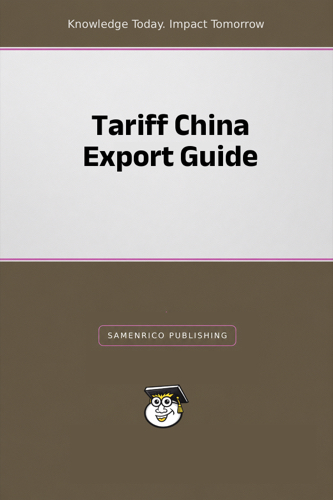
Non-FictionBusiness Brief / China
Tariff China Export Guide eBook
Manages Chinese export tariffs, VAT rebates, and c
Manages Chinese export tariffs, VAT rebates, and customs procedures from China.
Formats
Free sample
Chapter 1: The Three Gatekeepers--–- Every container that leaves China passes through three invisible gates before it ever reaches a ship or a plane. These gates are not physical barriers you can see or touch. They are systems of control, each operated by a different government agency, each with its own rules, databases, and enforcement powers. Together, they decide whether your shipment clears in hours or sits for weeks. They decide whether you get your VAT refund or wait six months.
And if you do not understand how they work, they will decide something else entirely: how much money you lose.This chapter introduces the three gatekeepers of Chinese exports: the General Administration of Customs (GAC), the State Taxation Administration (STA), and the State Administration of Foreign Exchange (SAFE). By the time you finish reading, you will understand who they are, what each one wants from you, and—most importantly—how to make them work for you instead of against you.If you are sourcing products from China, you have probably focused most of your attention on the factory. You negotiated prices. You inspected samples. You argued about quality control.
And then, after all that work, you discovered a new set of problems: customs declarations, VAT paperwork, foreign exchange matching, audit risks. These problems feel bureaucratic and mysterious because they are. But they are also predictable. The system follows rules. And rules can be learned.Let us start with the most important truth about exporting from China: the exporter-of-record must be a Chinese legal entity.
Not you. Not your offshore company. A registered Chinese business with a tax identification number, a customs registration, and a foreign exchange account. This single fact explains almost every complication you will encounter. It is why you need a Chinese customs broker.
It is why your factory sometimes refuses to issue the correct invoice. And it is why the three gatekeepers matter so much.The First Gatekeeper: General Administration of Customs (GAC)The General Administration of Customs, known by its acronym GAC, is the agency that physically controls what enters and leaves China. Think of GAC as the border guard. Every export declaration files through GAC’s system. Every container selected for inspection is flagged by GAC.
Every tariff, every restricted product category, every license requirement—GAC enforces them all.GAC operates under the State Council and has offices at every port, airport, and land border in China. Its legal authority comes from the Customs Law of the People’s Republic of China, which gives it broad powers to inspect goods, demand documentation, assess duties, and impose penalties. For exporters, GAC is the first point of contact. Before your goods can leave China, GAC must approve the export declaration.The Single Window System In 2014, China launched the "Single Window" system—a unified online portal where exporters submit all required documentation in one place. Before the Single Window, exporters had to file separately with customs, tax, and foreign exchange authorities.
Now, one submission goes to all three agencies simultaneously. This sounds efficient, and it is—when everything matches. But the Single Window also creates a new risk: data mismatches are instantly visible to all three gatekeepers. A small error in your commercial invoice can freeze your VAT refund and flag your foreign exchange reconciliation at the same time.The Single Window accepts declarations 24 hours a day, seven days a week. Once submitted, GAC’s risk management system assigns a color code to your shipment: green for automatic release, yellow for document review, or red for physical inspection.
Most routine exports receive green channel clearance within minutes. But if your product category is sensitive, your declared value seems unusual, or your exporter-of-record has a history of violations, you will see yellow or red.GAC’s Risk Management System GAC uses an algorithmic risk management system that scores every export declaration based on dozens of variables: the exporter’s history, the product’s HS code, the declared value, the destination country, the shipping method, and more. The system learns from past inspections. If GAC discovered undervalued shipments of a particular product from a particular region, the algorithm increases risk scores for similar declarations.You cannot see your risk score. But you can influence it.
Consistent, accurate declarations over time lower your risk profile. Frequent amendments, mismatches, or inspections raise it. This is why experienced exporters invest in getting their HS codes right the first time and why they maintain clean records. GAC remembers.Export Controls and Restricted Goods Not everything can be exported freely from China. The Export Control Law of 2020, updated significantly in recent years, restricts dual-use items—goods and technologies that have both civilian and military applications.
Controlled categories include certain chemicals, advanced materials, encryption technology, drones with specific capabilities, and more. Exporting controlled goods without a license is a criminal offense, not just an administrative violation.Even outside of dual-use controls, many products require export licenses: agricultural products subject to quotas, cultural relics, endangered species products, certain pharmaceuticals, and goods covered by international treaties. Your customs broker can tell you whether your product requires a license. But you should ask early—before you commit to production volumes that cannot legally leave China.The Second Gatekeeper: State Taxation Administration (STA)The State Taxation Administration, or STA, is the tax authority of China. For exporters, the STA matters for one reason above all others: VAT refunds.
When you export goods from China, you are entitled to a refund of the value-added tax paid on production inputs. This refund can be substantial—often 9%, 10%, or even 13% of the declared value of your goods. For many importers, the VAT refund is the difference between a profitable product and a money-losing one.But the STA does not simply send refunds to anyone who asks. You must prove that the goods physically left China, that you paid the underlying VAT, and that the transaction is legitimate. The STA cross-references your refund claim with GAC’s export declaration data and SAFE’s foreign exchange records.
If anything does not match, your refund freezes.The Zero-Rate Principle China applies a 0% VAT rate to exported goods. This is not the same as "exempt." Exemption simply means you do not charge VAT to your customer. Zero-rating means you also get back the VAT you paid to your suppliers. This is a crucial difference. Under a zero-rate regime, the entire VAT chain is neutral: the government collects no net tax from exports.
Under an exemption regime, you would lose the input VAT you paid.For a typical manufacturing product, the applicable VAT rate is 13%. But the refund rate is often lower—9% for some electronics, 5% for certain processed foods, even 0% for some raw materials. The difference between the 13% you paid and the refund rate you receive becomes a cost. Smart exporters know the refund rate for their HS code before they negotiate factory prices.The VAT Refund Application Process Claiming a VAT refund requires a monthly filing through the STA’s tax rebate system. You submit your export declaration numbers, your factory VAT invoices, and your proof of foreign exchange receipt.
The STA’s system matches your data against GAC’s customs records and SAFE’s payment records. This is called the "hit system"…
This is the end of the free sample. Get the eBook to keep going. Buy now
About this book
Details
- Author
- Stamm Mariana
- Publisher
- SamEnrico
- Language
- English
- Genre
- Non-Fiction, Business Brief / China
- Released
- 2026-06-09
- Pages (approx.)
- 151
- Available as
- eBook, Audiobook

Read better in the ZLOADR app
Your eBooks on your phone or tablet. Sign in with your SamEnrico account and start reading.
More by Stamm Mariana
 The Binge Eating Voice Separation GuideStamm Mariana$11.99
 Caregiver Boundaries with FamilyStamm Mariana$11.99
 Stress Management for AccountantsStamm Mariana$11.99
 Whispers in the HollowStamm Mariana$11.99
 How to Produce Aquarium Temperature ControllersStamm Mariana$11.99
 Terms Update Notification GuideStamm Mariana$12.99
 A Beginners Guide to Kite landboarding (Volume 1)Stamm Mariana$11.99
 Web & Graphic DesignerStamm Mariana$11.99
You may also like
 Hong Kong Handover 1997Dunn Johnnie$11.99
 Zumba For Postnatal Recovery CourseNeal Christian$11.99
 Zumba for BeginnersLadner Nikia$11.99
 YouTube Comment Mining GuideHumes Pandora$12.99
 Worry Box MeditationCarlin Rudy$11.99
 Workplace Stress MeditationNguyen Lynn$11.99
 Workplace Stress and Sleep RepairHawley Ivory$11.99
 Workplace Perfectionism CureDelaney Jeffry$11.99
 Workplace Injustice Anger GuideWallen Isabelle$11.99
 Work Addiction and Burnout LinkGreenwood Ester$11.99
 Women in Yoga and WellnessBeattie Galina$11.99
 Women in Stand Up ComedyChun Evangeline$11.99