
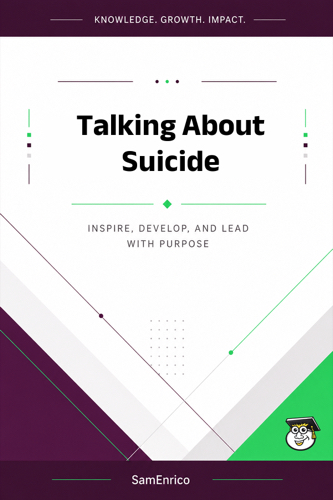
Non-FictionSelf-HelpSuicide Prevention
Talking About Suicide eBook
Approach loved ones in crisis and connect them to
Approach loved ones in crisis and connect them to help.
Formats
Free sample
Chapter 1: The Silence Before...--–- The call always comes at 3:00 AM. Not literally, of course—suicide does not send a calendar invite. But for every person who has lost someone this way, there is a specific, haunting moment when they realize they should have known. Often, that moment arrives in the middle of the night, in the strange quiet between the last text message and the knock on the door from a police officer. The silence, in retrospect, was never empty.
It was full of clues.If you are reading this book, chances are good that you are already afraid. Perhaps someone you love has been withdrawing, sleeping too much or too little, talking in ways that worry you. Perhaps they have said something like “I can’t do this anymore” or “Everyone would be better off without me.” Perhaps they have said nothing at all, but you feel it anyway—a cold current running beneath the surface of your shared life. You are here because you want to know what to do before the 3:00 AM call comes. That is the bravest thing a person can do: to look directly at the possibility of suicide and refuse to look away.This chapter is called The Silence Before because that is where you are standing right now.
You are in the space between suspicion and action, between worry and words. Most people freeze here. They freeze because they are terrified of being wrong. What if they ask and the person laughs? What if they ask and the person gets angry?
What if they ask and the person says yes, and then they are responsible for something they do not know how to fix? These fears are real, and they will be addressed in every chapter of this book. But first, you need to understand what you are looking for. You cannot talk about suicide if you do not recognize it when it is standing in front of you.The Architecture of a Suicidal Crisis Suicide is not an event. It is a process.
This is the single most important fact you will learn in this entire book, and it is the foundation upon which everything else is built. People do not wake up one morning, perfectly fine, and decide to die by suicide that afternoon. There are exceptions—impulsive attempts do happen, particularly among young people under the influence of alcohol or drugs—but the vast majority of suicidal crises build over days, weeks, or months. They follow a predictable architecture, and once you know the blueprint, you can see the cracks forming long before the structure collapses.The first level of the process is suicidal ideation. This is the passive thought of death.
It sounds like: “I wish I wouldn’t wake up,” or “I don’t want to be here anymore,” or simply “What’s the point?” Ideation is dangerous, but it is not yet intent. Many people experience passive suicidal thoughts without ever making a plan. They are suffering, and they deserve help, but they are not necessarily in immediate danger of death. The critical task at this stage is to listen without panic and connect them to support before the thoughts escalate.The second level is suicidal intent. This is when ideation becomes specific.
The person moves from “I wish I were dead” to “I am going to kill myself.” Intent includes three components: a plan (how they would do it), means (access to the method, such as a firearm, pills, or a rope), and a timeline (when they would do it). When all three are present, the risk is imminent. You are no longer in the realm of worry; you are in the realm of emergency. Chapter 6 of this book is dedicated entirely to that moment. For now, the distinction between ideation and intent is your most powerful diagnostic tool.
Most people who die by suicide have both—but they often hide the intent while expressing the ideation. They will say “I feel hopeless” while secretly thinking “I have the pills in my nightstand.”The third level, which is rarely discussed in public, is resolution. This is the terrifying calm that often precedes an attempt. Many survivors report that their loved one seemed better in the days before they died. They were less sad, more peaceful, even generous.
This is not a sign of recovery; it is a sign that they have resolved to die. The internal war is over. They have made a decision, and that decision brings a strange, final relief. They give away prized possessions. They say goodbye in subtle ways: “You’ve been a great friend.” They tie up loose ends.
And everyone around them exhales, thinking the crisis has passed. This is the silence before. It is the most dangerous silence of all.Why We Miss What Is Right in Front of Us If suicidal crises are predictable, why do so many people miss them? The answer is not that people are careless or unobservant. The answer is that the human brain is wired to avoid threatening information, especially when that information implicates us in someone else’s suffering.Psychologists call this motivated inattention.
It is the same mechanism that allows a person to drive past a homeless person on the corner without really seeing them. Your brain registers the presence of pain, but it immediately generates a series of minimizations: “They’re probably fine.” “Someone else will help.” “I’m probably overreacting.” When it comes to suicide, motivated inattention is amplified by fear. If you ask someone if they are suicidal and they say yes, you are now responsible for doing something about it. That is a terrifying prospect. It is much easier, in the short term, to tell yourself that you are imagining things.There is a second reason we miss the signs: the myth of the depressed person.
Most people imagine a suicidal person as someone who is visibly, dramatically sad. They picture someone who cannot get out of bed, who cries constantly, who is obviously in distress. And certainly, some suicidal people fit that description. But many do not. Some suicidal people are high-functioning.
They go to work. They laugh at jokes. They pay their bills. They hide their pain so effectively that even their therapists are sometimes surprised by their deaths. The actor Robin Williams is the most famous example.
He was funny, successful, beloved—and he died by suicide while his wife slept in the next room. No one saw it coming because no one was looking for the right signs.The right signs are not always sadness. They are often behavioral changes that seem minor in isolation but form a pattern over time. Consider the following list, synthesized from the best-selling books on suicide prevention, survivor accounts, and clinical research. You do not need to see all of them.
You need to see enough of them to trust your fear.The Behavioral Clues: A Catalog Sleep disturbances. This is the single most common warning sign, and it is often overlooked. A person who is becoming suicidal may sleep fourteen hours a day, using sleep as an escape from unbearable wakefulness. Or they may sleep…
This is the end of the free sample. Get the eBook to keep going. Buy now
About this book
Details
- Author
- Castleberry Santina
- Publisher
- SamEnrico
- Language
- English
- Genre
- Non-Fiction, Self-Help, Suicide Prevention
- Released
- 2026-06-08
- Pages (approx.)
- 138
- Available as
- eBook, Audiobook

Read better in the ZLOADR app
Your eBooks on your phone or tablet. Sign in with your SamEnrico account and start reading.
More by Castleberry Santina
 Interruption Recovery ScriptCastleberry Santina$11.99
 Loneliness Improv Comedy ClassCastleberry Santina$11.99
 Construction Industry Relationship BuildingCastleberry Santina$11.99
 Agoraphobia HypnosisCastleberry Santina$11.99
 Senior Sleep Esteem GuideCastleberry Santina$11.99
 Stage Four SurvivorCastleberry Santina$11.99
 Burnout Recovery for LawyersCastleberry Santina$11.99
 Antwerp Heist Evidence RoomCastleberry Santina$11.99
 Xochiquetzal and Tezcatlipoca: The Flowered Serpent's Forbidden LoveCastleberry Santina$11.99
 The Iron Spine of Asia: How a Forgotten Engineer Defied Colonial Powers to Build the Godavari BridgeCastleberry Santina$11.99
 The Great Space Race: How Two Nations Split the CosmosCastleberry Santina$11.99
 The Mineral Guide to TanzaniteCastleberry Santina$11.99
You may also like
 Hong Kong Handover 1997Dunn Johnnie$11.99
 Zumba For Postnatal Recovery CourseNeal Christian$11.99
 Zumba for BeginnersLadner Nikia$11.99
 YouTube Comment Mining GuideHumes Pandora$12.99
 Worry Box MeditationCarlin Rudy$11.99
 Workplace Stress MeditationNguyen Lynn$11.99
 Workplace Stress and Sleep RepairHawley Ivory$11.99
 Workplace Perfectionism CureDelaney Jeffry$11.99
 Workplace Injustice Anger GuideWallen Isabelle$11.99
 Work Addiction and Burnout LinkGreenwood Ester$11.99
 Women in Yoga and WellnessBeattie Galina$11.99
 Women in Stand Up ComedyChun Evangeline$11.99