
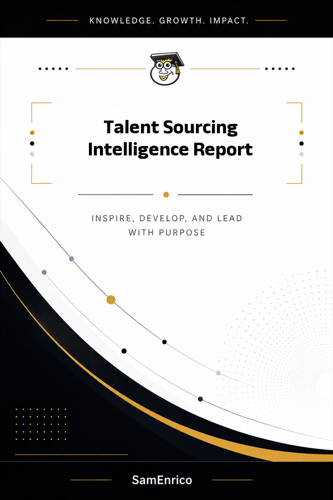
Non-FictionStrategic AtlasRecruiting Intelligence
Talent Sourcing Intelligence Report eBook
Map where fast growing firms find their best candi
by Melvin Cami
Map where fast growing firms find their best candidates through data driven analysis.
Formats
Free sample
Chapter 1: The 70% Rule...--–- Sarah Chen’s phone buzzed at 8:47 AM on a Tuesday. She glanced at the notification, expecting another internal meeting request or a candidate ghosting her on a scheduled call. Instead, she saw a trigger alert she had configured six months earlier—an alert she had almost forgotten about. A senior machine learning engineer at Google’s Zurich office had just updated his Git Hub profile for the first time in eighteen months. More importantly, he had starred a repository related to her company’s specific tech stack: a niche graph database library that fewer than five thousand engineers worldwide understood.Sarah was the Head of Talent at a Series-C AI startup.
Forty-eight hours later, she had a signed offer letter from that engineer. Sixty hours after that, her counterpart at a direct competitor—who had posted the same role on Linked In, sponsored job ads, and waited for applications—was still reviewing resumes from candidates who had never built a production graph database.This is not a story about luck. It is a story about intelligence. And it is the difference between winning the war for talent and being perpetually two steps behind.The Most Expensive Myth in Recruiting For the past twenty years, talent acquisition has operated under a single, unexamined assumption: if you post a job, the right people will eventually apply. This assumption has been reinforced by an entire ecosystem of job boards, applicant tracking systems, and recruiting software built to process inbound applications more efficiently.
The assumption feels logical. It feels safe. It is also catastrophically wrong.Let us begin with a single data point that will reframe everything you think you know about finding talent. According to longitudinal studies from Linked In, Gallup, and the Bureau of Labor Statistics, approximately 70 percent of the global workforce is passive. These individuals are employed.
They are not browsing job boards. They have not updated their resumes. They are not clicking on “Easy Apply” buttons. And yet, they are open to the right opportunity if it finds them.Seventy percent. Let that number land.It means that for every three people who have the skills you need, two will never see your job posting.
They will never click your sponsored ad. They will never be captured by your carefully optimized application form. They are invisible to traditional recruiting methods.The third person—the 30 percent who are actively looking—is already being bombarded by every other company hiring for that role. Your job posting is one of dozens, possibly hundreds, competing for the same limited pool of active candidates. That pool is not only small; it is often the weakest segment of the talent market.
Why? Because the best performers are rarely the ones who need to look for work. They are being pursued. They are being retained. They are being developed.
They are not scrolling through job boards on Sunday night.And yet, the vast majority of recruiting budgets are spent fighting over that 30 percent. Job board subscriptions, sponsored posts, career fair booths, agency fees for active candidates—all of it directed at the smallest, most competitive, and often lowest-quality segment of the talent market.This is the Post-and-Pray Era. It is a strategy rooted in hope rather than intelligence. It treats talent acquisition as a numbers game: post broadly, pray for applicants, and sort through whatever comes in. The firms that still operate this way are not just inefficient.
They are being systematically outcompeted by organizations that have learned to find the invisible 70 percent.Why Your ATS Is a Graveyard If the Post-and-Pray Era has a patron saint, it is the Applicant Tracking System. The ATS was designed to solve a problem that no longer exists. Twenty years ago, companies received paper resumes and needed a way to digitize, organize, and search them. The ATS solved that problem admirably. But the problem has changed, and the ATS has not.Today, the ATS is a backward-looking database of people who have already raised their hands.
It captures intent—who applied, when they applied, what keywords they used. It captures exactly zero potential. It cannot tell you who should apply. It cannot tell you where the best candidates actually work. It cannot tell you when they might be ready to move.
It is a library of the willing, not a map of the talented.Here is a simple test. Open your ATS today. Pick a hard-to-fill role—say, a senior cloud architect with specific experience in Kubernetes and Terraform. Run a search for candidates who have those skills. How many qualified, passive candidates appear?
The answer, almost certainly, is zero. Not because those candidates do not exist, but because they have never applied. They have never even seen your job posting. Your ATS has no idea they exist.Now consider what you are spending on that ATS. Licensing fees, maintenance, integration costs, recruiter training time, and the opportunity cost of building workflows around a system that fundamentally misaligns with the reality of the talent market.
You are not just paying for a tool. You are paying for a worldview that is twenty years out of date.This is not an argument for abandoning all technology. It is an argument for recognizing that the ATS is one tool in a larger ecosystem, and that its role has been grossly overstated. The ATS is useful for compliance, for tracking candidates once they enter your pipeline, and for basic workflow management. It is useless for finding the people who will actually transform your organization.The Sourcing Intelligence Framework If the ATS is the past, what is the future?
The answer is a fundamentally different approach to talent acquisition, one that treats sourcing as a competitive intelligence function rather than an administrative support function.We call this approach the Sourcing Intelligence Framework. It is built on three pillars, each of which replaces a traditional recruiting assumption with a data-driven alternative.Pillar One: Workforce Planning Traditional recruiting is reactive. A hiring manager submits a requisition. A recruiter posts a job. The market responds—or does not.
Everything begins with the requisition.Sourcing Intelligence inverts this sequence. It begins with data about the business: Where is the company growing? What products are launching? What technologies are being adopted? What competitors are entering the market?
From this data, you forecast the skills you will need six, twelve, even eighteen months in advance.Workforce planning in this model is not a bureaucratic exercise conducted annually by HR. It is a dynamic, data-driven process updated quarterly or even monthly. You track signals from the business—product roadmaps, sales forecasts, R&D investments—and translate them into skill requirements. When the business decides to enter a new market, you already know what talent that market requires. When a competitor announces a new product, you already know which of their employees have the skills to build it.The output of workforce planning is not a headcount plan.
It is a talent forecast: a list of skills, roles, and seniority levels the business will need, organized by probability and urgency. Some needs are certain and imminent. Others are possible and distant. Both are tracked, because both inform…
This is the end of the free sample. Get the eBook to keep going. Buy now
About this book
Details
- Author
- Melvin Cami
- Publisher
- SamEnrico
- Language
- English
- Genre
- Non-Fiction, Strategic Atlas, Recruiting Intelligence
- Released
- 2026-06-10
- Pages (approx.)
- 133
- Available as
- eBook, Audiobook

Read better in the ZLOADR app
Your eBooks on your phone or tablet. Sign in with your SamEnrico account and start reading.
More by Melvin Cami
 The Mr. Rogers KindnessMelvin Cami$11.99
 Beginner Mindfulness for ProcrastinationMelvin Cami$11.99
 The Complicated Grief Mindfulness GuideMelvin Cami$11.99
 UX Designer Non Artist GuideMelvin Cami$11.99
 The Wealthy Wisdom of the Wangara Traders: Africa's Financial PioneersMelvin Cami$11.99
 How to Start a Call Horns Business (Beginners Guide)Melvin Cami$11.99
 Corporate Housing SpecialistMelvin Cami$11.99
 Tech Adoption Generations GuideMelvin Cami$12.99
 UTZ Certification Export GuideMelvin Cami$12.99
You may also like
 Hong Kong Handover 1997Dunn Johnnie$11.99
 Zumba For Postnatal Recovery CourseNeal Christian$11.99
 Zumba for BeginnersLadner Nikia$11.99
 YouTube Comment Mining GuideHumes Pandora$12.99
 Worry Box MeditationCarlin Rudy$11.99
 Workplace Stress MeditationNguyen Lynn$11.99
 Workplace Stress and Sleep RepairHawley Ivory$11.99
 Workplace Perfectionism CureDelaney Jeffry$11.99
 Workplace Injustice Anger GuideWallen Isabelle$11.99
 Work Addiction and Burnout LinkGreenwood Ester$11.99
 Women in Yoga and WellnessBeattie Galina$11.99
 Women in Stand Up ComedyChun Evangeline$11.99