
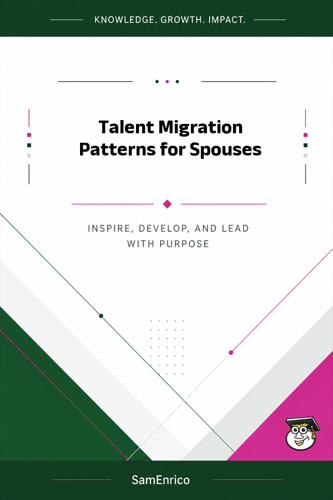
Non-FictionForecast & OutlookGender EconomicsDual Career
Talent Migration Patterns for Spouses
Study trailing spouse employment policies and thei
by Christie Min
Study trailing spouse employment policies and their effect on talent attraction success.
Formats
About this book
Free sample
Chapter 1: The Language Trap...--–- The term arrived quietly, buried in a 1981 Wall Street Journal article about corporate relocations. No one thought much of it at the time. A writer needed a phrase to describe the spouses—almost always wives—who packed up their households, resigned from their jobs, and followed their husbands to new cities for new positions. "Trailing spouse," the article called them. The phrase was descriptive, perhaps even sympathetic.
It certainly did not seem dangerous.But words are never just words. They carry assumptions, encode histories, and shape the possible. Forty years later, that seemingly innocent phrase has become one of the most powerful barriers to global talent mobility—not because of its dictionary definition, but because of the entire worldview it smuggles into every conversation about international assignments.This chapter dismantles that worldview. It traces the origin and evolution of the "trailing spouse" concept, exposes the hidden assumptions baked into the language, and reveals the staggering economic cost of those assumptions. More importantly, it begins the process of reframing—moving from a language of dependency to a language of partnership.
Because you cannot design policies for "dependents" while expecting them to act as co-equal contributors to a successful international assignment. The words you use are the world you build.The Origin Story: How a Phrase Became a Prison The 1981 Wall Street Journal article did not set out to create a lasting stigma. It was a straightforward piece of business journalism, reporting on the growing phenomenon of corporate relocation and the family dynamics that accompanied it. The reporter noted that these "trailing spouses" often struggled with unemployment, social isolation, and loss of identity. The phrase was meant to capture a reality, not construct one.But language has a way of hardening.
By the mid-1980s, "trailing spouse" had moved from journalistic description to corporate shorthand. Human resources departments used it in internal memos. Relocation specialists used it in client meetings. Expatriate support groups used it in their literature. And with each repetition, the assumptions embedded in the phrase became more entrenched.What were those assumptions?
Three in particular.First, the assumption that the primary earner is male. The phrase "trailing spouse" emerged in an era when…
This is the end of the free sample. Get the eBook to keep going. Buy now
Contents
- Chapter 1
- Chapter 2
- Chapter 3
- Chapter 4
- Chapter 5
- Chapter 6
- Chapter 7
- Chapter 8
- Chapter 9
- Chapter 10
- Chapter 11
- Chapter 12
Details
- Author
- Christie Min
- Publisher
- SamEnrico
- Language
- English
- Genre
- Non-Fiction, Forecast & Outlook, Gender Economics, Dual Career
- Released
- 2026-06-08
- Pages (approx.)
- 142
- Available as
- eBook, Audiobook

Read better in the ZLOADR app
Your eBooks on your phone or tablet. Sign in with your SamEnrico account and start reading.
More by Christie Min
 The Kercher Autopsy Forensic ReviewChristie Min$11.99
 Suicide Loss HandbookChristie Min$11.99
 Pain Neuroscience Education PrimerChristie Min$11.99
 Bill Gates Antitrust BattleChristie Min$11.99
 The Last Broadcast: The Night Radio Saved a NationChristie Min$11.99
 Understanding Lichen PlanusChristie Min$17.99
 How to Become a CollectorChristie Min$11.99
 EdTech Language Learning GuideChristie Min$12.99
 West African Trade Payment Solutions GuideChristie Min$12.99
 Diagnostic Medical SonographerChristie Min$11.99
You may also like
 Hong Kong Handover 1997Dunn Johnnie$11.99
 Zumba For Postnatal Recovery CourseNeal Christian$11.99
 Zumba for BeginnersLadner Nikia$11.99
 YouTube Comment Mining GuideHumes Pandora$12.99
 Worry Box MeditationCarlin Rudy$11.99
 Workplace Stress MeditationNguyen Lynn$11.99
 Workplace Stress and Sleep RepairHawley Ivory$11.99
 Workplace Perfectionism CureDelaney Jeffry$11.99
 Workplace Injustice Anger GuideWallen Isabelle$11.99
 Work Addiction and Burnout LinkGreenwood Ester$11.99
 Women in Yoga and WellnessBeattie Galina$11.99
 Women in Stand Up ComedyChun Evangeline$11.99