
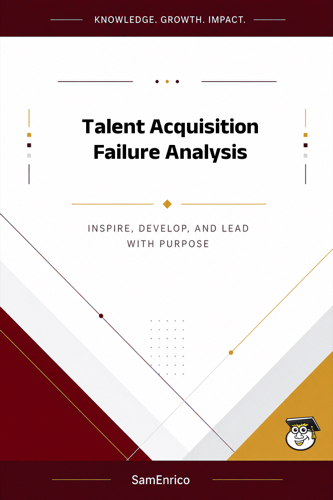
Non-FictionStrategic AtlasFailure Analysis
Talent Acquisition Failure Analysis eBook
Learn from missteps of firms that scaled too fast
Learn from missteps of firms that scaled too fast without hiring infrastructure.
Formats
Free sample
Chapter 1: The Velocity Trap...--–- The email arrived at 11:47 PM on a Tuesday. The subject line read: "Urgent: Engineering hiring crisis." The VP of Talent at a promising Series C Saa S company—let us call it Swift Scale—opened it to find a tirade from the head of product. "We have lost three candidates this week to competitors because our process takes 22 days from screen to offer. Our biggest competitor is closing in 11. We need to cut every corner.
Approve waivers for reference checks. Drop the panel interview. I don't care how. Just ship bodies."Six months later, Swift Scale had grown from 400 to 1,200 employees. Revenue had tripled.
The board was ecstatic. But beneath the surface, something had cracked. Product defects had doubled. Customer churn, which had been 2% quarterly, was now 9%. The engineering team, now five times its original size, had stopped communicating across squads.
Two of the original three founders had resigned, citing "cultural exhaustion." And the VP of Talent who received that late-night email? She had been fired three weeks earlier, blamed for "poor quality hires."The autopsy of Swift Scale is not a story of bad people or lazy recruiters. It is a story of the Velocity Trap—the predictable, mathematically demonstrable point at which the pursuit of hiring speed destroys the very quality that made growth possible in the first place.The Anatomy of the Velocity Trap The Velocity Trap is the central pathology of scaling without infrastructure. It operates on a simple but counterintuitive premise: hiring is not a linear process. Doubling recruiting headcount does not double output quality.
Approving more requisitions does not accelerate time-to-productivity. In fact, beyond a certain threshold—unique to every organization—adding more speed actively degrades the system.To understand why, we must abandon the intuitive but flawed mental model that most executives carry. That model looks like this: more hires → more output → more revenue. It treats hiring as a factory assembly line, where throughput is king and quality is assumed. But hiring is not manufacturing.
It is a complex adaptive system involving human judgment, cultural transmission, and organizational learning. When you push speed beyond the system's carrying capacity, you do not simply get more of the same. You get a phase transition into dysfunction.The two critical decay curves The Velocity Trap reveals itself through two measurable decay curves. The first is the relationship between time-to-hire and quality-of-hire. At Swift Scale, when time-to-hire was 45 days, quality-of-hire—measured by six-month performance ratings, manager satisfaction, and first-year retention—was consistently high.
Eighty-seven percent of hires met or exceeded expectations. When leadership compressed time-to-hire to 30 days, quality dropped to 72 percent. At 22 days, it fell to 58 percent. At 15 days—the target the product head demanded—quality collapsed to 31 percent.This is not a linear decline. It is a cliff.
The data from Swift Scale and dozens of other scaling firms show that quality-of-hire remains relatively stable until time-to-hire falls below a critical threshold, typically around 20 to 25 days for mid-to-senior knowledge-worker roles. Below that threshold, quality drops non-linearly. The reason is structural: below 20 days, you cannot complete reference checks, you cannot run a proper panel interview loop, you cannot conduct meaningful due diligence on a candidate's work history, and you cannot allow for the necessary cooling-off period that separates enthusiasm from judgment.The second decay curve is the relationship between offer velocity and what we might call "post-acceptance regret." When offers are extended too quickly—often within 48 hours of a final interview—both parties suffer from incomplete information. The candidate has not had time to properly evaluate the firm's culture, speak to future peers, or assess the role's long-term fit. The firm has not had time to run background checks, speak to references, or allow for internal calibration.
The result is a predictable pattern: offers are accepted, but candidates either never show up on day one (ghosting) or leave within 90 days without filing an exit interview.At Swift Scale, the ghosting rate among candidates who received offers within three days of their final interview was 18 percent. Among candidates who received offers after seven days, ghosting was 4 percent. The difference was not random; it was the difference between impulsive acceptance and deliberate commitment.The Unsustainable Throughput Formula The Velocity Trap is not an abstract concept. It can be quantified. Let us introduce the concept of sustainable throughput—the maximum number of quality hires an organization can produce per month given its current infrastructure.
The formula is deceptively simple:Maximum Sustainable Hires per Month = (Manager Bandwidth Hours × Interview Capacity) / (Average Time per Quality Hire)Let us break this down. Manager bandwidth hours refer to the total number of hours per week that hiring managers have available for recruiting activities: writing job descriptions, screening resumes, conducting interviews, providing feedback, and making decisions. At a typical scaling firm, a manager might have 40 hours of total work per week. If they are responsible for existing team management, product delivery, and strategic planning, they might have only 5 to 10 hours remaining for hiring. If you ask them to conduct 15 interviews per week, something will break.
Usually, it is the quality of those interviews.Interview capacity refers to the total number of interviews the organization can conduct per week, given the availability of trained interviewers, scheduling coordinators, and feedback loops. Most firms dramatically overestimate their interview capacity because they fail to account for coordination overhead. Every additional interviewer adds not just interview time but also scheduling friction, feedback collection, and calibration overhead.The denominator, average time per quality hire, is the total time invested per hire that results in a successful outcome. This includes sourcing, screening, interviewing, decision-making, offer negotiation, and pre-boarding. Critically, this is not average time per hire overall—it is average time per hire that stays for at least one year and meets performance expectations.
If you are cutting corners to close hires faster, your average time per quality hire may actually increase because you are generating more mis-hires that require rework.When a firm exceeds its sustainable throughput, the system does not simply slow down. It collapses into a state of what we might call high-velocity dysfunction. More recruiting effort produces fewer quality hires. More interviews produce more false positives and false negatives. More offers produce more ghosting and early attrition.The Warning Signs of the Velocity Trap How can you tell if your organization is already caught in the Velocity Trap?
The indicators are measurable, and they appear long before the full collapse. Here are the six most reliable warning signs.First, declining offer acceptance rates. When your process is moving too fast, candidates sense the desperation. They begin to question why you are rushing. They wonder what you are hiding.
And they start using your offer as leverage against competitors who maintain a more deliberate, respectful process. If your offer acceptance rate has dropped by more than 10 percent in two quarters, you are likely in the Velocity Trap.Second, increasing renege rates. A renege is a candidate who accepts an offer and then withdraws before starting. This is not the same as ghosting. Reneges are active decisions, often driven by a candidate's realization that they made a rushed commitment.
At Swift Scale, the renege rate tripled during the 18-month growth sprint, from 3 percent to 11 percent.Third, rising first-year…
This is the end of the free sample. Get the eBook to keep going. Buy now
About this book
Details
- Author
- Stuckey Maren
- Publisher
- SamEnrico
- Language
- English
- Genre
- Non-Fiction, Strategic Atlas, Failure Analysis
- Released
- 2026-06-07
- Pages (approx.)
- 151
- Available as
- eBook, Audiobook

Read better in the ZLOADR app
Your eBooks on your phone or tablet. Sign in with your SamEnrico account and start reading.
More by Stuckey Maren
 The Assertive Feedback GuideStuckey Maren$11.99
 The Nightmare Childhood GuideStuckey Maren$11.99
 Thermidorian Reaction And Directory GuideStuckey Maren$11.99
 Lewis Hamilton Champion StoryStuckey Maren$11.99
 The Celestial Architects of the Nile: Egypt's Stargazers and the Birth of TimeStuckey Maren$11.99
 Understanding Sweet SyndromeStuckey Maren$17.99
 How to Start a Absorptiometer (electronic) Business (Beginners Guide)Stuckey Maren$11.99
 WACC for Intangible AssetsStuckey Maren$12.99
 Chinese Supplier Negotiation GuideStuckey Maren$12.99
 Environmental ManagerStuckey Maren$11.99
You may also like
 Hong Kong Handover 1997Dunn Johnnie$11.99
 Zumba For Postnatal Recovery CourseNeal Christian$11.99
 Zumba for BeginnersLadner Nikia$11.99
 YouTube Comment Mining GuideHumes Pandora$12.99
 Worry Box MeditationCarlin Rudy$11.99
 Workplace Stress MeditationNguyen Lynn$11.99
 Workplace Stress and Sleep RepairHawley Ivory$11.99
 Workplace Perfectionism CureDelaney Jeffry$11.99
 Workplace Injustice Anger GuideWallen Isabelle$11.99
 Work Addiction and Burnout LinkGreenwood Ester$11.99
 Women in Yoga and WellnessBeattie Galina$11.99
 Women in Stand Up ComedyChun Evangeline$11.99