
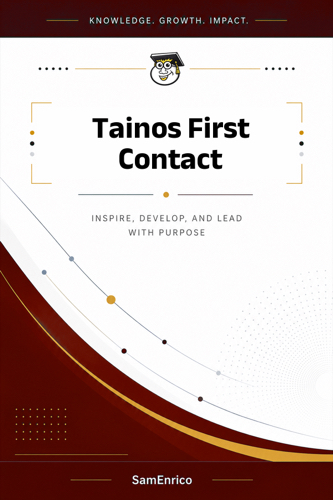
Tainos First Contact Audiobook
undefined
by Beck Andres
undefined
Formats
Free sample
Chapter 1: The World They Made...--–- Before there was a word called "discovery," before any European had dreamed of islands beyond the western sea, there was already a world. It was not an empty world, not a wilderness waiting for a human touch, not a paradise without people. It was a world of villages and gardens, of trade routes and alliances, of ceremonies that lasted through the night and wars that ended with the sunrise. It was a world where the sea was not a barrier but a highway, where dugout canoes carried news and goods and brides across hundreds of miles of open water, where every island knew its neighbors and every cacique knew the names of his rivals. This was the Caribbean in the year 1492, and the people who called it home were the Tainos—though they did not call themselves that.
They called themselves by the names of their islands: the people of Borikén, the people of Kiskeya, the people of Cuba, the people of Xaymaca. They did not know they were about to become the first Americans to meet Europe.This chapter does something that most histories refuse to do. It stops. It pauses the clock of European expansion and refuses to turn the lens toward the sailing ships on the horizon. Instead, it looks inward, east to west, across the archipelago as it existed before any foreign sail appeared on the ocean's edge.
It asks a simple question that is rarely asked: Who were the people who greeted Columbus? Not as victims, not as footnotes to the Spanish story, not as a tragedy waiting to happen—but as living, breathing, complicated human beings who had built a civilization that worked for them for centuries. The answer changes everything we think we know about first contact.The Geography of a Living Archipelago The Caribbean archipelago in 1492 was not a single culture but a mosaic. Stretching from the Bahamas in the north to the Lesser Antilles in the east, from Cuba in the west to Trinidad in the south, the islands contained three major cultural groups, each with its own language, customs, and relationship to the others. Understanding these groups is not an academic exercise.
It is the difference between seeing Columbus as a discoverer of empty land and seeing him as an invader of occupied territory.The first group, and the first to meet Columbus…
This is the end of the free sample. Get the Audiobook to keep going. Buy now
About this book
Details
- Author
- Beck Andres
- Publisher
- SamEnrico
- Language
- English
- Genre
- Non-Fiction, Biography / Indigenous Rights
- Released
- 2026-06-12
- Pages (approx.)
- 110
- Available as
- eBook, Audiobook

Listen in the VoxFlicks app
Audiobooks and audio dramas wherever you go. Sign in with your SamEnrico account and press play.
More by Beck Andres
 Science Fair OrganizerBeck Andres$11.99
 Growing Up Without a Permanent AddressBeck Andres$11.99
 Physics Nobel Mistakes and ControversiesBeck Andres$11.99
 Benzo Freedom Overcoming Fear Of WithdrawalBeck Andres$11.99
 Post Workout Protein GuideBeck Andres$11.99
 Metta for Sober Living HomesBeck Andres$11.99
 Legacy Planning WorkbookBeck Andres$11.99
 The Royal Ballet of Dahomey: Grace and Power in the Court of King GhezoBeck Andres$11.99
 Kali’s Dance of Destruction: The Warrior-Goddess Who Shatters IllusionBeck Andres$11.99
 How to Produce WaxBeck Andres$11.99
 How to Start a Apprenticeship Training BusinessBeck Andres$11.99
 How to Produce Lunch and Deli MeatsBeck Andres$11.99
You may also like
 Massasoit WampanoagClayton Gerald$11.99
 Tariana TuriaSykes Shellie$11.99
 Vincent LingiariSnow Elouise$11.99
 Moana JacksonPounds Anthony$11.99
 Anacaona Taíno ChiefCreech Cecila$11.99
 Steve Biko Black ConsciousnessField In$11.99
 Sitting Bull Life StoryWeis Jannet$11.99
 Charles PerkinsThrasher Jodee$11.99
 Winona LaDuke ActivistBrownlee Jacqualine$11.99
 Maori Rights AdvocatesLattimore Ebonie$11.99
 Linda Tuhiwai SmithMatthews Kate$11.99
 Cacique LempiraBox Tammi$11.99