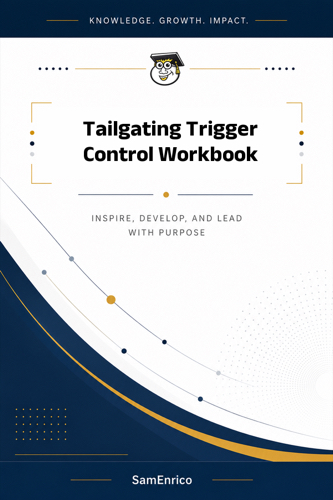
Tailgating Trigger Control Workbook eBook
Creates response protocols for when drivers follow
Creates response protocols for when drivers follow too closely.
Formats
Free sample
Chapter 1: The Mirror That Lies--–- The average driver checks their rearview mirror 12 to 15 times per minute. Every one of those glances is a risk assessment, a calculation of threat, a micro-decision about whether to speed up, slow down, or change lanes. And here is the terrifying truth that no driving manual has ever fully acknowledged: most of those assessments are wrong. Your brain is not designed to evaluate cars approaching from behind. It is designed to evaluate predators approaching from behind.
And in the three million years since that design was finalized, absolutely nothing has prepared your amygdala to distinguish between a hungry lion and a distracted real estate agent in a leased SUV.This chapter is not about what tailgaters do. It is about what you see when you look for them—and why your eyes are only half the equation. The rearview mirror is not a window. It is a psychological projector. You do not see the car behind you.
You see your fear of the car behind you, filtered through a nervous system that cannot tell the difference between a tailgater and a terrorist. Before you can learn a single protocol, before you can master a single drill, you must first understand that the threat in your mirror is never just the threat in your mirror. The real danger is the 90-second window during which your rational brain takes a coffee break and your lizard brain takes the wheel.This is the chapter that will save your life not by teaching you what to do, but by teaching you what to stop doing. You will learn the 90-Second Rule of Emotional Flooding. You will learn how to distinguish between a Phantom Risk and a Real Collision Threat.
And you will learn the single most important question a driver can ask while being tailgated: "Is this driver actually dangerous, or am I just reacting?"By the end of this chapter, you will have completed your first workbook exercise: The Rearview Mirror Audit. You will have a laminated card for your visor that tells you when to wait and when to act. And you will understand why the first conditioned reflex you must build is not a physical movement but a cognitive pause. The mirror lies. This chapter teaches you to see through it.The 90-Second Hijack: Why You Lose Your Mind (And Your Brakes)Let us begin with a simple physiological fact.
The amygdala—a small, almond-shaped cluster of nuclei located deep within the temporal lobe—processes threats in approximately 30 milliseconds. That is 0.03 seconds. By the time your conscious brain registers that a car is following closely, your amygdala has already decided whether that car wants to kill you. And here is the problem: the amygdala cannot distinguish between a genuine threat and a perceived one. It cannot tell the difference between a tailgater who is actively trying to run you off the road and a tailgater who is simply late for a dentist appointment.
It processes both as existential danger because, evolutionarily speaking, it was never given the software update to handle traffic.This brings us to the 90-Second Rule of Emotional Flooding. When your amygdala perceives a threat, it initiates a cascade of neurochemical events. Cortisol and adrenaline flood your bloodstream. Your heart rate increases by an average of 30 to 50 beats per minute. Your peripheral vision narrows—a phenomenon called tunnel vision that evolutionary biologists believe helped our ancestors focus on a single predator but which, on a highway, causes you to miss the car braking in the adjacent lane.
Your prefrontal cortex—the part of your brain responsible for rational decision-making, impulse control, and long-term planning—is partially suppressed. This is not a metaphor. Functional MRI studies of drivers under stress show measurable decreases in prefrontal cortex activity during tailgating incidents. You literally become stupider when someone follows you too closely.The 90-second window is the time it takes for this neurochemical flood to peak and begin receding. For approximately 90 seconds after a perceived threat, your decision-making is impaired.
During that window, you are statistically more likely to:Brake check (which, as Chapter 3 will explain in brutal physical detail, is assault with a deadly weapon)Speed up to "escape" (which rarely works and often leads to a high-speed collision)Change lanes unsafely (without checking blind spots or signaling)Make aggressive hand gestures (which escalate the conflict)Tailgate someone else (because stress is contagious)Here is the critical nuance that every other defensive driving book gets wrong. The 90-Second Rule is not a command to wait 90 seconds before doing anything. That would be suicidal if the car behind you is a genuine threat moving at 80 miles per hour. The 90-Second Rule applies conditionally: it tells you how long to wait before responding to an ambiguous threat. If you have not yet determined whether the car behind you is dangerous, you must wait 90 seconds before taking any action other than maintaining your lane and speed.
Why? Because any action you take during that window will be driven by the amygdala, not the prefrontal cortex. And the amygdala's only strategy is fight, flight, or freeze—none of which are optimal for highway driving.If, however, you have already determined that the car behind you is a Real Collision Threat—not just a Phantom Risk—then the 90-Second Rule does not apply. You move immediately. That distinction is the entire point of this chapter.
The Rearview Mirror Audit, which you will complete shortly, is the tool that makes that distinction possible. Without it, you are either overreacting to harmless drivers (90 percent of tailgating incidents) or underreacting to dangerous ones (the remaining 10 percent that cause most fatalities). The 90-Second Rule gives you permission to pause. The Rearview Mirror Audit gives you the criteria to know whether that pause is safe or suicidal.The Three Profiles: Who Is Actually Behind You?Not all tailgaters are created equal. In fact, most tailgaters are not tailgaters at all in the sense that you imagine.
They are drivers who happen to be following closely for reasons that have nothing to do with aggression, malice, or even awareness of your existence. This chapter breaks down the following vehicle into three distinct profiles based on decades of traffic psychology research and crash reconstruction data from the National Highway Traffic Safety Administration (NHTSA) and the American Automobile Association (AAA).Profile One: The Distracted Driver (Low Risk, Phantom)The Distracted Driver is the most common tailgater you will encounter, comprising approximately 60 to 70 percent of close-following incidents. This driver is not following you closely on purpose. They are following you closely because their attention is elsewhere: on a phone screen, a navigation system, a conversation with a passenger, or their own internal monologue. The Distracted Driver's following distance varies widely because their foot pressure on the accelerator is inconsistent.
They drift closer, then drift back, then drift closer again. They may look up suddenly, brake hard, and then resume their previous distance. They rarely use turn signals. They may weave slightly within their lane. They will almost never flash their headlights or honk.The Distracted Driver is a Phantom Risk.
They are annoying. They are unsafe. They are statistically overrepresented in rear-end collisions. But they are not trying to harm…
This is the end of the free sample. Get the eBook to keep going. Buy now
About this book
Details
- Author
- Shorter Lahoma
- Publisher
- SamEnrico
- Language
- English
- Genre
- Non-Fiction, Self-Help, Driving Safety
- Released
- 2026-06-12
- Pages (approx.)
- 159
- Available as
- eBook, Audiobook

Read better in the ZLOADR app
Your eBooks on your phone or tablet. Sign in with your SamEnrico account and start reading.
More by Shorter Lahoma
 Meeting Scheduling OptimizationShorter Lahoma$11.99
 Cocaine Recovery Anhedonia GuideShorter Lahoma$11.99
 September Massacres GuideShorter Lahoma$11.99
 Talking About Postpartum Depression GuideShorter Lahoma$11.99
 Anger and Pornography UseShorter Lahoma$11.99
 Postpartum Depression Financial Stress GuideShorter Lahoma$11.99
 Self Hypnosis Script HandbookShorter Lahoma$11.99
 Exercise Protocols for Joint Pain ReliefShorter Lahoma$11.99
 The Visionaries of Stone: How Christopher Wren Built a New LondonShorter Lahoma$11.99
 Quetzalcoatl’s Feathered Serpent: The Cosmic Dance of CreationShorter Lahoma$11.99
 The Last Sip: How Nespresso Revolutionized Coffee CultureShorter Lahoma$11.99
 Understanding Angioma Hereditary NeurocutaneousShorter Lahoma$17.99