
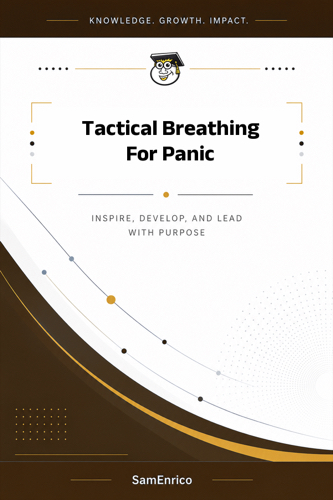
Non-FictionMental WealthMilitary Techniques
Tactical Breathing For Panic eBook
Use Navy SEAL 4 4 4 4 box breathing to force calm
Use Navy SEAL 4 4 4 4 box breathing to force calm nervous system.
Formats
Free sample
Chapter 1: The Paradox of Panic--–- The first time Sarah felt her heart slam against her ribs like a trapped bird, she was standing in the checkout line at a grocery store. There was no threat. No masked man. No medical emergency. Just fluorescent lights, the hum of a freezer case, and a woman in front of her counting coupons.
And yet, within sixty seconds, her vision tunneled to a pinprick, her hands went numb, and she was absolutely certain—beyond any logic, beyond any reassurance—that she was about to die. She left her cart full of groceries and fled to her car, where she sat shaking for twenty-three minutes before she could drive home. The attack came from nowhere. It ended for no reason. And it left her terrified of the next one.This is the paradox of panic.
You are not afraid of anything real. There is no predator, no falling object, no attacker. Your body is responding as if there is, with the full force of a survival system that evolved over millions of years to save your life from physical threats. But there is no threat. And that mismatch—between the internal emergency and the external reality—is what makes panic attacks so bewildering and so terrifying.
You cannot fight what is not there. You cannot flee from nothing. So you are left frozen in the checkout line, the boardroom, the highway, the elevator, wondering if you are losing your mind, having a heart attack, or both.This book will teach you a different way out. Not through positive thinking, which fails precisely when you need it most. Not through avoidance, which shrinks your world one feared place at a time.
But through a mechanical, physiological override that has been used by Navy SEALs in combat, paramedics in the field, and pilots in emergency landings. It is called tactical breathing, and it works not because it calms your thoughts, but because it forces your nervous system to change state whether your thoughts agree or not.Before we get to the technique, you need to understand why everything you have been told about calming down is wrong, what actually happens inside your body during the first sixty seconds of a panic attack, and why your breath is the only tool that can reach the control panel of your autonomic nervous system.The Worst Advice in the World Let us begin with the most common, most well-intentioned, and most damaging piece of advice given to panic sufferers: "Just relax." Or its cousins: "Calm down," "Take it easy," "There's nothing to be afraid of," and "Just breathe."On the surface, these seem reasonable. Of course you want to calm down. Of course you know there is nothing to be afraid of. The problem is that your brain does not process these commands as helpful guidance.
It processes them as evidence. Here is what happens in the milliseconds after someone tells you to "calm down" while you are panicking.Your brain runs a rapid, unconscious calculation. First, it registers the command. Second, it assesses why such a command would be necessary. Third, it concludes: if someone is telling me to calm down, I must not be calm.
And if I am not calm despite no visible threat, the threat must be internal, invisible, and serious. This triggers a secondary surge of adrenaline, layered on top of the first. The result is not calm. It is intensified panic.This is called the Paradox of Panic, and it has been observed in clinical settings for decades. The more you try to force calm, the more you signal to your brain that something is wrong.
It is the same mechanism that makes "Don't think about a white bear" cause you to think about nothing but white bears. The brain does not process negatives efficiently. "Don't panic" becomes "panic." "Calm down" becomes "there is something to be afraid of."Worse, the advice "just relax" carries an implicit judgment. It suggests that panic is a failure of will, a lack of effort, a weakness that could be overcome if you simply tried harder. This is not only false—panic is not a character flaw but a physiological event—but it adds shame to the already overwhelming experience of terror.
Now you are not only panicking. You are also failing at not panicking. The shame creates more adrenaline. The cycle accelerates.If you have ever been told to "just calm down" during a panic attack and felt worse afterward, you are not broken. You are not weak.
You were given the wrong tool for the job. Telling someone in the middle of a sympathetic nervous system surge to relax is like telling someone in the middle of a sprint to slow down by thinking about slowing down. It does not work. The body has its own momentum. You need a mechanical brake, not a suggestion.The Cortisol Tsunami: What Happens in the First Sixty Seconds To understand why your breath is the answer, you must first understand what happens inside your body during the opening minute of a panic attack.
This is not a psychological failure. It is a chemical and electrical event, as predictable and measurable as a seizure.It begins with a trigger. The trigger can be external—a crowded elevator, a highway exit, a public speech. Or it can be internal—a skipped heartbeat, a dizzy spell, a feeling of unreality. In many cases, the trigger is so subtle that you never consciously notice it.
Your brain's threat detection system, called the amygdala, fires a warning signal before you know why.Within milliseconds, the amygdala sends a distress signal to the hypothalamus, the command center of your stress response. The hypothalamus activates the sympathetic nervous system, which is the gas pedal of your autonomic nervous system. This is not a decision you make. It is a reflex, older than human consciousness, designed to save you from predators.The first chemical to flood your system is adrenaline (epinephrine). It hits your bloodstream within two to three seconds.
Your heart rate jumps from a resting rate of 60-80 beats per minute to 120, then 140, then 160. Your heart is not malfunctioning. It is responding exactly as it should to a perceived threat, pumping blood faster to your large muscle groups so you can fight or run.Next comes cortisol, the primary stress hormone. It takes slightly longer to ramp up, peaking around thirty to sixty seconds after the trigger. Cortisol does several things at once.
It releases glucose from your liver into your bloodstream, providing emergency fuel. It suppresses non-essential systems like digestion and reproduction. It narrows your blood vessels to increase blood pressure. And it communicates with your brain to heighten vigilance.Now the physical sensations begin in earnest. Your breathing shifts from slow, deep diaphragmatic breaths to rapid, shallow thoracic breaths—chest breathing.
This is the body preparing for exertion. You are taking in more oxygen to fuel your muscles. The problem is that you are not exerting yourself. You are standing in a grocery store. So the rapid breathing leads to a slight drop in carbon dioxide levels in your blood, a state…
This is the end of the free sample. Get the eBook to keep going. Buy now
About this book
Details
- Author
- Mccorkle Coralee
- Publisher
- SamEnrico
- Language
- English
- Genre
- Non-Fiction, Mental Wealth, Military Techniques
- Released
- 2026-06-09
- Pages (approx.)
- 143
- Available as
- eBook, Audiobook

Read better in the ZLOADR app
Your eBooks on your phone or tablet. Sign in with your SamEnrico account and start reading.
More by Mccorkle Coralee
 Mindful Eating MBSR PracticeMccorkle Coralee$11.99
 Crohn's Fistula TreatmentMccorkle Coralee$11.99
 Delegation Metrics TrackingMccorkle Coralee$11.99
 The Phantom of the Comédie-Française: The Ghost Who Saved a TheaterMccorkle Coralee$11.99
 Price Match Guarantee Without FearMccorkle Coralee$12.99
 How to Produce Cassette Players and RecordersMccorkle Coralee$11.99
 10 Ways to Use Allspice (Recipe Book)Mccorkle Coralee$11.99
 Mortgage Loan UnderwriterMccorkle Coralee$11.99
You may also like
 Hong Kong Handover 1997Dunn Johnnie$11.99
 Zumba For Postnatal Recovery CourseNeal Christian$11.99
 Zumba for BeginnersLadner Nikia$11.99
 YouTube Comment Mining GuideHumes Pandora$12.99
 Worry Box MeditationCarlin Rudy$11.99
 Workplace Stress MeditationNguyen Lynn$11.99
 Workplace Stress and Sleep RepairHawley Ivory$11.99
 Workplace Perfectionism CureDelaney Jeffry$11.99
 Workplace Injustice Anger GuideWallen Isabelle$11.99
 Work Addiction and Burnout LinkGreenwood Ester$11.99
 Women in Yoga and WellnessBeattie Galina$11.99
 Women in Stand Up ComedyChun Evangeline$11.99