
Non-FictionMental WealthDigital Declutter
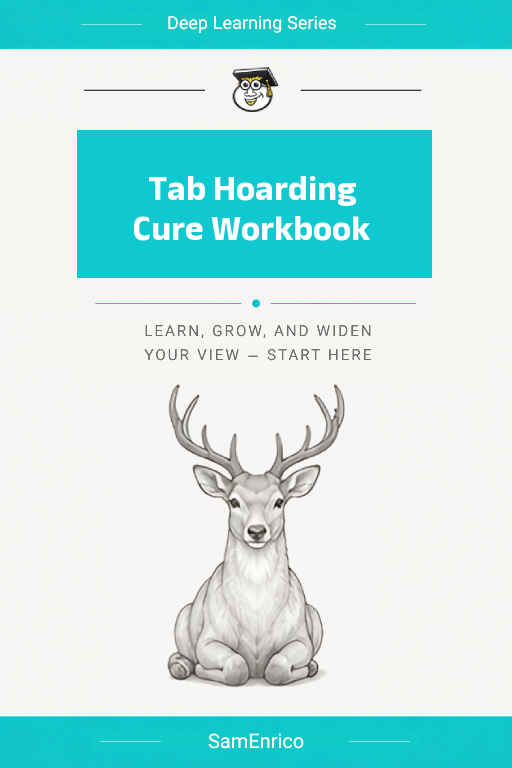
Tab Hoarding Cure Workbook eBook
Close 50 plus browser tabs with a decision framewo
by Sauer Antone
Close 50 plus browser tabs with a decision framework that reduces visual noise and cognitive load.
Formats
Free sample
Chapter 1: The Attention Leak--–- You are not lazy. You are not undisciplined. And you are certainly not alone.Look at your browser right now. Go ahead. Glance at the top of your screen.
How many tabs are open? Not the ones you're actively using this minute, but the ones that have been sitting there for days, weeks, maybe even months. The job application you meant to finish. The recipe for a dinner you never cooked. The research article you swore you'd read.
The shopping cart you abandoned. The documentation for a software project you started last quarter.Now count them.If you are like the vast majority of knowledge workers, students, and digital creators in 2026, that number is somewhere between 30 and 80. Some people we surveyed for this book reported numbers above 200. One reader admitted to over 500 tabs spread across three different browsers. She cried when she told us.
Not because she was embarrassed, but because she had no idea how to dig herself out.This chapter is not going to tell you to "just close them." If it were that simple, you would have done it already. This chapter is going to show you why those tabs are still open, what they are costing you, and how to measure the damage so you can finally begin the recovery process. Welcome to the diagnosis.The Shame of the Overstuffed Browser There is a particular flavor of digital shame that comes from looking at a browser crowded with identical favicons. You know the feeling. You open your laptop to do one specific thing—check email, write a document, join a meeting—and immediately you are confronted with the accumulated weight of every unfinished thought you have had in the past several weeks.
The tabs stare back at you like unfinished conversations. Each one whispers a small reminder: "You still need to do this. You forgot about me. You're falling behind."The shame is compounded by the fact that you cannot remember why half of them are there. You hover over a tab.
The title is truncated. You click on it, stare at the page for five seconds, and realize you have no memory of opening it. Was it important? Maybe. Was it urgent?
Probably not. But closing it feels like a risk. What if you needed it? What if the information is gone forever? What if closing the tab means admitting defeat?This is not a character flaw.
This is a design flaw. The modern browser, for all its power, was never designed to handle the way we use it today. Browsers were built for a world where you visited a page, read it, and left. They were not built for a world where every page is a potential task, every link a promise to your future self, and every click a new thread in an ever-expanding web of unfinished business.But before we can fix the browser, we need to understand what is happening inside your brain. Because the problem is not really the tabs.
The problem is what the tabs represent.Cognitive Load Theory: Why Your Brain Feels Like It's Drowning In the 1980s, educational psychologist John Sweller developed something called Cognitive Load Theory. He was trying to understand why some learning materials were more effective than others, but his insights have proven extraordinarily useful for understanding the digital workplace of 2026.Sweller distinguished between three types of cognitive load. The first is intrinsic load—the inherent difficulty of the task you are trying to accomplish. Writing a report, solving a problem, learning a new skill—these things require mental effort by their very nature. You cannot eliminate intrinsic load, nor would you want to.
It is the work itself.The second type is germane load—the mental effort you invest in building useful mental structures, like learning a new framework or developing a skill. This is good load. It is how you grow.The third type is extraneous load—the mental effort wasted on things that have nothing to do with the task at hand. A confusing user interface. A noisy environment.
A browser with fifty-seven tabs open at the top of the screen.Here is the problem. Your brain has a limited amount of working memory. You can only hold about three to four pieces of information in your conscious mind at any given moment. This is not a guess; it is a well-replicated finding in cognitive psychology. When you are trying to write a report (intrinsic load), and your brain is simultaneously keeping track of the fifty-seven tabs sitting above your document (extraneous load), you are not operating at full capacity.
You are operating at a fraction of it.Every time your eye catches a different favicon, every time you briefly wonder what that tab is doing there, every time you suppress the urge to click away from your current task, you burn a small amount of mental fuel. Over the course of a day, that adds up. Over the course of a week, it is catastrophic.Most people assume that leaving tabs open is harmless. They are just sitting there, after all. You are not actively looking at them.
But the research tells a different story. The mere presence of unfinished tasks—represented visually by those tabs—creates what psychologists call attention residue.The Zeigarnik Effect: The Brain's Annoying To-Do List In the 1920s, a Russian psychologist named Bluma Zeigarnik observed something peculiar about waiters. She noticed that waiters seemed to remember unpaid orders perfectly but forgot them almost immediately after the bill was settled. Intrigued, she designed a series of experiments and discovered a fundamental truth about human memory: people remember uncompleted or interrupted tasks significantly better than completed ones.This is the Zeigarnik Effect, and it is the reason those fifty-seven tabs are still open.Every tab represents an interrupted task. Maybe you opened a tab to read an article, then got distracted by an email.
Maybe you opened a tab to buy a gift, then realized you needed to check your budget first. Maybe you opened a tab for a work project, then got called into a meeting. In each case, you did not finish what you started. And your brain, faithful and exhausting, has been reminding you ever since.The Zeigarnik Effect is not a bug. It is a feature of how your brain evolved.
In an environment where forgetting an unfinished task could mean leaving food uncollected or a predator undetected, the ability to remember incomplete work was essential for survival. But in the modern digital environment, that same feature becomes a liability.Every open tab is a small, persistent "remember me" notification firing in the background of your consciousness. You are not aware of it most of the time, just as you are not aware of your own breathing. But it is there, consuming resources, demanding attention, and slowly draining your capacity to focus on what matters.The worst part is that the Zeigarnik Effect intensifies the more tabs you have. Each new tab creates another open loop.
Each open loop adds to the cognitive burden. At some point—usually somewhere between fifteen and thirty tabs—your brain stops being able to…
This is the end of the free sample. Get the eBook to keep going. Buy now
About this book
Details
- Author
- Sauer Antone
- Publisher
- SamEnrico
- Language
- English
- Genre
- Non-Fiction, Mental Wealth, Digital Declutter
- Released
- 2026-06-01
- Pages (approx.)
- 145
- Available as
- eBook, Audiobook

Read better in the ZLOADR app
Your eBooks on your phone or tablet. Sign in with your SamEnrico account and start reading.
More by Sauer Antone
 Perfectionism at Work GuideSauer Antone$11.99
 Spousal Anger CBT GuideSauer Antone$11.99
 Failure Rituals and CeremoniesSauer Antone$11.99
 HGH and Body CompositionSauer Antone$11.99
 Talking About Gender IdentitySauer Antone$11.99
 Special Needs Financial PlanningSauer Antone$11.99
 Outsourcing for Small BusinessSauer Antone$11.99
 Ashton Manual GuideSauer Antone$11.99
 The Lovers of the Starry Sky: A Navajo Skywalker’s SacrificeSauer Antone$11.99
 The Fire Beneath Constantinople: Byzantine Engineering and the Thera VolcanoSauer Antone$11.99
 How to Start a Manicurist Business (Beginners Guide)Sauer Antone$11.99
 How to Produce Protective PackagingSauer Antone$11.99
You may also like
 Hong Kong Handover 1997Dunn Johnnie$11.99
 Zumba For Postnatal Recovery CourseNeal Christian$11.99
 Zumba for BeginnersLadner Nikia$11.99
 YouTube Comment Mining GuideHumes Pandora$12.99
 Worry Box MeditationCarlin Rudy$11.99
 Workplace Stress MeditationNguyen Lynn$11.99
 Workplace Stress and Sleep RepairHawley Ivory$11.99
 Workplace Perfectionism CureDelaney Jeffry$11.99
 Workplace Injustice Anger GuideWallen Isabelle$11.99
 Work Addiction and Burnout LinkGreenwood Ester$11.99
 Women in Yoga and WellnessBeattie Galina$11.99
 Women in Stand Up ComedyChun Evangeline$11.99