
Non-FictionHistoryMilitary Biography
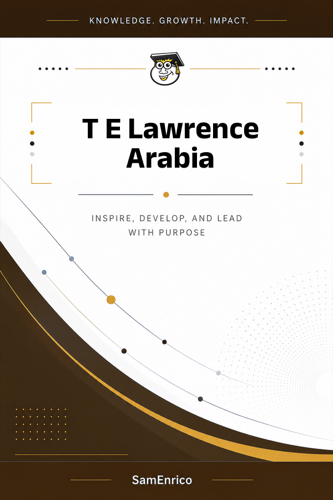
T E Lawrence Arabia eBook
Explores the British officer who helped lead the A
by Gough Sam
Explores the British officer who helped lead the Arab Revolt.
Formats
Free sample
Chapter 1: The Bastard Son...--The house at 2 Polstead Road in Oxford was unremarkable from the outside—a modest Victorian villa of red brick, with bay windows and a small garden, indistinguishable from its neighbors. But inside those walls, behind those lace curtains, a secret lived and breathed. It was a secret that would shape a boy named Thomas Edward Lawrence into a man who wore masks so skillfully that even he eventually forgot which face was real.The secret was this: his father was not who he said he was. And his mother had never told him her own name.The man Ned Lawrence called "Father" was Sir Thomas Chapman, seventh baronet of South Hill in County Westmeath, Ireland. He was a landowner, a gentleman, a man of title and estate.
But Sir Thomas had done something unforgivable in the rigid moral universe of Victorian Britain: he had fallen in love with the wrong woman. Not a woman of lower class—that could be managed, hidden, paid off. No, he had fallen in love with the family governess, a woman named Sarah Junner. And worse, he had left his wife and four legitimate daughters to live with her.Sarah Junner was herself a secret wrapped in a mystery. She had been raised in a poorhouse in Sunderland, the daughter of a woman named Elizabeth Junner, who worked as a domestic servant.
Elizabeth never married. Sarah never knew her father's name. In the ledgers of the Sunderland workhouse, she was simply "Sarah Junner, bastard." That word—bastard—would follow her like a shadow. And because she was illegitimate, her children would be illegitimate too. The stain of uncertain parentage was her inheritance, and she passed it to her sons.When Sir Thomas abandoned his title and his legitimate family to elope with Sarah, he did not divorce his wife—divorce was scandalous, expensive, and nearly impossible for a man of his standing.
Instead, he simply disappeared from his own life. He changed his name to "Lawrence," taking his mother's maiden name. He moved to Oxford, a university town far from Irish gossip. And he lived there with Sarah as man and wife, though they were never legally married because his first wife was still alive.The neighbors knew nothing. The boys—there would be five of them, born between 1885 and 1903—knew nothing for years.
They were raised as Lawrences, the sons of a respectable if somewhat mysterious gentleman scholar. But children sense what adults try to hide. They feel the weight of unspoken things. And the Lawrence household was heavy with secrets.The Mother's Shadow Sarah Lawrence was a woman forged in the fire of shame. She had been abandoned as an infant by a mother who could not or would not keep her.
She had grown up knowing she was nobody's legitimate daughter. Then she had become the governess in a wealthy household and fallen in love with the master—a story as old as time, and one that rarely ends well for the woman. But unlike most governesses in Victorian novels, Sarah did not fade away. She held on. She demanded that Sir Thomas choose her.
And when he did, she demanded that he never look back.The price of that choice was a life of terrified respectability. Sarah Lawrence became a puritan, a disciplinarian, a woman who ruled her household with a Bible in one hand and a moral strictness that bordered on cruelty. She would not allow her boys to forget that they were different—not in so many words, but in the thousand small ways that mothers communicate worth. She cleaned obsessively. She prayed incessantly.
She denied them affection as if love were a luxury they could not afford.Ned—the name Thomas Edward went by as a child—was her second son, born on August 16, 1888. He was small, pale, and quiet. He had his mother's intensity and his father's intelligence, but neither parent's ease with the world. From the beginning, he was a watcher. He observed people the way other children observed insects: with a detached, almost scientific curiosity that seemed odd in such a young boy.Sarah loved her sons, but she loved them the way a sculptor loves marble—by chipping away everything that was not perfect.
She demanded excellence. She punished failure with cold silences that lasted days. She taught her boys that the world would judge them harshly, so they must judge themselves first. Ned learned to anticipate her moods, to read her face for signs of displeasure, to disappear into books when the tension in the house became unbearable.The Father's Retreat If Sarah was the enforcer, Sir Thomas—now Mr. Lawrence, though everyone in Oxford suspected he was more than that—was the enabler.
He had given up his title, his land, his legitimate children for this woman. Having made that sacrifice, he could not now disagree with her. He retreated into his study, into his books, into his photography. He took the boys on long walks through the Oxfordshire countryside, teaching them to identify birds and flowers, showing them how to compose a photograph, how to see the world through a lens. He was gentle, distant, and haunted.Tom—as the boys called him, never Sir Thomas—was a man who had erased himself.
He had changed his name, abandoned his class, and moved to a city where no one knew him. He had chosen love over duty, and then discovered that love in hiding was not the same as love in the light. He could not hold Sarah's hand in public without risking exposure. He could not acknowledge his sons as the heirs to a baronetcy that no longer recognized them. He had become a ghost while still alive.Ned loved his father, but he also pitied him—and pity is a dangerous emotion for a child to feel toward a parent.
From Tom, Ned learned that identity is negotiable. A man could be one thing in Ireland and another thing in Oxford. A man could have one name on his birth certificate and another on his door. A man could simply decide to become someone else, and the world would accept it if the performance was convincing enough.This was the first and most important lesson of Ned Lawrence's childhood: identity is a mask, and masks can be changed.The School of Loneliness Ned did not thrive at school. He was small for his age, with a high-pitched voice and a face that was more striking than handsome—pale skin, startling blue eyes, a shock of sandy hair that never lay flat.
He was not athletic. He was not popular. He was not the kind of boy other boys wanted to play with.But he was brilliant. Not merely smart—brilliant in the way that made teachers uncomfortable. He read voraciously, everything he could find: history, poetry, military strategy, medieval romances.
He taught himself French and Latin. He developed a passion for chivalry and knights, for the age of Crusaders, for men who rode into battle with armor and ideals. He loved the idea of honor, perhaps because he had so little of it in his…
This is the end of the free sample. Get the eBook to keep going. Buy now
About this book
Details
- Author
- Gough Sam
- Publisher
- SamEnrico
- Language
- English
- Genre
- Non-Fiction, History, Military Biography
- Released
- 2026-06-06
- Pages (approx.)
- 113
- Available as
- eBook, Audiobook

Read better in the ZLOADR app
Your eBooks on your phone or tablet. Sign in with your SamEnrico account and start reading.
More by Gough Sam
 Anger Iceberg Exploration GuideGough Sam$11.99
 Russian Gasoline Wars 1990sGough Sam$11.99
 Workplace Anger Trigger GuideGough Sam$11.99
 The Construction Safety StockGough Sam$11.99
 Brainstorming for SolopreneursGough Sam$11.99
 The Great Mother ArchetypeGough Sam$11.99
 Procrastination for Social WorkersGough Sam$11.99
 The Shadow Warriors: The Secret Wars of 18th-Century Martial MastersGough Sam$11.99
 The Silk and Scalpel: Healing Hands of the Swahili CoastGough Sam$11.99
 How to Produce Power SweepersGough Sam$11.99
 Hempseed: Harvesting For Oil & BirdseedGough Sam$11.99
 Grant Writing Evaluation Tools WorkbookGough Sam$12.99
You may also like
 Hong Kong Handover 1997Dunn Johnnie$11.99
 Zumba For Postnatal Recovery CourseNeal Christian$11.99
 Zumba for BeginnersLadner Nikia$11.99
 YouTube Comment Mining GuideHumes Pandora$12.99
 Worry Box MeditationCarlin Rudy$11.99
 Workplace Stress MeditationNguyen Lynn$11.99
 Workplace Stress and Sleep RepairHawley Ivory$11.99
 Workplace Perfectionism CureDelaney Jeffry$11.99
 Workplace Injustice Anger GuideWallen Isabelle$11.99
 Work Addiction and Burnout LinkGreenwood Ester$11.99
 Women in Yoga and WellnessBeattie Galina$11.99
 Women in Stand Up ComedyChun Evangeline$11.99