
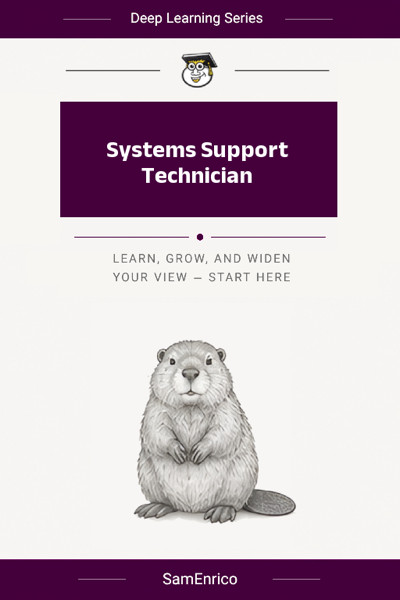
Systems Support Technician eBook
A Coursebook on Systems Support Technician
A Coursebook on Systems Support Technician
Formats
Free sample
Chapter 1: The First Ten Minutes...--–- The ticket appears on your screen at 8:47 AM on a Tuesday. "Email won't send," it reads. That's it. Three words. No context, no screenshot, no indication of whether "won't send" means "slow," "error message," "disappears into the void," or "computer is on fire." Your heart rate increases slightly.
You have been in this role for exactly four days.This chapter is not about email servers or SMTP protocols. Those come later. This chapter is about something far more important and far more frequently ignored in technical training: what you do in the first ten minutes of any support interaction will determine whether the next ten hours are productive or miserable. The systems and tools matter enormously, but they serve a larger purpose. Your job is not to fix computers.
Your job is to enable humans to do their work, and computers happen to be the medium. Get that order wrong, and you will be a competent technician who everyone hates to call. Get it right, and you will be the person who saves the day, every day, without breaking a sweat.Before we dive into hardware specifications and command-line incantations, we must establish the foundation upon which every technical skill in this book will rest. That foundation has three pillars: understanding what a Systems Support Technician actually does in the modern workplace, knowing where this career can take you, and mastering the operational and ethical frameworks that separate professionals from amateurs. The technical skills will come with practice and repetition.
The mindset must be built from the first page.The Myth of the Basement-Dwelling Tech Close your eyes and picture an IT support technician. If you are like most people, you imagined someone in a dark room, surrounded by blinking lights and empty energy drink cans, speaking a language of acronyms that no normal human can understand. This stereotype persists in movies, television shows, and unfortunately in the minds of many new technicians who believe that technical skill alone is sufficient. It is not. It never has been.The modern Systems Support Technician works in the open.
You will sit near the people you support. You will answer phone calls from vice presidents who cannot log in five minutes before a board meeting. You will receive chat messages from accounting during tax season when the printer has jammed for the third time at 4:45 PM. You will walk across the office, the factory floor, or the hospital wing to look at a screen and ask, "Show me what happened right before the error appeared." You will do this while maintaining patience, professionalism, and the appearance of calm competence even when you have no idea what is wrong.This is the reality that no certification exam fully captures. Comp TIA A+ will teach you how many pins are on a DIMM module.
It will not teach you how to tell a senior executive that their unsaved spreadsheet is almost certainly gone forever. The textbooks will explain the difference between NTFS and FAT32. They will not explain how to de-escalate a situation where a user is crying because their grant proposal disappeared. This book bridges that gap. The technical content is rigorous and complete, but it is wrapped in the human skills that determine whether you succeed or burn out within six months.Consider the case of Marcus, a newly certified technician who joined a mid-sized law firm.
On his third day, a partner's computer would not boot. Marcus diagnosed a failing hard drive within minutes. He was technically correct. He was also about to be fired. The problem was not the diagnosis.
The problem was that Marcus announced, "Your drive is dead. Hope you had backups," and walked away. The partner had not backed up in six weeks. The partner had a brief due the next morning. Marcus had the technical answer and zero understanding of the human situation.
A senior technician pulled Marcus aside and explained: "The drive is failing. You know that. They don't need to know that yet. First, you say, 'I see the issue. Let me see what we can recover before we do anything else.' Then you start data recovery.
Then, after they have their files, you explain the hardware failure and the backup policy. Order matters more than facts."Marcus survived that day because his senior intervened. Many new technicians are not so lucky. They are technically brilliant and interpersonally disastrous, and they wash out of the profession within a year, convinced that users are unreasonable and management is unfair. The users are often unreasonable.
Management is often unfair. But the technician's job is to navigate those realities, not to complain about them.From Help Desk to Architect: The Career Pathway One of the most common questions new technicians ask is, "Is this a real career, or am I stuck resetting passwords forever?" The answer is that Systems Support is one of the most reliable pathways into the technology industry, offering multiple trajectories from entry-level to six-figure compensation. Understanding these pathways early will inform every decision you make about which skills to prioritize and which certifications to pursue.The entry point for most technicians is the Help Desk or Service Desk. These roles are often described as the "front lines" of IT, and the description is accurate. You will handle a high volume of tickets, many of which are repetitive: password resets, printer issues, email configuration, and the eternal mystery of "my computer is slow." The work can feel tedious, especially when you explain for the hundredth time how to connect to the VPN.
However, the Help Desk is also where you learn the rhythm of support: how to triage competing priorities, how to document solutions for future reuse, and how to interact with every personality type in the organization. Most importantly, the Help Desk teaches you what breaks most often and what users actually need versus what they ask for. These insights are invaluable and cannot be learned from any book or video course.From Help Desk, the natural progression is to Desktop Support or Deskside Support. These roles involve more hands-on work with hardware, more direct interaction with users at their workstations, and greater responsibility for resolving issues without escalation. Desktop Support technicians are the ones who replace failed power supplies, reimage computers for new hires, and troubleshoot the weird problems that the Help Desk could not solve remotely.
The pay is better, the work is more varied, and the stress is lower because you have the autonomy to solve problems rather than following a rigid script.Beyond Desktop Support, the pathways diverge into specializations. Some technicians move into Network Administration, managing routers, switches, firewalls, and the complex systems that keep organizations connected. Others move into System Administration, managing servers, Active Directory, and the back-end infrastructure that supports user-facing systems. Security is a rapidly growing specialization, with Security Operations Center (SOC) roles that monitor for threats and respond to incidents. Cloud administration, focusing on Azure, AWS, or Google Cloud, is one of the fastest-growing specializations with correspondingly high salaries.
There are also pathways into management, leading teams of technicians and coordinating IT strategy, and into specialized domains like database…
This is the end of the free sample. Get the eBook to keep going. Buy now
About this book
Details
- Author
- Marlow Venetta
- Publisher
- SamEnrico
- Language
- English
- Genre
- Non-Fiction, Informative, Educational
- Released
- 2026-05-11
- Pages (approx.)
- 160
- Available as
- eBook, Audiobook

Read better in the ZLOADR app
Your eBooks on your phone or tablet. Sign in with your SamEnrico account and start reading.
More by Marlow Venetta
 Perceived Lack Of Accomplishment GuideMarlow Venetta$11.99
 Stroheim Von RealismMarlow Venetta$11.99
 Cleft Lip Self Esteem GuideMarlow Venetta$11.99
 Twins Sleep Management GuideMarlow Venetta$11.99
 The Difficult Conversation with TeenagersMarlow Venetta$11.99
 Quetzalcoatl’s Flute: The Feathered Serpent’s Divine MelodyMarlow Venetta$11.99
 Japan Metaverse Regulation GuideMarlow Venetta$12.99
 Business Model Canvas PromptsMarlow Venetta$12.99
 Understanding Mesodermal Defects Lower TypeMarlow Venetta$17.99
 How to Become a Kiln PlacerMarlow Venetta$11.99