
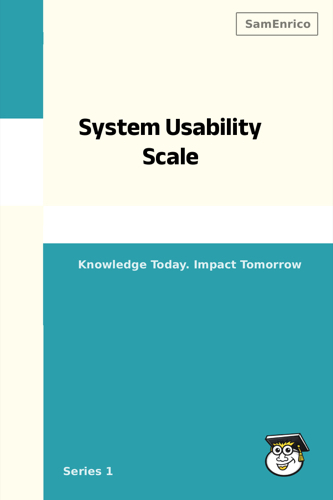
System Usability Scale eBook
Validated 10-question usability survey.
Validated 10-question usability survey.
Formats
Free sample
Chapter 1: The 68-Point Lie--–- In 2016, a mid-sized healthcare technology company celebrated a milestone that would later become a cautionary tale taught in UX courses. After eighteen months of development and $4.2 million in engineering investment, their new electronic health records system had achieved a System Usability Scale score of 71. The product manager sent a celebratory email to the entire organization with the subject line: “We did it – officially ‘Good’ by industry standards.” The CEO replied within minutes: “Fantastic work, team. Ship it.”Nine months later, the product was dead.Not because it failed technically. Not because the market was too crowded.
Not because the sales team dropped the ball. The product died because the nurses who used it every day—the very people the SUS had supposedly spoken for—quietly abandoned it. They didn’t submit angry feedback. They didn’t fill out exit surveys. They simply found workarounds.
They kept paper records in parallel. They shared secret spreadsheets. And eventually, they told their administrators that the “official” system was too much trouble, and they returned to the previous workflow entirely.The SUS score of 71 had been correct. The product was, by the numbers, “Good.” And yet, the product failed.This is the problem that no one in the usability industry wants to talk about. We have spent thirty-five years perfecting a ten-question survey that tells us, with admirable statistical precision, whether users find a product usable.
We have built careers on this number. We have convinced organizations to invest millions based on this number. And yet, products with perfectly “good” SUS scores fail every single day.The truth is more uncomfortable than any of us want to admit: the SUS was never designed to tell you whether to ship a product. It was designed to tell you when to stop and look deeper. We have been using a tripwire as a trophy, and the consequences are everywhere.This book is not another dry manual on how to calculate SUS scores.
You can find that information in a five-minute blog post. This book is about something much harder: understanding what the SUS actually measures, what it dangerously hides, and how to stop fooling yourself with numbers that feel good but mean nothing.The 68-Point Myth Let us start with the most destructive number in usability: 68.If you have spent any time in the UX field, you have heard some version of the following: “The average SUS score is 68, so anything above 68 is above average, and anything below 68 needs work.” This piece of received wisdom appears in conference talks, vendor slide decks, and internal reports at companies ranging from startups to Fortune 500s. It is repeated with the confidence of physical law.It is also wrong.The number 68 comes from a specific dataset at a specific time. In 2008, Jeff Sauro published a landmark analysis of 206 separate usability studies, aggregating thousands of SUS responses. The mean score across that aggregate was 68.
That is a factual historical observation. But somewhere along the way, “the average in these 206 studies was 68” transformed into “the acceptable threshold is 68” which then became “anything above 68 is good.”This chain of reasoning commits three fatal errors.First, it ignores variance. In the original dataset, the standard deviation was approximately 20 points. That means a score of 68 is not a meaningful threshold—it is simply the midpoint of a very wide distribution. A product scoring 65 is not “below average” in any practical sense; it is well within the noise of normal variation.Second, it ignores context.
The 206 studies included everything from medical devices to video games to tax preparation software. Averaging across these categories is like averaging the heights of basketball players and jockeys and concluding that the average person is five-foot-eight—technically true, but useless for evaluating any specific individual.Third, and most dangerously, it treats “above average” as synonymous with “good enough.” This is where the 68-point lie becomes actively harmful. A product can score 72—four points above that mythical threshold—and still be completely unusable for its specific users in their specific context.A Brief and Necessary History To understand why we have built our industry around such a fragile number, we must return to the unlikely origins of the SUS. The story begins not in an academic psychology department, but in the engineering labs of Digital Equipment Corporation in 1986.John Brooke was not trying to invent the most cited usability questionnaire in history. He was trying to solve a practical problem.
Digital Equipment Corporation built complex computer systems for technical users—engineers, scientists, programmers. These systems were expensive to develop and even more expensive to ignore. If users could not figure out how to use a system, the company lost millions.Brooke needed a way to quickly assess whether a system was usable enough to release. He did not have time for laboratory studies with thirty participants. He did not have budget for elaborate psychometric validation.
He needed something fast, cheap, and reasonably accurate. He needed, in his own memorable phrase, something “quick and dirty.”The original SUS emerged from a pool of fifty potential questions. Brooke tested and refined, cutting and keeping, until he arrived at exactly ten items. He alternated positive and negative phrasing deliberately, a design choice intended to combat what psychologists call “acquiescence bias”—the tendency for survey respondents to agree with statements regardless of content. If all questions were phrased positively (“This system is easy to use”), a lazy respondent could simply click “Strongly Agree” down the line.
By mixing positive and negative items, Brooke forced respondents to actually read each question.The scoring algorithm was equally pragmatic. Rather than using complex weighting or factor analysis, Brooke simply transformed responses on a 0-4 scale, summed them, and multiplied by 2.5 to create a 0-100 metric. The number 100 had no special significance except that humans like numbers that feel complete. A 0-100 scale was intuitive. Managers understood it.Brooke published his work in a short paper that he expected would be read by a handful of fellow practitioners and then forgotten.
He titled it with characteristic modesty. He moved on to other problems.Three decades later, that “quick and dirty” tool had become the gold standard of usability measurement. It had been cited in thousands of academic papers. It had been translated into dozens of languages. It had been embedded in the workflows of every major technology company.
And in the process, its limitations had been quietly forgotten.What the SUS Actually Measures Here is what the SUS does well: it captures a user’s subjective perception of usability after interacting with a system. The ten questions cover two underlying factors—usability (eight items) and learnability (two items)—that together predict overall satisfaction and, to a reasonable degree, behavioral outcomes like task completion and time-on-task.When you administer the SUS correctly and interpret it appropriately, it provides valuable signal. A score of 45 tells you something useful: users do not like this product. A score of 95 tells you something useful: users genuinely enjoy this product. The problems arise in the middle—the vast middle, where most products actually live.The SUS was never validated as a pass/fail test.
It was never intended to provide a threshold above which a product was “done.” It was designed to be a…
This is the end of the free sample. Get the eBook to keep going. Buy now
About this book
Details
- Author
- England Michaela
- Publisher
- SamEnrico
- Language
- English
- Genre
- Non-Fiction, Self-Help, SUS
- Released
- 2026-06-06
- Pages (approx.)
- 139
- Available as
- eBook, Audiobook

Read better in the ZLOADR app
Your eBooks on your phone or tablet. Sign in with your SamEnrico account and start reading.
More by England Michaela
 Sam Sheppard Legal LegacyEngland Michaela$11.99
 Probiotics For IBS GuideEngland Michaela$11.99
 Witness Trauma Survivor GuideEngland Michaela$11.99
 Space Economy InvestmentEngland Michaela$11.99
 Compound Lifts MasteryEngland Michaela$11.99
 Postpartum Formula Feeding GuideEngland Michaela$11.99
 Alcohol Recovery and EmploymentEngland Michaela$11.99
 Dreaming for Addiction RecoveryEngland Michaela$11.99
 The Last Theorem: Archimedes' Hidden CodeEngland Michaela$11.99
 The Silk and Steel of Charlemagne: Fashioning a RenaissanceEngland Michaela$11.99
 Gold, Glory, and the Ghost of MunichEngland Michaela$11.99
 How to Start a Pork Butcher (wholesale) Business (Beginners Guide)England Michaela$11.99