
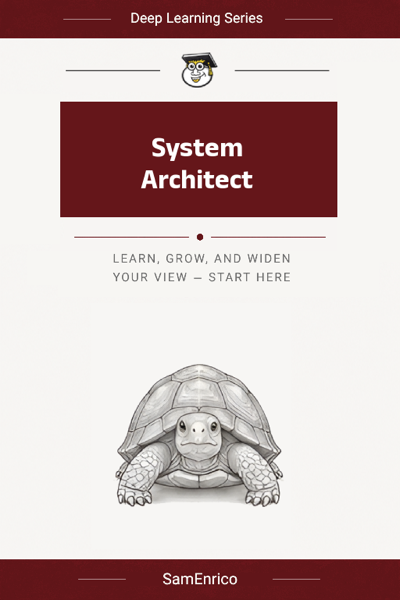
Non-FictionInformativeEducational
System Architect eBook
A Coursebook on System Architect
A Coursebook on System Architect
Formats
Free sample
Chapter 1: Galloping Gertie's Ghost--–- In the summer of 1940, the Tacoma Narrows Bridge was a marvel of economy and ambition. Stretching nearly a mile across Puget Sound in Washington State, it was the third-longest suspension bridge in the world at the time, built for fourteen million dollars—a fraction of the cost of its rivals. The engineers had calculated every load, tested every cable, and certified every beam. On July 1, the bridge opened to traffic and to celebration. The celebration lasted four months.–- From the beginning, drivers noticed something unsettling.
On windy days, the bridge deck would undulate—slowly, rhythmically, like a lazy ocean swell. The locals nicknamed it "Galloping Gertie." The engineers were not alarmed. They had designed for static loads: the weight of cars, the pull of wind, the tension of cables. They had not designed for something they could not quite name, something that only revealed itself when the wind blew at exactly forty-two miles per hour.–- On the morning of November 7, the wind came. A film crew captured what happened next: the deck began to twist instead of undulate.
The motion shifted from vertical to torsional—a violent, corkscrewing oscillation that no bridge had ever been designed to withstand. Concrete cracked. Steel cables snapped like thread. At 11:02 AM, the center span gave way, collapsing three hundred feet into the water below. Miraculously, no one died.
The only casualty was a three-legged dog trapped in a car on the bridge, abandoned by its owner who fled on foot.–- Fifty years later and 350 miles above the Earth's surface, another engineering marvel began its mission with the same hidden flaw. The Hubble Space Telescope launched aboard the Space Shuttle Discovery on April 24, 1990, the product of fifteen years of design, fabrication, and political navigation. Its mirror was the smoothest ever created—polished to within one-fiftieth the width of a human hair. When the first images came back, they were breathtaking in their blurriness. Stars that should have appeared as sharp pinpricks of light looked like smeared cotton balls.
A spherical aberration had rendered the telescope myopic.–- The investigation traced the error to a null corrector—a device used to test the mirror's curvature during grinding. The corrector's lens had been assembled 1.3 millimeters out of position. The mirror was polished to perfection. It was perfectly wrong.–- Two failures. One on Earth, one in space.
One moving cars, one moving light. One killed by wind, one killed by a lens. They share a hidden architecture that this entire book exists to reveal.The Definition That Changes Everything–- Let us start with a definition so compact that it fits on a sticky note and so profound that it separates everyone who designs systems from everyone who truly architects them.–- Architecture is the set of decisions that are too expensive to change later.–- Read that again. Pause. Let it settle.–- This definition flips the usual understanding.
Most engineers think architecture is about structure: boxes and lines, layers and components, protocols and interfaces. Those are outputs of architecture, not architecture itself. Architecture is not what the system looks like. Architecture is what the system can never stop being.–- Consider Galloping Gertie. The decision to use solid plate girders instead of open trusses was architectural.
Once the steel was fabricated and the concrete poured, reversing that decision meant demolishing the entire span and starting over. Which is exactly what happened—at triple the original budget and with a two-year delay.–- Consider Hubble. The decision to rely on a single null corrector without an independent verification method was architectural. Once the mirror was ground and polished, the only fix was a space shuttle mission to install corrective optics—a "contact lens" for the telescope that cost hundreds of millions of dollars and forced three years of embarrassed silence from NASA.–- These are not mistakes of calculation or oversight. They are mistakes of locking in.
The architects made decisions that seemed reasonable at the time, using the best available information. Those decisions created constraints that propagated through every subsequent choice. By the time the consequences became visible, reversal was ruinously expensive.–- By contrast, consider a decision about how to compress image data inside Hubble's onboard computer. If the algorithm was slow or inefficient, engineers could upload new software. That decision was not architectural.
It was design. It could be changed with moderate effort, confined to a single subsystem, without rebuilding the mirror or relaunching the telescope.The Hard Line Between Architecture and Design–- This distinction between architecture and design is the fault line that runs through every organization that builds complex systems. Organizations that understand it thrive. Organizations that blur it drown in technical debt.–- Design decisions are reversible. They can be changed locally without rippling through the system.
If you modify how a function validates input, you do not need to rewrite the database schema. If you change the color of a button, you do not need to reconfigure the load balancer. If you replace one compression algorithm with another, the rest of the system does not notice. Design decisions have bounded consequences. They live inside modules.
They are the domain of daily work.–- Architectural decisions are irreversible, or nearly so. They create constraints that propagate everywhere. If you choose a monolithic database over a distributed one, every query for the lifetime of the system must obey that choice. If you choose a synchronous request-response protocol over asynchronous messaging, every timeout, retry, and failure must be handled in that mode. If you choose to couple two modules through a shared data structure, every change to that structure affects both modules, and every engineer who touches either module must understand both.–- This is why the architect cannot be "just another engineer who draws boxes." The engineer working on a single module makes decisions that can be undone tomorrow.
The architect makes decisions that will still be echoing in pull requests, outage post-mortems, and onboarding sessions five years from now.–- Here is a practical test. Ask yourself: "If I change this decision next month, how many people will need to be notified, how many tests will need to be rewritten, and how many customers will experience downtime?" If the answer is "one person, zero tests, zero downtime," you are making a design decision. If the answer is "the entire engineering organization, half the test suite, and a scheduled maintenance window," you are making an architectural decision.The Three Pillars of Every Successful System–- Throughout this book, we will test every architectural decision against three pillars. A decision can be elegant, clever, and technically flawless. If it fails any of these pillars, it is a bad decision.–- Pillar One: Stakeholder Value.
Does the system serve the people who pay for it, operate it, depend on it, or suffer from it?–- Note that we did not say "users." Users are one category of stakeholder, and often not the most important one. Payers care about cost and return on investment. Operators care about uptime, maintainability, and monitoring. Regulators care about compliance, safety, and audit trails. Sufferers—people who never touch the system but…
This is the end of the free sample. Get the eBook to keep going. Buy now
About this book
Details
- Author
- Tipton Leanne
- Publisher
- SamEnrico
- Language
- English
- Genre
- Non-Fiction, Informative, Educational
- Released
- 2026-05-09
- Pages (approx.)
- 129
- Available as
- eBook, Audiobook

Read better in the ZLOADR app
Your eBooks on your phone or tablet. Sign in with your SamEnrico account and start reading.
More by Tipton Leanne
 Active Listening With Hearing LossTipton Leanne$11.99
 Imposter Syndrome During InterviewsTipton Leanne$11.99
 TM for Sales ProfessionalsTipton Leanne$11.99
 Affirmations for MorningsTipton Leanne$11.99
 The Wealth Envy GuideTipton Leanne$11.99
 The Green Sage of Timbuktu: Al-Hassan ibn Muhammad al-Wazzan al-Fasi’s Natural WondersTipton Leanne$11.99
 Business Plan in One HourTipton Leanne$12.99
 Pixlr Replaces Photoshop GuideTipton Leanne$12.99
 Understanding TorticollisTipton Leanne$17.99
 How to Start a Cinema Kiosk (retail) Business (Beginners Guide)Tipton Leanne$11.99
You may also like
 Hong Kong Handover 1997Dunn Johnnie$11.99
 Zumba For Postnatal Recovery CourseNeal Christian$11.99
 Zumba for BeginnersLadner Nikia$11.99
 YouTube Comment Mining GuideHumes Pandora$12.99
 Worry Box MeditationCarlin Rudy$11.99
 Workplace Stress MeditationNguyen Lynn$11.99
 Workplace Stress and Sleep RepairHawley Ivory$11.99
 Workplace Perfectionism CureDelaney Jeffry$11.99
 Workplace Injustice Anger GuideWallen Isabelle$11.99
 Work Addiction and Burnout LinkGreenwood Ester$11.99
 Women in Yoga and WellnessBeattie Galina$11.99
 Women in Stand Up ComedyChun Evangeline$11.99