
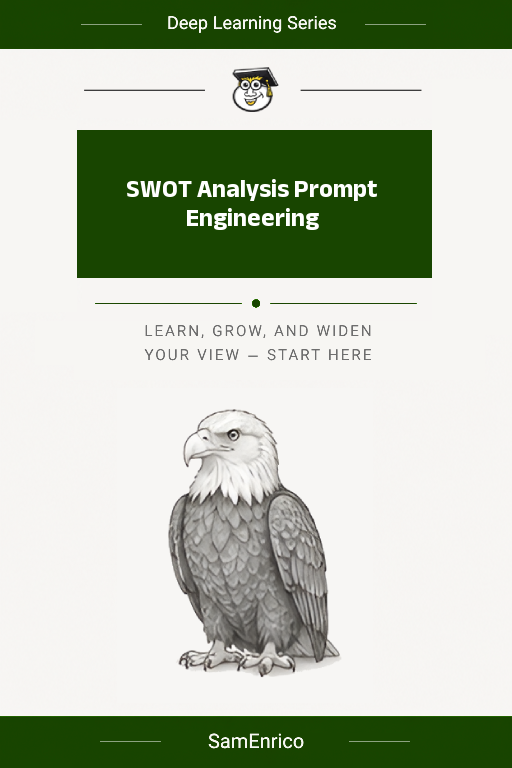
Non-FictionAI OperatorStrategic Analysis
SWOT Analysis Prompt Engineering eBook
Craft prompts that produce comprehensive SWOT anal
Craft prompts that produce comprehensive SWOT analyses from market research and internal capability data.
Formats
Free sample
Chapter 1: The Whiteboard Lie--Most strategy tools die not from misuse, but from ritual. They become something you do rather than something you use. The SWOT analysis—that four-box grid of Strengths, Weaknesses, Opportunities, and Threats—has suffered this fate more than any other framework in the history of business planning.Walk into almost any conference room where a strategic offsite is taking place, and you will find the same scene. A facilitator stands at a whiteboard. Someone has drawn four quadrants.
Post-it notes in four colors begin to accumulate. The loudest voice in the room gets their point on the board first. The most senior person gets their point on the board last, and it stays there regardless of merit. By noon, the SWOT is complete. By 1 p.m., the team has moved on to action planning.
By the following quarter, no one can remember what was written on any of those post-it notes.This is not a failure of the SWOT framework itself. The SWOT, properly understood, is a remarkably useful tool for organizing strategic thinking. The failure is in how it is executed: subjectively, statically, and without rigor. And for decades, strategists have accepted this failure as unavoidable. After all, strategy is human judgment.
How could it be otherwise?Enter large language models. For the first time, we have a tool that can process vast amounts of market research, internal performance data, and competitive intelligence—and then produce a SWOT that is auditable, repeatable, and grounded in evidence rather than office politics. But here is the crucial insight that this book will develop across twelve chapters: the AI does not replace the strategist. It forces the strategist to become more disciplined. You cannot ask a vague question and get a useful answer.
You cannot feed garbage data and receive strategic gold. And you cannot delegate your judgment to a machine.This chapter will show you why traditional SWOT is broken, how AI fundamentally changes the game, and what the Strategic Prompting Loop—the core framework of this book—looks in practice. By the end, you will understand why prompt engineering is not a technical skill for developers but a strategic skill for leaders. The whiteboard has been lying to you. It is time to see the truth.The Three Fatal Flaws of Traditional SWOTLet us begin with honesty.
How many times have you participated in a SWOT exercise that felt meaningful? How many times did the output actually change a strategic decision? If you are like most executives, the answer is somewhere between rarely and never. This is not because you are bad at strategy. It is because the traditional method of conducting a SWOT is structurally flawed in three ways.
These flaws are not occasional problems. They are guarantees.Flaw One: Subjectivity In any group SWOT exercise, the outcome is determined not by the weight of evidence but by the weight of voices. The most confident person in the room—not the most informed—shapes the list of strengths. The most politically powerful person ensures that certain weaknesses never appear on the board. The most recent hire, full of fresh perspective, gets ignored because they lack tenure.
This is not a bug in human collaboration. It is a feature of how status and hierarchy operate in organizations. But it is disastrous for strategic analysis.Consider a mid-sized manufacturing company we will call Apex Industrial. In their annual strategic offsite, the CEO led a SWOT exercise. The head of sales, a charismatic and forceful leader, argued that the company's greatest strength was its "unmatched customer relationships." He had anecdote after anecdote.
He told stories about golf outings and dinners and personal friendships with key accounts. The head of operations, a quieter and more analytical person, had data showing that customer retention had declined for three consecutive years. She had spreadsheets. She had churn calculations. She had exit interview transcripts.But the data never made it to the whiteboard.
The sales leader's confidence overrode the operations leader's evidence. His voice carried more weight because he spoke more forcefully, because he had more tenure, because he was louder. The company built its strategy around a strength that did not exist. Eighteen months later, they lost their largest customer to a competitor who had actually invested in relationship management. The sales leader had moved on to another job by then, promoted based on the perception of his strategic insight.
The operations leader had been laid off in a cost-cutting round. The whiteboard had lied, and everyone had believed it.Flaw Two: Recency Bias Humans are wired to overweight the most recent information. Psychologists call this the recency effect, and it is one of the most robust findings in cognitive science. When a team sits down to build a SWOT, they will inevitably focus on the last quarter's results, the most recent crisis, the competitor move that happened three weeks ago. Slow-moving trends—the gradual erosion of a distribution advantage, the steady but quiet rise of a new entrant, the compounding effect of underinvestment in R&D—are systematically underweighted.
They do not feel urgent. They do not have a champion in the room. And so they are ignored.The retail chain we mentioned earlier exemplifies this perfectly. Let us call them Classic Goods. Their SWOT, conducted in early 2019, listed "strong in-store foot traffic" as a top strength.
Foot traffic had been strong in Q4 of 2018. The holiday season had been excellent. Same-store sales were up. The recency of that success blinded the team to the five-year trend of declining mall visits, the steady improvement of direct-to-consumer competitors, and the changing behavior of younger shoppers who preferred mobile commerce. The data was available.
Multiple industry reports had documented the shift. But the data was not recent, and recent data told a different story.When COVID-19 accelerated the shift to online by three to five years, Classic Goods had no strategy to respond. Their last SWOT had told them they were strong. They believed it. Their competitors, who had been watching the five-year trend rather than the quarterly numbers, were already positioned for a digital-first world.
The recency bias had killed them, and they never saw it coming.Flaw Three: Static Thinking A SWOT is typically conducted as a discrete event: a two-hour workshop, a one-day offsite, a quarterly planning session. The output is a document. That document is filed away. And then the world changes. Competitors launch new products.
Regulations shift. A key hire leaves. A new technology emerges. The SWOT, frozen in time, becomes not just useless but actively misleading because it creates a false sense of certainty.A technology company we will call Nexus Software conducted a SWOT in January. The analysis was thorough by traditional standards.
They had good data. They had engaged facilitators. They produced a fifty-page document. The strategy for the year was built around that SWOT. By March, a competitor had released a product that nullified Nexus's primary strength—a proprietary algorithm that had taken three years to develop.
The competitor had built something better, faster, and cheaper. But because the SWOT was the basis for the annual plan, the leadership team continued to invest in…
This is the end of the free sample. Get the eBook to keep going. Buy now
About this book
Details
- Author
- Kunkel Xavier
- Publisher
- SamEnrico
- Language
- English
- Genre
- Non-Fiction, AI Operator, Strategic Analysis
- Released
- 2026-06-01
- Pages (approx.)
- 128
- Available as
- eBook, Audiobook

Read better in the ZLOADR app
Your eBooks on your phone or tablet. Sign in with your SamEnrico account and start reading.
More by Kunkel Xavier
 The Difficult Peer Feedback GuideKunkel Xavier$11.99
 Burnout In Nonprofit Sector CourseKunkel Xavier$11.99
 Port Wine Stain Birthmark GuideKunkel Xavier$11.99
 Cukor Women DirectorKunkel Xavier$11.99
 Grandparent Sleep ConsistencyKunkel Xavier$11.99
 The Phantom of Yankee Stadium: The Secret Blueprint That Built a DynastyKunkel Xavier$11.99
 How to Become a Distribution SupervisorKunkel Xavier$11.99
 Understanding Mesenteric IschemiaKunkel Xavier$17.99
 US Corporate Transparency ActKunkel Xavier$12.99
 System Automation DeveloperKunkel Xavier$11.99
You may also like
 Hong Kong Handover 1997Dunn Johnnie$11.99
 Zumba For Postnatal Recovery CourseNeal Christian$11.99
 Zumba for BeginnersLadner Nikia$11.99
 YouTube Comment Mining GuideHumes Pandora$12.99
 Worry Box MeditationCarlin Rudy$11.99
 Workplace Stress MeditationNguyen Lynn$11.99
 Workplace Stress and Sleep RepairHawley Ivory$11.99
 Workplace Perfectionism CureDelaney Jeffry$11.99
 Workplace Injustice Anger GuideWallen Isabelle$11.99
 Work Addiction and Burnout LinkGreenwood Ester$11.99
 Women in Yoga and WellnessBeattie Galina$11.99
 Women in Stand Up ComedyChun Evangeline$11.99