
Non-FictionInformativeEducational
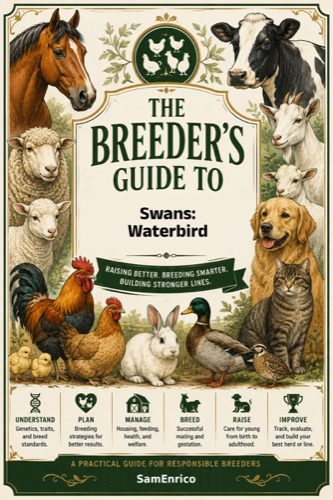
Swans: Waterbird eBook
This wildlife publication, published by SamEnrico,
by Osgood Dona
This wildlife publication, published by SamEnrico, covers Swans: Waterbird
Formats
Free sample
Chapter 1: The Lake Remembers...--The water is still this morning, the color of old lead. A thin skin of ice clings to the reeds along the shoreline, and the only sound is the low creak of frozen sedges rubbing against one another. Then, without warning, the silence shatters.A pair of Trumpeter Swans lifts off from the far end of the lake. Their wings beat against the air with a sound like sheets snapping on a clothesline in a gale—deep, rhythmic, almost mechanical. Water cascades from their bodies in silver sheets.
Their necks stretch forward, long as a child's arm, and their black bills point toward a sky the color of pearl. For thirty seconds, they run across the surface, webbed feet slapping the water in a frantic, splashing gallop. Then, at the exact moment when it seems impossible that anything so heavy could leave the earth, they rise. The lake releases them. And they are gone.This is the moment that has captivated humans for thousands of years.
Not the swan at rest—though that image has its own poetry—but the swan in transition. The swan moving between elements. The swan that belongs to water and air, to the surface and the sky, to the visible world and the one just beyond it. All swans are waterbirds, yes. But they are also something more.
They are the boundary crossers.If you have ever watched a swan take flight, you know what I mean. There is effort there, even struggle. A swan does not spring from the water like a duck, which seems to bounce off the surface as if the water were a trampoline. A swan labors. It gathers itself.
It commits to a run that can last fifty meters or more, and in that run there is something deeply vulnerable. The swan cannot turn back once it begins. It cannot abort. It has made its choice, and now physics will either reward that choice or punish it. When the swan finally lifts, you feel a strange relief, as if you yourself have just escaped something.
And when it glides, when its wings lock into that broad, slightly curved shape and it simply hangs there, motionless against the wind, you feel something else entirely. You feel the weight of the world lift from your own shoulders.This book is about that feeling. It is also about the creature that produces it—a creature that is far stranger, far tougher, and far more interesting than the cartoon of romance and grace that floats through our collective imagination. Swans are not just beautiful. They are biological marvels.
They are survivors. They are creatures of extreme adaptation and unexpected ferocity. And they are, at this moment, more vulnerable than most people realize.The Taxonomy of Wonder Before we can understand the swan as a living animal—as a creature of muscle and feather, hunger and migration, courtship and conflict—we must first understand what a swan actually is. This is not as simple as it sounds. To the casual observer, a swan is a large white bird with a long neck that lives on ponds and parks.
But this description, while not wrong, is woefully incomplete. It is like describing a wolf as a large dog that lives in the woods. It misses everything that matters.Swans belong to the family Anatidae, which includes ducks, geese, and swans. Within this family, they are placed in the genus Cygnus, a Latin word that means "swan" and that also gives us the name of the constellation Cygnus, the Swan, which arcs across the summer sky in the shape of a cross. (The Greeks saw a swan in those stars.
The Romans did too. We are not the first to be moved by this bird.) The genus Cygnus contains six living species, distributed across every continent except Antarctica and—contrary to a common misconception—Africa, where swans are naturally absent, though small introduced populations of Mute Swans exist in South Africa around Cape Town and the Western Cape.Six species. That is a surprisingly small number for a bird so widely recognized. There are seventeen species of penguins, fifty species of gulls, and over one hundred and fifty species of ducks. But only six swans.
This scarcity is part of their mystique. Swans are not everywhere. They are selective. They require specific conditions: large bodies of open water, abundant aquatic vegetation, and a certain remoteness during their most vulnerable periods. To encounter a swan in the wild is still an event, even in places where they are relatively common.The six species break down into two natural groupings: the Northern Hemisphere swans, which are mostly white, and the Southern Hemisphere swans, which include the entirely black Black Swan of Australia and the strikingly patterned Black-Necked Swan of South America.
The Northern swans are the ones most familiar to European and North American audiences: the Mute Swan, the Whooper Swan, the Trumpeter Swan, and the Tundra Swan (which includes two subspecies, the Whistling Swan of North America and Bewick's Swan of Eurasia). Each of these species will receive a full profile in Chapter 2, but here we will sketch their essential differences.The Mute Swan (Cygnus olor) is the one you have most likely seen. It is the swan of ornamental ponds, of castle moats, of municipal parks with paddleboats and ice cream stands. It is not native to North America—it was brought over from Europe in the late 19th century as a decorative addition to the estates of the wealthy—but it has since established feral populations across the Great Lakes, the Northeast, and the Pacific Northwest. The Mute Swan is easily identified by its orange bill with a prominent black knob at the base, and by its neck, which it holds in an elegant S-curve.
It is also, despite its name, not mute at all. It hisses, grunts, snorts, and makes a strange, wheezing sound when threatened. The name comes from the fact that it is less vocal than the Whooper Swan, whose call carries for miles across the northern marshes. But "less vocal" is not silent. Anyone who has been chased by an angry Mute Swan can attest that they make plenty of noise.The Whooper Swan (C.
cygnus) is the wilder cousin. It breeds in Iceland, Scandinavia, and northern Russia, and winters in the British Isles, northern Europe, and East Asia. Its bill is yellow and black, with the yellow extending past the nostril in a wedge shape that is the surest field mark for identification. Its call is a loud, two-syllable whoop—whoop-er, whoop-er—that gave the bird its English name and that has been described as sounding like a French horn played by someone who has just seen a ghost. The Whooper Swan is the one that flies over the Himalayas at twenty-seven thousand feet, a feat of high-altitude endurance that was not confirmed until GPS transmitters were attached to a flock in the early 2000s.
It is also the national bird of Finland, where it appears on the one-euro coin.The Trumpeter Swan (C. buccinator) is the largest of them all. It is also the heaviest, with males…
This is the end of the free sample. Get the eBook to keep going. Buy now
About this book
Details
- Author
- Osgood Dona
- Publisher
- SamEnrico
- Language
- English
- Genre
- Non-Fiction, Informative, Educational
- Released
- 2026-05-11
- Pages (approx.)
- 148
- Available as
- eBook, Audiobook

Read better in the ZLOADR app
Your eBooks on your phone or tablet. Sign in with your SamEnrico account and start reading.
More by Osgood Dona
 Presentation Deck CanvaOsgood Dona$11.99
 Nap During Work MeetingsOsgood Dona$11.99
 Football Receiver HypnosisOsgood Dona$11.99
 Cabin in the Woods ImageryOsgood Dona$11.99
 Acupuncture for Morning SicknessOsgood Dona$11.99
 Self Hypnosis for Kidney Stone PainOsgood Dona$11.99
 Hemophobia Blood FearOsgood Dona$11.99
 Virtual Whiteboard CollaborationOsgood Dona$11.99
 The Lion's Gambit: The Strategic Brilliance of Queen Nzinga MbandeOsgood Dona$11.99
 The Green Horde: Genghis Khan’s Eco-Warfare in the SteppesOsgood Dona$11.99
 How to Produce DesksOsgood Dona$11.99
 A Collector's Handbook to the Wolseley 16Osgood Dona$11.99
You may also like
 Hong Kong Handover 1997Dunn Johnnie$11.99
 Zumba For Postnatal Recovery CourseNeal Christian$11.99
 Zumba for BeginnersLadner Nikia$11.99
 YouTube Comment Mining GuideHumes Pandora$12.99
 Worry Box MeditationCarlin Rudy$11.99
 Workplace Stress MeditationNguyen Lynn$11.99
 Workplace Stress and Sleep RepairHawley Ivory$11.99
 Workplace Perfectionism CureDelaney Jeffry$11.99
 Workplace Injustice Anger GuideWallen Isabelle$11.99
 Work Addiction and Burnout LinkGreenwood Ester$11.99
 Women in Yoga and WellnessBeattie Galina$11.99
 Women in Stand Up ComedyChun Evangeline$11.99