
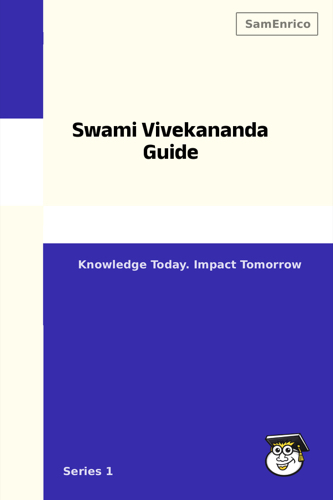
Swami Vivekananda Guide eBook
Follows the Indian monk who introduced Vedanta to
Follows the Indian monk who introduced Vedanta to the West at the 1893 Parliament of Religions.
Formats
Free sample
Chapter 1: The Man Who Dared to Doubt--–- He was eighteen years old, brilliant, angry, and convinced that every religious person he had ever met was either a fraud or a fool. The year was 1881. The place was Calcutta, the jewel of the British Empire and the graveyard of a million Indian hopes. And the young man pacing the floor of his modest family home was Narendra Nath Datta—soon to be known to history as Swami Vivekananda—though at this moment, he had no interest in holiness, no patience for gurus, and no tolerance for what he called "the opium of the pious."He had just returned from another frustrating encounter with another holy man who had promised miracles and delivered only theatrical chanting. His father, an attorney with a fierce intellect and an even fiercer appetite for Western philosophy, had raised Narendra to question everything.
David Hume, John Stuart Mill, Herbert Spencer—these were the gods of the Datta household. God, as described by the local temple priests, was a fairy tale for the weak-minded."Show me God," Narendra had demanded of every teacher who crossed his path. "Not stories. Not rituals. Show me God as clearly as I see this table.
Then I will believe."No one had answered him. Not one.This chapter is not a hagiography. It is not a pious retelling of a saint's life, scrubbed clean of doubt, failure, and human messiness. It is the story of a man who began as a skeptic, became a seeker, suffered devastating losses, and only then—through failure, grief, and relentless questioning—became the monk who would shake the world. If you are looking for a version of Vivekananda who was born enlightened, floating on a cloud of divine certainty, close this book now.
That man never existed.The man who did exist was forged in fire. He lost his father, his faith, his health, and his way. He wept, raged, and considered abandoning everything. And because he did, his teachings are not abstractions. They are survival strategies forged in real pain.
This chapter lays the foundation for everything that follows: the Four Yogas, the Parliament triumph, the social revolution. Before you can understand what he taught, you must understand who he was—and how he became that person one broken piece at a time.The Boy Who Asked "Why?"Narendra was born on January 12, 1863, into a Bengali family that embodied contradiction. His father, Vishwanath Datta, was a successful attorney who quoted Voltaire at dinner and kept a library stocked with Western rationalists. His mother, Bhuvaneshwari Devi, was a deeply religious woman who prayed for hours before the family shrine and told her children stories from the Ramayana. Young Narendra grew up in a house where Shakespeare and the Sanskrit scriptures sat on the same shelf, and where the question "Why?" was answered with evidence, not authority.From his earliest years, he displayed what his teachers called "a restless and penetrating intelligence." He memorized entire passages of poetry after a single reading.
He mastered mathematics and philosophy faster than students twice his age. But he was no docile prodigy. He argued with professors, corrected their errors, and was once thrown out of a classroom for pointing out that the textbook had misquoted a Sanskrit verse. His fellow students loved him for his courage. His teachers feared him for his insolence.At Scottish Church College, where he studied Western logic and philosophy, Narendra encountered the works of John Stuart Mill, Immanuel Kant, and Herbert Spencer.
He devoured Spencer's First Principles and declared that Spencer had explained the material universe better than any Indian philosopher he had read. He began to identify as a rationalist, an agnostic, and—in his more provocative moments—an atheist."I cannot accept anything on faith alone," he told a friend. "If there is a God, He must be as demonstrable as gravity. If He is not, then He is not worth worshipping."This was not teenage rebellion. It was intellectual honesty.
Narendra had seen too much religious hypocrisy to trust any claim that could not be tested. He had watched priests bless the wealthy while ignoring the poor. He had heard pundits recite scriptures they could not explain. He had witnessed his own mother's devotion—beautiful, sincere, and utterly useless in the face of the family's poverty after his father's death. If God existed, Narendra demanded evidence.
And no one provided it.The Meeting That Changed Everything In 1881, a family friend mentioned a strange temple priest named Sri Ramakrishna, who lived in the Dakshineswar Kali Temple just outside Calcutta. The friend described Ramakrishna as a man who claimed to have seen God—not metaphorically, but literally, directly, as one sees a mango on a tree.Narendra laughed. "Another deluded mystic," he said. "I've met a hundred like him."But the friend persisted. "This one is different," he said.
"He doesn't ask for money. He doesn't perform tricks. He just... sees God. And he says that everyone can."Narendra agreed to go, not because he believed, but because he wanted the pleasure of dismantling another fraud.
He prepared his arguments carefully. He would demand proof. He would expose logical fallacies. He would walk away victorious, his skepticism intact.When he entered Ramakrishna's small room at Dakshineswar, he found not a pompous guru but a simple, unassuming man sitting on a wooden cot, smiling like a child who had just discovered something wonderful. There were no elaborate robes, no incense, no disciples prostrating themselves.
Just a man who seemed utterly at peace.Narendra began his assault. "Have you seen God?" he asked, his voice sharp with challenge.Ramakrishna looked at him—really looked, not at his face but through it, as if reading something written on his soul. Then he smiled and said, "Yes. I see Him more clearly than I see you. I talk to Him more directly than I am talking to you.
And you, my boy, can see Him too. But first, you must stop fighting."Narendra was unprepared for this. He had expected defensiveness, claims of secret knowledge, demands for money or obedience. He had not expected a man who answered a hostile question with childlike simplicity and an invitation."Show me," Narendra demanded.Ramakrishna reached out and touched Narendra's chest, over his heart. Later, Narendra would describe what happened next as the most terrifying and liberating moment of his life.
It felt as though the walls of his identity—his education, his pride, his carefully constructed rationalism—melted like ice in boiling water. He lost all sense of his body, his name, his history. He became consciousness without boundaries, awareness without an object, existence without form.This was nirvikalpa samadhi—the state of oneness with the absolute that the ancient texts described but which Narendra had dismissed as fantasy. It lasted only minutes, but when he returned to ordinary awareness, he was not the same person who had entered that room.It is crucial to note—because many hagiographic accounts simplify this moment into a magical transformation—that this was not a single event that instantly perfected him. Narendra would later confess that the experience was so overwhelming, so alien to his rational mind, that he…
This is the end of the free sample. Get the eBook to keep going. Buy now
About this book
Details
- Author
- Bobbitt Jackelyn
- Publisher
- SamEnrico
- Language
- English
- Genre
- Non-Fiction, Biography, Vedanta
- Released
- 2026-06-06
- Pages (approx.)
- 129
- Available as
- eBook, Audiobook

Read better in the ZLOADR app
Your eBooks on your phone or tablet. Sign in with your SamEnrico account and start reading.
More by Bobbitt Jackelyn
 DBT For Impulse ControlBobbitt Jackelyn$11.99
 The Doctor Who Made House CallsBobbitt Jackelyn$11.99
 Alcohol Craving Emergency KitBobbitt Jackelyn$11.99
 Rental Property LLC FormationBobbitt Jackelyn$11.99
 Breath Awareness Before MealsBobbitt Jackelyn$11.99
 Pomodoro For Music PracticeBobbitt Jackelyn$11.99
 Overcoming Conditional Love LegacyBobbitt Jackelyn$11.99
 Shadows of the Scarab: The Pharaoh's Silent WarBobbitt Jackelyn$11.99
 Neon Ghosts of Tokyo: The Vanishing Street Performers of ShibuyaBobbitt Jackelyn$11.99
 How to Produce Studio Light and Flash AccessoriesBobbitt Jackelyn$11.99How to Produce Studio Light and Flash AccessoriesBobbitt Jackelyn$11.99
 How to Become a Stonemason ApprenticeBobbitt Jackelyn$11.99
You may also like
 Hong Kong Handover 1997Dunn Johnnie$11.99
 Zumba For Postnatal Recovery CourseNeal Christian$11.99
 Zumba for BeginnersLadner Nikia$11.99
 YouTube Comment Mining GuideHumes Pandora$12.99
 Worry Box MeditationCarlin Rudy$11.99
 Workplace Stress MeditationNguyen Lynn$11.99
 Workplace Stress and Sleep RepairHawley Ivory$11.99
 Workplace Perfectionism CureDelaney Jeffry$11.99
 Workplace Injustice Anger GuideWallen Isabelle$11.99
 Work Addiction and Burnout LinkGreenwood Ester$11.99
 Women in Yoga and WellnessBeattie Galina$11.99
 Women in Stand Up ComedyChun Evangeline$11.99