
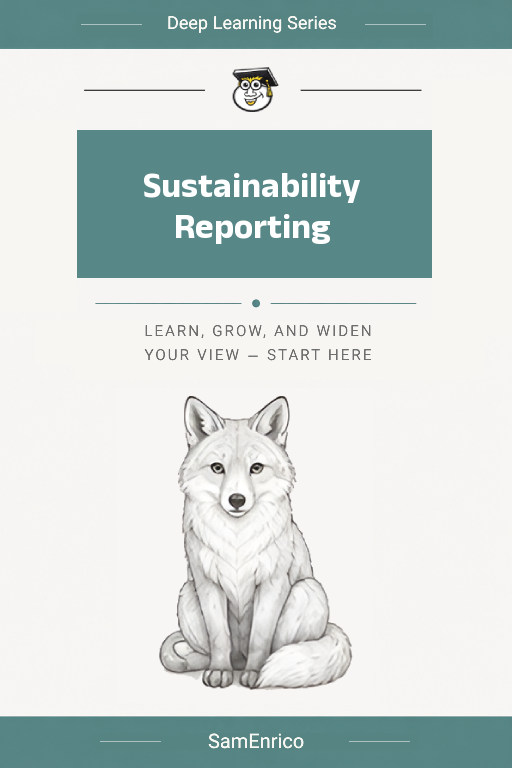
Non-FictionNon-Obvious CareerSustainability ReportingGRI
Sustainability Reporting eBook
Learn GRI Standards to write corporate sustainabil
by Byers Fay
Learn GRI Standards to write corporate sustainability reports for companies.
Formats
Free sample
Chapter 1: The 87% Lie--–- The email arrived at 6:47 AM on a Tuesday. Sarah Chen, the newly appointed Sustainability Director at a mid‑sized manufacturing firm called Meridian Industries, had been in her role for just four months. She had done everything the consultants told her to do. She had followed the GRI checklist line by line. She had produced a 147‑page report with a glossy cover, heartfelt letters from the CEO, and more charts than a financial analyst could count.
She had even won a minor industry award for "transparency excellence."The email was from the company's general counsel. Subject line: "Urgent – Regulatory Inquiry from EU Authorities."Sarah's stomach dropped. She clicked open the attached PDF. A European regulator had launched a preliminary investigation into Meridian's sustainability claims. The allegation?
Greenwashing. The evidence? The company's own sustainability report.Specifically, the regulator had noted three problems. First, the report claimed to follow the GRI Standards but had failed to conduct a proper double materiality assessment. Second, the report buried negative water pollution data on page 134, using vague language about "occasional compliance challenges" instead of disclosing the actual violation notices from local environmental agencies.
Third, the report included a cheerful photograph of a community outreach event on the same page where a footnote mentioned that the company had been fined for illegal wastewater discharge – a footnote so small that it was nearly invisible in the printed version.Sarah had not written the report. Her predecessor had. But her name was on it as the current director. And the regulator did not care who had written what. They wanted to know: was this intentional deception, gross negligence, or simple incompetence?Sarah's story is not unique.
It is not even rare. In the two years since the European Union's Corporate Sustainability Reporting Directive (CSRD) began taking effect, regulatory authorities have opened more than 200 formal investigations into sustainability reporting across member states. In the United States, the Securities and Exchange Commission has launched over three dozen greenwashing investigations against asset managers, publicly traded corporations, and ESG rating agencies. In the United Kingdom, the Advertising Standards Authority has banned dozens of sustainability claims for being vague, misleading, or unsubstantiated.And in every single case, the root cause is the same. Not fraud.
Not malice. Not even particularly bad intentions. The root cause is the mistaken belief that sustainability reporting is a compliance exercise – a box to check, a template to fill, a burden to endure – rather than a strategic discipline that requires judgment, honesty, and courage.This chapter is about why that belief is not merely wrong, but dangerously wrong. It is about the hidden costs of "checklist reporting." It is about the difference between a report that protects your company and a report that becomes evidence in a lawsuit. And it is about the one number that should terrify every sustainability professional who reads this book: 87%.The Number That Should Keep You Awake at Night Let us begin with that number.According to a 2023 survey conducted by Reporting 3.0 in partnership with the Global Reporting Initiative (GRI), approximately 87% of sustainability professionals report that their organizations' sustainability reports are not used for internal strategic decision-making.Read that sentence again.
Slowly.Eighty-seven percent. That means that for nearly nine out of ten companies, the sustainability report exists as an external artifact – a document published to satisfy regulators, impress NGOs, or quiet activist investors – but not as a tool that helps leaders run the business. The report is produced, printed, and published. And then it sits on a shelf, physical or digital, collecting dust.Think about what that number implies. A typical sustainability report for a mid‑sized company costs between 100,000and100,000 and 100,000and500,000 to produce, not including internal staff time.
For large multinationals, the cost can easily exceed $2 million. That is a significant investment – an investment that, according to 87% of the people who work on these reports every day, produces almost no internal value.Why is this happening? The answer is not a lack of data. Most reports are packed with data. The answer is not a lack of effort.
Most reporting teams work tirelessly, often through weekends and late nights. The answer is not even a lack of technical skill. Many sustainability professionals have advanced degrees, professional certifications, and years of experience.The answer is something more fundamental: the reports are designed for compliance, not for insight. They are designed to check boxes, not to answer questions. They are designed to avoid criticism, not to enable decisions.
They are designed to be defensible, not to be useful.Consider the anatomy of a typical "compliance-first" report. It begins with a CEO letter full of aspirational language: "we are committed to," "we believe that," "we strive to." The letter contains no numbers, no deadlines, no specific commitments that could be measured or audited. It is warm, vague, and essentially meaningless from a decision-making perspective.Next comes the general disclosures section. Governance structures. Ethics policies.
Stakeholder engagement methods. This section is nearly identical to the previous year's report, which was nearly identical to the year before that. The only changes are updated dates and the names of committee members who have rotated on and off.Then comes the performance data. Dozens of metrics, many of which are selected not because they matter to the business but because they are easy to measure or because competitors report them. Energy consumption.
Water withdrawal. Waste diversion rates. Employee turnover. Training hours. The numbers go up and down, but rarely does the report explain why they changed or what management is doing about the changes.Then comes the narrative section.
This is where the company tells its sustainability story. The problem is that the story is almost always a story of progress, improvement, and success. Negative information, if it appears at all, is buried in dense prose, hidden in appendices, or softened with euphemisms like "challenges" and "opportunities for improvement."Finally, there is the GRI Content Index. A multi-page table that lists every disclosure requirement from the GRI Standards and provides a cross-reference to the page number or URL where the reader can find the answer. In theory, this is useful.
In practice, many indexes are so vague ("see page 45," "refer to sustainability section of annual report") that they function more as a compliance checkbox than as a navigation tool.This kind of report serves no one. It does not help the CFO understand climate risk to the balance sheet. It does not help the COO identify inefficiencies in the supply chain. It does not help the board oversee non‑financial performance. It does not even help investors, who have learned to distrust reports that look too polished and say too little.What it does do, as Sarah Chen discovered, is create legal exposure.
A compliance‑first report invites scrutiny. It claims adherence to standards. It makes assertions about performance. And when those assertions are vague, incomplete, or misleading – even unintentionally – they become evidence in regulatory investigations, shareholder lawsuits, and consumer protection actions.The Fragmented Landscape: Three Frameworks, One Foundation To understand why compliance‑first reporting is failing so spectacularly, we must first understand the regulatory and standard-setting landscape. Over the past five years, this…
This is the end of the free sample. Get the eBook to keep going. Buy now
About this book
Details
- Author
- Byers Fay
- Publisher
- SamEnrico
- Language
- English
- Genre
- Non-Fiction, Non-Obvious Career, Sustainability Reporting, GRI
- Released
- 2026-05-29
- Pages (approx.)
- 156
- Available as
- eBook, Audiobook

Read better in the ZLOADR app
Your eBooks on your phone or tablet. Sign in with your SamEnrico account and start reading.
More by Byers Fay
 Manganese Nodule CollectorByers Fay$11.99
 Therapist Vicarious Trauma GuideByers Fay$11.99
 Merger Agreement AI AbstractionByers Fay$11.99
 Anapanasati For ChemotherapyByers Fay$11.99
 Floating on Clouds GuideByers Fay$11.99
 Client Details PalaceByers Fay$11.99
 Healthcare Burnout DBTByers Fay$11.99
 Was Scepter GuideByers Fay$11.99
 Rewiring Childhood NeglectByers Fay$11.99
 The Wyvern’s Last Roar: A Breton Dragon’s RevengeByers Fay$11.99
 The Phoenix Protocol: How a Broken Body Became a Global IconByers Fay$11.99
 The Lobbyist Who Broke the InternetByers Fay$11.99
You may also like
 Hong Kong Handover 1997Dunn Johnnie$11.99
 Zumba For Postnatal Recovery CourseNeal Christian$11.99
 Zumba for BeginnersLadner Nikia$11.99
 YouTube Comment Mining GuideHumes Pandora$12.99
 Worry Box MeditationCarlin Rudy$11.99
 Workplace Stress MeditationNguyen Lynn$11.99
 Workplace Stress and Sleep RepairHawley Ivory$11.99
 Workplace Perfectionism CureDelaney Jeffry$11.99
 Workplace Injustice Anger GuideWallen Isabelle$11.99
 Work Addiction and Burnout LinkGreenwood Ester$11.99
 Women in Yoga and WellnessBeattie Galina$11.99
 Women in Stand Up ComedyChun Evangeline$11.99