
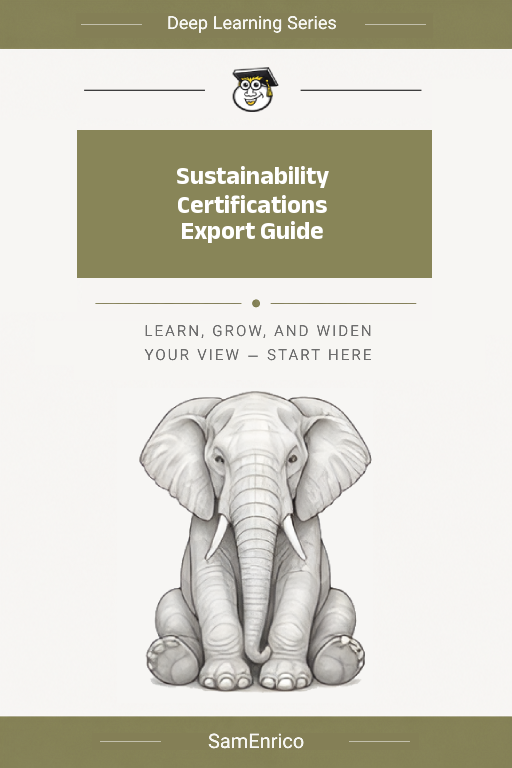
Non-FictionBusiness BriefEco-Compliance
Sustainability Certifications Export Guide eBook
Choose between Fairtrade, Rainforest Alliance, Org
Choose between Fairtrade, Rainforest Alliance, Organic, and B Corp for accessing European and US markets.
Formats
Free sample
Chapter 1: The New Bastille--–- On a rainy Tuesday in October 2023, a forty-foot shipping container carrying 20,000 bags of green coffee beans arrived at the port of Antwerp. The coffee was certified organic, Rainforest Alliance, and Fairtrade. The paperwork was in order. The buyer was a major European roaster with a decades-long relationship with the exporting cooperative. And yet, the container never left the port.The Belgian customs authority, acting on a new directive from the European Commission, had begun randomly selecting agricultural shipments for enhanced due diligence checks.
This container was selected. The customs officer requested three specific documents: the Certificate of Inspection (COI) from the EU's TRACES NT system, the GPS polygon coordinates of every farm that contributed to the shipment, and a mass balance reconciliation showing that the certified volume matched the shipped volume. The exporter provided the COI within two hours. The GPS coordinates took four days to assemble because the cooperative's smallholder farmers had never been asked to mark their boundaries. The mass balance reconciliation took another week because the exporter had been using a simplified accounting method that did not track certified and conventional product separately.By the time all documents were submitted, the container had accrued €6,800 in storage fees.
The buyer, facing its own production deadlines, had sourced replacement coffee from a certified competitor. The cooperative lost the contract. The container was eventually sold at a discount to a spot buyer. The cooperative's financial loss exceeded $200,000. Its reputation loss was incalculable.This is not a story about a rogue customs officer or an unusually demanding buyer.
This is the story of a new era in international trade—an era in which sustainability certifications have ceased to be optional marketing tools and have become mandatory legal requirements for market access. The exporter who treats certification as a stamp on a package is already obsolete. The exporter who treats certification as a system—a living, breathing, auditable system of documentation, traceability, and continuous improvement—will survive and thrive.The Death of Voluntary Virtue For two decades, sustainability certifications occupied a strange middle ground in global trade. They were not legally required, but they were commercially valuable. A USDA Organic seal could command a premium price.
A Fairtrade label could open doors to specialty retailers. A Rainforest Alliance certification could differentiate a coffee brand from its conventional competitors. Exporters pursued these certifications as strategic investments, weighing the cost of certification against the expected return in price and market access.That era is over. The middle ground has collapsed.The European Union's European Green Deal, adopted in 2020 and now rapidly rolling out across all twenty-seven member states, has transformed sustainability from a voluntary aspiration into a mandatory condition of trade. The centerpiece of this transformation is the Corporate Sustainability Due Diligence Directive (CSDDD), adopted in final form in 2024.
The CSDDD holds large importers—defined as companies with more than 1,000 employees and €450 million in annual revenue—legally liable for environmental violations and human rights abuses occurring anywhere in their supply chains, including in third countries. If a German importer buys coffee from a Peruvian cooperative that clears forest land illegally, the German importer can be sued in German courts, fined up to 5 percent of its global revenue, and banned from future EU imports.The importer, facing existential legal risk, will do what any rational actor would do: push the liability down the supply chain. The importer's contracts now require every supplier to provide documented, auditable, third-party-verified proof of environmental and social compliance. The supplier who cannot provide this proof—or who can provide it only slowly, incompletely, or after repeated requests—will be replaced. The cost of switching suppliers is lower than the cost of a CSDDD lawsuit.On the United States side, the shift has been equally dramatic, though different in mechanism.
The Uyghur Forced Labor Prevention Act (UFLPA), enacted in 2021, creates a statutory presumption that goods produced in certain regions are made with forced labor unless the importer can prove otherwise. The burden of proof has shifted. It is no longer on the government to find a violation. It is on the importer to prove compliance. And the importer, again, pushes that burden down to the exporter.The UFLPA's enforcement has been aggressive.
In 2024, US Customs and Border Protection detained over 3,200 shipments valued at more than 780millionunderthe UFLPA.Mostdetentionswereresolved—somethroughdocumentation,somethroughre−export,somethroughdestruction—buteverydetentioncosttheexportertime,money,andbuyerconfidence.Theaveragedetentionlastedforty−sevendays.Theaveragestorageandadministrativecostexceeded780 million under the UFLPA. Most detentions were resolved—some through documentation, some through re-export, some through destruction—but every detention cost the exporter time, money, and buyer confidence. The average detention lasted forty-seven days. The average storage and administrative cost exceeded 780millionunderthe UFLPA.Mostdetentionswereresolved—somethroughdocumentation,somethroughre−export,somethroughdestruction—buteverydetentioncosttheexportertime,money,andbuyerconfidence.Theaveragedetentionlastedforty−sevendays.Theaveragestorageandadministrativecostexceeded15,000 per container. And the buyers, watching their supply chains freeze, began demanding pre-shipment documentation review as a condition of contracting.The Three Walls of Fire To understand why sustainability certifications have become essential rather than optional, the exporter must understand what I call the Three Walls of Fire—the three overlapping pressures that now surround every international shipment.The first wall is regulatory.
The EU's CSDDD and EU Deforestation Regulation (EUDR), the US's UFLPA and FORCED LABOR Act, and a growing web of national laws in France (Devoir de Vigilance), Germany (Lieferkettengesetz), and the United Kingdom (Modern Slavery Act) all impose legal penalties for supply chain violations. These penalties are not theoretical. In 2023, a Dutch court ordered a global commodity trader to pay €1.2 million in fines and remediation costs for failing to prevent deforestation in its cocoa supply chain. In 2024, a French court held a fashion retailer liable for human rights abuses in its Uzbek cotton supply chain, ordering €450,000 in damages to victims. The regulatory wall is not coming down.
It is getting taller, wider, and more aggressively enforced.The second wall is retailer. Large retailers—the gatekeepers to the consumer market—have their own sustainability requirements that often exceed regulatory minimums. Walmart's Project Gigaton requires suppliers to report emissions reductions. Aldi's Sustainability Policy requires deforestation-free supply chains by the end of 2025. Whole Foods Market has long required USDA Organic certification for any product sold under its private label.
These retailer requirements are enforced through supplier contracts, and the penalty for non-compliance is not a fine—it is delisting. Lose your retailer contract, lose your market. In 2024, a major UK supermarket chain delisted fourteen suppliers who could not provide deforestation-free documentation for their palm oil imports. The suppliers were given ninety days' notice. None of them recovered their export volume.The third wall is reputation.
In the age of social media and activist journalism, a single exposé of forced labor, deforestation, or environmental contamination can destroy a brand overnight. The 2020 investigation into palm oil supply chains in Indonesia, which linked major consumer brands to rainforest destruction, led to immediate boycotts, shareholder lawsuits, and a permanent decline in brand trust that cost the industry an estimated $4 billion. The 2022 investigation into cocoa child labor in West Africa, which implicated several major chocolate companies, triggered congressional hearings, investor divestment campaigns, and a sustained drop in consumer confidence. The reputation wall is the hardest to quantify and the most expensive to repair. A company can…
This is the end of the free sample. Get the eBook to keep going. Buy now
About this book
Details
- Author
- Milliken Marylou
- Publisher
- SamEnrico
- Language
- English
- Genre
- Non-Fiction, Business Brief, Eco-Compliance
- Released
- 2026-05-30
- Pages (approx.)
- 156
- Available as
- eBook, Audiobook

Read better in the ZLOADR app
Your eBooks on your phone or tablet. Sign in with your SamEnrico account and start reading.
More by Milliken Marylou
 Cognitive Behavioral Therapy For GamblingMilliken Marylou$11.99
 Separating Personal Business FinancesMilliken Marylou$11.99
 Alcoholism Recovery in LGBTQ+ CommunitiesMilliken Marylou$11.99
 HIIT for Joint Pain GuideMilliken Marylou$11.99HIIT for Joint Pain GuideMilliken Marylou$11.99
 Franchising Your Local Brand Across Borders Climate RiskMilliken Marylou$11.99
 Mental Illness PartnershipMilliken Marylou$11.99
 Senior Housing NOI GuideMilliken Marylou$11.99
 Fatty Liver and SugarMilliken Marylou$11.99
 The Global Game: How Baseball Conquered the 19th Century WorldMilliken Marylou$11.99
 The Clockwork Dreams of Jacques de Vaucanson: Automata and the Dawn of Modern InventionMilliken Marylou$11.99
 How to Produce StaircasesMilliken Marylou$11.99
You may also like
 Hong Kong Handover 1997Dunn Johnnie$11.99
 Zumba For Postnatal Recovery CourseNeal Christian$11.99
 Zumba for BeginnersLadner Nikia$11.99
 YouTube Comment Mining GuideHumes Pandora$12.99
 Worry Box MeditationCarlin Rudy$11.99
 Workplace Stress MeditationNguyen Lynn$11.99
 Workplace Stress and Sleep RepairHawley Ivory$11.99
 Workplace Perfectionism CureDelaney Jeffry$11.99
 Workplace Injustice Anger GuideWallen Isabelle$11.99
 Work Addiction and Burnout LinkGreenwood Ester$11.99
 Women in Yoga and WellnessBeattie Galina$11.99
 Women in Stand Up ComedyChun Evangeline$11.99