
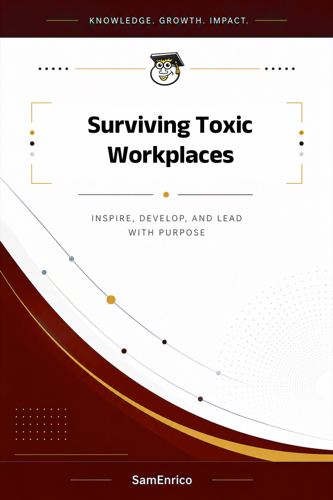
Non-FictionSelf-HelpWorkplace Bullying
Surviving Toxic Workplaces eBook
Protect self-esteem when working under abusive man
Protect self-esteem when working under abusive managers or bullying colleagues.
Formats
Free sample
Chapter 1: The Asshole Tax...--If you are reading this book, there is a very good chance that you have woken up at three in the morning with your heart racing, your jaw clenched, and a single sentence looping through your mind like a broken record: I cannot do this anymore. You have probably cried in a bathroom stall with the toilet lid down so your knees wouldn't show under the door. You have likely rehearsed conversations in the shower that you will never actually have, because the person on the other side of those conversations does not listen, does not care, and would probably enjoy watching you squirm. You have almost certainly asked yourself some version of the same terrible question: Is it me? Am I the problem?
Am I just too sensitive, too weak, too emotional, too difficult?Let me stop you right there.The answer is no. Not maybe. Not sometimes. No.What you are experiencing is not a character flaw. It is not a lack of resilience.
It is not something a green smoothie, a meditation app, or a "positive mindset" can fix. You are not broken. You are being taxed. Every single day, someone in your workplace is reaching into your nervous system and withdrawing a payment you never agreed to make. That withdrawal has a name.
It is called the Asshole Tax, and once you understand how it works, you will never blame yourself for exhaustion again.The Economics of Abuse Let us start with the math, because numbers do not gaslight you. Numbers do not tell you that you are overreacting.In his landmark book The No Asshole Rule, Stanford professor Robert Sutton did something that had never been done before in the management literature. He put a price tag on toxicity. After analyzing data from dozens of organizations across multiple industries, Sutton calculated that a single abusive employee—one manager who yells, one colleague who sabotages, one executive who humiliates—costs an organization an average of $160,000 per year. That money disappears into the black hole of increased turnover (good people leave), legal fees (harassment claims add up), lost productivity (frightened employees make mistakes), and healthcare costs (stressed bodies get sick).But here is what Sutton understood that most experts miss: that $160,000 is just the corporate tax.
The real tax is levied on you.Your personal Asshole Tax includes every hour of sleep you have lost replaying a cruel comment. Every sick day you took because you could not face walking into that building. Every therapy copay. Every drink you had too many of on a Sunday night, trying to numb the dread of Monday morning. Every pound you gained from stress eating, every pound you lost from stress starving, every headache, every back spasm, every panic attack, every single time you looked in the mirror and did not recognize the exhausted, flattened person staring back.Add it up.
Go ahead. I will wait.If you are like most people who end up in a toxic workplace, your personal Asshole Tax is probably somewhere between $10,000 and $50,000 per year in measurable costs alone. That does not even count the incalculable losses: your confidence, your sense of humor, your belief that people are generally good, your ability to trust a colleague's smile, your willingness to speak up in a meeting without first checking to see if the Credit Kraken is watching.You are not broke because you are weak. You are broke because someone has been picking your pocket every single day, and you have been taught to call that pickpocketing "teamwork."The Neurobiology of the Tax Here is where the story gets physiological, and I need you to pay close attention, because this is the part that will finally silence the voice in your head that says you should just try harder.Your brain is wired for survival, not for happiness. Deep in the oldest part of your skull, tucked behind your forehead like a paranoid security guard, sits your amygdala.
The amygdala has one job: detect threats. In our ancestral environment, threats were sabertooth tigers and rival tribesmen with clubs. Your amygdala could not afford false negatives—missing a real threat was death—so it evolved to err wildly on the side of false positives. Better to mistake a stick for a snake than a snake for a stick.Here is what modern neuroscience has discovered that changes everything. Your amygdala does not distinguish between a physical threat and a social threat.
Being yelled at by your boss activates the exact same neural circuits as being charged by a predator. Being excluded from a meeting triggers the same brain regions as physical pain. Being gaslit—having someone tell you that your memory of events is wrong, that you are crazy, that you are imagining things—lights up the same alarm systems as being lost in the wilderness with no map and no water.When you work under an abusive manager or alongside a bullying colleague, your amygdala is not being "too sensitive." It is doing exactly what evolution designed it to do. It is sounding the alarm because, to your ancient lizard brain, social rejection was a death sentence. Exile from the tribe meant no protection, no food sharing, no mating opportunities.
You would literally die alone in the wilderness.So every time your boss dismisses your idea in front of the team, your amygdala releases cortisol. Every time your colleague takes credit for your work, your amygdala floods your system with adrenaline. Every time you see the Credit Kraken's name pop up in your inbox, your amygdala prepares your body for fight or flight. Your heart rate increases. Your breathing shallows.
Your digestion slows down (that is the knot in your stomach). Your prefrontal cortex—the smart part of your brain that handles complex reasoning, long-term planning, and emotional regulation—gets partially shut down to conserve energy for the emergency.This is why you forget things when you are stressed. This is why you cannot think clearly in meetings with the Howler. This is why you walk out of a performance review with a bully and cannot remember a single word they said, only the feeling of your face burning. Your brain has literally decoupled your thinking centers from your survival centers.And here is the cruelest part of the entire biological betrayal.
Chronic cortisol exposure damages your hippocampus, the part of your brain responsible for memory and learning. Over months and years of workplace abuse, you are not just suffering in the moment. You are literally becoming less capable of remembering, learning, and regulating your emotions. The very skills you need to escape the toxic environment are the skills that the toxic environment is destroying.That is not weakness. That is physiology.
That is a tax.Why "Resilience" Is a Trap Before we go any further, I need to say something that might make you uncomfortable. Something that might even make you angry. Good. You should be angry.The entire resilience industry—the self-help books, the corporate wellness programs, the mindfulness apps, the "stress management" workshops that your HR department rolls out every time someone files a complaint—is built on a lie. The lie is…
This is the end of the free sample. Get the eBook to keep going. Buy now
About this book
Details
- Author
- Schmid Vaughn
- Publisher
- SamEnrico
- Language
- English
- Genre
- Non-Fiction, Self-Help, Workplace Bullying
- Released
- 2026-06-06
- Pages (approx.)
- 140
- Available as
- eBook, Audiobook

Read better in the ZLOADR app
Your eBooks on your phone or tablet. Sign in with your SamEnrico account and start reading.
More by Schmid Vaughn
 Detecting Lies Through Body LanguageSchmid Vaughn$11.99
 Ethnic Diversity In Wellness MarketSchmid Vaughn$11.99
 Teen Self Esteem in LGBTQ YouthSchmid Vaughn$11.99
 The Thai Eastern Corridor Talent ImportSchmid Vaughn$11.99
 Whispers of the Iron Phoenix: The Untold Mentorship of Sun TzuSchmid Vaughn$11.99
 Understanding Microcephaly MSchmid Vaughn$17.99
 SEO Meta Data AI GuideSchmid Vaughn$12.99
 How to Start a Building Completion Work Business (Beginners Guide)Schmid Vaughn$11.99
 Green Hydrogen Investment GuideSchmid Vaughn$12.99
 Youth WorkerSchmid Vaughn$11.99
You may also like
 Hong Kong Handover 1997Dunn Johnnie$11.99
 Zumba For Postnatal Recovery CourseNeal Christian$11.99
 Zumba for BeginnersLadner Nikia$11.99
 YouTube Comment Mining GuideHumes Pandora$12.99
 Worry Box MeditationCarlin Rudy$11.99
 Workplace Stress MeditationNguyen Lynn$11.99
 Workplace Stress and Sleep RepairHawley Ivory$11.99
 Workplace Perfectionism CureDelaney Jeffry$11.99
 Workplace Injustice Anger GuideWallen Isabelle$11.99
 Work Addiction and Burnout LinkGreenwood Ester$11.99
 Women in Yoga and WellnessBeattie Galina$11.99
 Women in Stand Up ComedyChun Evangeline$11.99