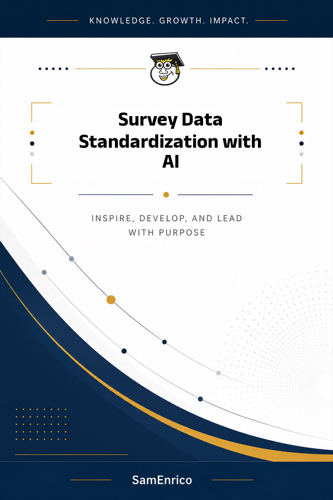
Survey Data Standardization with AI eBook
Standardize survey response formats using AI with
by Galvez Inga
Standardize survey response formats using AI with this market research integration skills guide.
Formats
Free sample
Chapter 1: The Friday Night Test--It was 6:47 PM on a Friday when Maria’s career almost ended.Not with a dramatic resignation or a shouting match with a client. It ended the way most research careers quietly flatline: a spreadsheet with 47 columns, 12,843 rows, and a deadline that had already passed. The client had merged data from three different surveys—one using a 5-point satisfaction scale, one using a 0-10 NPS, and one with open-ended responses in Spanish, English, and something that looked like autocorrect gone haywire. The instruction from her boss was simple: “Clean it and have the crosstabs on my desk by Monday.”Maria had spent the previous weekend manually recoding “very satisfied,” “V.S.,” “5,” “😊,” and “extremely happy” into a single category. She had done this by hand, row by row, her eyes glazing over somewhere around row 4,000.
When she finished, she had a clean dataset. But something felt wrong. The open-ended responses that had once contained rich, contradictory, deeply human opinions— “I love the product but hate the shipping” —had been flattened into a single sentiment score of “Positive.” The nuance was gone. The insight was gone. And Maria was already looking at job postings.If you are a market researcher, you have been Maria.
You have stared at a messy CSV file on a Friday night, felt your soul leave your body, and wondered if there wasn’t a better way.There is.This book is that better way. But before we get to the AI prompts, the data pipelines, and the 90-day implementation plan, we need to understand exactly what we’re up against. We need to quantify the cost of chaos. We need to name the enemy. And we need to confront the uncomfortable question that most data cleaning books ignore entirely: when we standardize data, what do we lose?Let’s start with the numbers.
They are worse than you think.The Price of Messy Data Every year, the market research industry spends an estimated $3.2 billion on data cleaning and preparation. That is not analysis. That is not insight generation. That is not strategy. That is pure, unadulterated janitorial work performed by highly paid researchers who were trained to find insights, not mop floors.The breakdown is even more depressing.
According to the CMA AI Playbook 2025, researchers spend an average of:32% of their time on data cleaning and preparation28% on reconciling inconsistent response formats across studies15% on coding and categorizing open-ended responses10% on de-duplicating records across multiple data sources The remaining 15% on actual analysis and insight generation Let that sink in. Researchers spend roughly 85% of their time on tasks that could be automated, standardized, or eliminated entirely. They spend only 15% of their time doing the work that actually matters—the work that gets them promoted, the work that changes business decisions, the work that reminds them why they entered this profession in the first place.But the cost is not just time. It is money. A mid-sized market research agency with 50 analysts might spend $1.2 million annually on salaries for data cleaning work that could be automated.
A large consumer goods company with an internal insights team of 200 might spend $5 million or more.And those are just the direct costs. The indirect costs—the opportunities missed, the insights never found, the decisions made on incomplete or inconsistent data—are almost impossible to quantify but certainly larger.There is a reason that The Research Society has issued repeated warnings about “garbage in, garbage out” in AI-assisted workflows. If you feed an AI model dirty data, it will not magically clean it. It will confidently produce clean-looking garbage. And then someone like Maria will be blamed when the client’s product launch fails because the “data said it would work.”The Nuance vs.
Noise Paradox Here is where things get interesting. And uncomfortable.Traditional data cleaning operates on a simple premise: messiness is bad, cleanliness is good. So we recode “sorta agree” to “agree.” We treat “very dissatisfied” and “extremely unhappy” as identical. We drop responses that don’t fit our precoded categories. We standardize by deleting everything that doesn’t match the template.This approach has a name.
I call it the Nuance vs. Noise Paradox: the very act of cleaning data to remove “noise” systematically destroys the nuance that makes qualitative data valuable in the first place.Consider a simple example. A customer writes in an open-ended survey: “I love the product but the customer service made me want to scream.”A traditional sentiment analysis model might tag this as “Mixed” or “Neutral” or, worse, split it into two separate responses (one positive, one negative) and lose the connection. A human reading this response understands something profound: the product itself is great, but the service experience is so bad it negates the product quality. That is actionable insight.
That tells you to fix service, not the product.A traditional cleaning approach might recode this as “Neutral” and move on. The insight is lost. The nuance is destroyed. And the product team spends six months redesigning a product that was fine while the service team hears nothing.This is the paradox. The more aggressively you clean your data, the more insight you potentially destroy.
The cleaner your spreadsheet looks, the dumber your analysis might be.Does that mean we should stop cleaning data? Of course not. Raw survey data is genuinely messy in ways that make analysis impossible. Inconsistent scale formats, duplicate responses, bot activity, missing values, contradictory entries—these are real problems that require real solutions.But the solution is not to clean harder. The solution is to stop cleaning altogether and start harmonizing.AI as Harmonizer, Not Cleaner This distinction is the single most important idea in this book, so I want to dwell on it.A cleaner removes things.
It deletes outliers. It discards responses that don’t fit. It treats messiness as contamination to be eliminated. A cleaner’s goal is a pristine dataset that conforms to a template.A harmonizer transforms things. It preserves structure while translating format.
It keeps outliers but contextualizes them. It treats messiness as information to be understood, not eliminated. A harmonizer’s goal is a dataset that is analyzable without being impoverished.Let me give you a concrete example.A cleaning approach to open-ended responses might use keyword matching to assign sentiment: if the response contains “happy,” “love,” “great,” tag as Positive. If it contains “hate,” “terrible,” “awful,” tag as Negative. Everything else is Neutral or discarded.A harmonizing approach, using the AI methods we will learn in Chapter 3, does something different.
It reads each response in context. It detects nuance: sarcasm (“Great job, really fantastic” when the product failed), conditional sentiment (“I would recommend it if they fix the packaging”), and compound emotions (“I’m frustrated because I want to love this product but I can’t”). It tags not with binary positive/negative but with granular emotion categories: Frustration, Anticipation, Confusion, Delight, Indifference, Disappointment.The cleaning approach is faster. The harmonizing approach is wiser.The cleaning approach produces a dataset that is easy to chart. The harmonizing approach produces a dataset that is easy to trust.Throughout this book, I will teach you how to become a harmonizer.…
This is the end of the free sample. Get the eBook to keep going. Buy now
About this book
Details
- Author
- Galvez Inga
- Publisher
- SamEnrico
- Language
- English
- Genre
- Non-Fiction, AI Operator, Data Standardization
- Released
- 2026-06-09
- Pages (approx.)
- 135
- Available as
- eBook, Audiobook

Read better in the ZLOADR app
Your eBooks on your phone or tablet. Sign in with your SamEnrico account and start reading.
More by Galvez Inga
 Mindful Walking Stress ReliefGalvez Inga$11.99
 Healthcare Patient Anger GuideGalvez Inga$11.99
 OCD And Digital HoardingGalvez Inga$11.99
 The Birth of the Emoji: How a Tiny Pile of Dots Changed the WorldGalvez Inga$11.99
 The Silk Road's Last Messenger: How a 19th-Century Diplomat Saved a Dying Trade RouteGalvez Inga$11.99
 10 Ways to Use Chamaemelum Nobile (Recipe Book)Galvez Inga$11.99
 Understanding Cantalamessa–baldini–ambrosi SyndromeGalvez Inga$17.99
 Swiss Master Degree Cost GuideGalvez Inga$12.99
 Masters Degree Without PublicationsGalvez Inga$12.99
 Growth Account ExecutiveGalvez Inga$11.99